



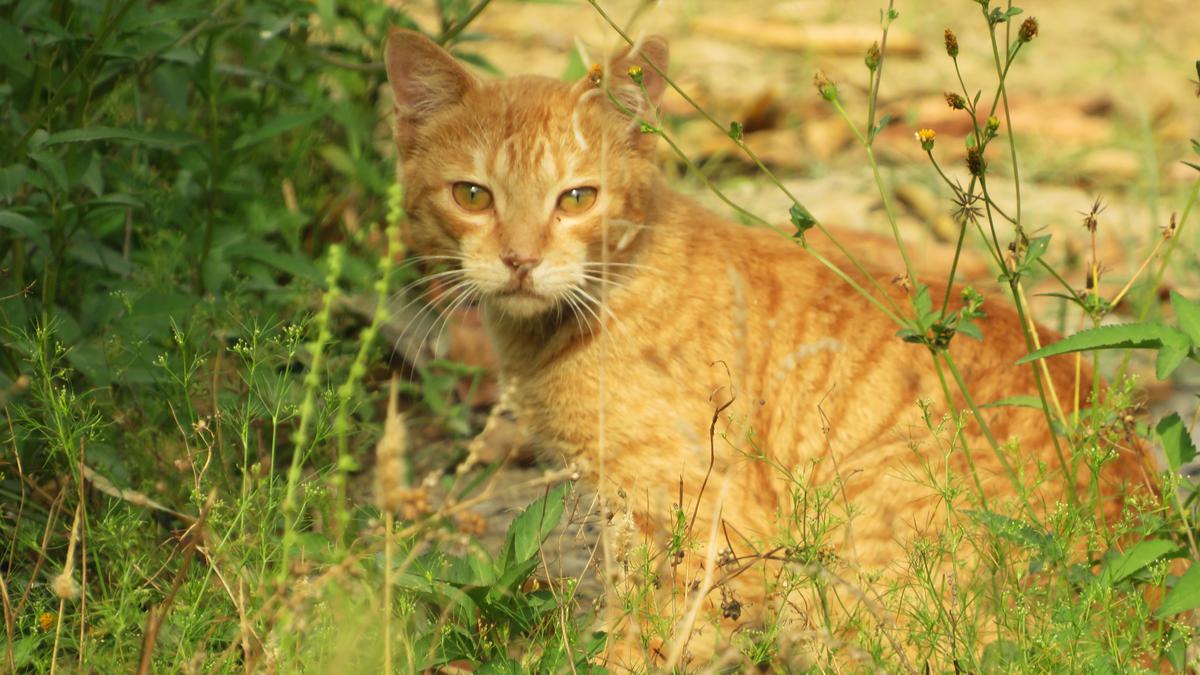
On the basis of 30 million observations by more than 30,000 birdwatchers, the ‘State of Indian Birds 2023’ exercise recently concluded that birds in India are faring poorly. Among many factors, the report acknowledged a silent bird-killer lurking in India’s urban areas: cats.
Cats may seem to pale in the shadow of the threats posed by forest degradation, industrialisation, and climate change, but conservationists know better. In the U.S. alone, free-ranging domestic cats have been estimated to kill billions of birds every year.
One study found that cats may be the “single greatest source of anthropogenic mortality” for birds and mammals in the U.S. Worldwide, free-ranging domestic cats have caused or contributed to dozens of extinctions of bird species recorded in the IUCN Red List.
‘Landscape of fear’
Disturbed by the lack of India-specific data on the issue, ecologist Monica Kaushik has been studying the hunting habits of free-ranging domestic cats on urban birds in Dehradun, a city that has 590 of the 1,359 species of birds recorded in the country. She found in a survey that pet cats hunted birds the most, followed by reptiles, insects, rodents, and amphibians.
While free-ranging dogs also harm wildlife, Dr. Kaushik said cats have retained the instinct to hunt through many years of domestication, even if they don’t need the skill anymore. Cats also can do something dogs can’t: “They can climb, so they can reach habitats such as the nests of canopy-dwellers.”
Cat saliva is also more likely to contain bacteria (Pasteurella multocida) that are lethal to birds. So if the direct impact of an attack doesn’t kill them, the bacteria will. Former urban wildlife rescuer Abhisheka Krishnagopal suspected that this could be why most cat-attacked birds reported to her didn’t survive the trip to a treatment centre.
Cats also maintain a ‘landscape of fear’. “This means that when cats are known to be in a particular area, the bird would avoid foraging or nesting there,” Dr. Kaushik explained. “They end up investing time and energy to be extra vigilant and to find alternative areas. This affects them individually and on a population level.”
Trap, neuter, return
Domestic cats (Felis catus) weren’t always this widespread. Palaeogenetic studies have found that wildcats (Felis sylvestris) were probably first domesticated in West Asia some 10,000 years ago. They spread via sailing ships much later. Today, they are one of the world’s 100 worst invasive alien species.
The proper way to deal with the cat problem has spiralled into a vicious debate in the west. Animal welfare groups usually advocate the ‘trap-neuter-return’ (TNR) policy, whereby stray cats or dogs are trapped, sterilised, and returned in the hope that this will reduce their populations. This is considered a humane approach because it could improve the quality of a cat’s life as well.
The trouble is that cats are not easy to trap. And unless most of them are sterilised at once, the population will not decrease in a sustained way. This is why TNR programmes around the world have had limited success. “Neutering is definitely needed, but this alone doesn’t help,” Ms. Krishnagopal said, “because free-ranging cats hunt every day, and birds take several weeks to raise a family, so it really takes a toll.”
Data on cat-killed birds
Former director of the Smithsonian Migratory Bird Centre, Peter Marra, has critiqued policies such as TNR as being “dictated by animal welfare issues rather than ecological impacts”. His study, published in Nature Communications in 2013, provided an exhaustive quantitative estimate of mortality due to cats in the U.S. He said that only a “concerted, nationwide effort to rid the landscape of cats” can help. This could include euthanasia.
That this debate is yet to kick off in India is partly because there is nearly no data. With the State of Indian Birds 2023’s unambiguous conclusion that India’s bird diversity is in peril, ecologists like Dr. Kaushik have called for more attempts to quantify the risks posed by various threats, including cats. “We need studies from various habitats where we would expect high mortality because of free ranging cats,” she said.
One source of data could be wildlife rehabilitation centres, per Ms. Krishnagopal. “We need more collaboration between researchers and animal rescuers,” she said. “Ornithologists can approach rehab centres and encourage them to start collecting data on the number of cat-attacked birds they receive. They can publish this data together and then we can start creating awareness based on evidence.”
Empathy for stray cats
Meanwhile, there are measures pet parents can adopt to reduce the damage their animals are wreaking. For one, they can restrict their cats’ outdoor movements. Dr. Kaushik’s survey found that cats whose owners play with them tend to hunt less, as do neutered cats. Studies have also found that cats with more protein in their food are less inclined to hunt. She also recommended “reflective collars or collars with bells” to alert birds that a cat is nearby.
Seema Mundoli, who teaches sustainability at Azim Premji University, Bengaluru, has been a foster parent to more than 40 cats. She contended that humans have a lot to gain by being empathetic towards stray cats, “because, what better way to connect with the natural world than through these species which are all around us?”
She admits cats are a threat to wildlife but doesn’t think killing them is the answer. “Thankfully, we don’t take all our decisions based purely on research and data, but also go with what we inherently feel is the right thing to do.”
So what is the right thing to do? Ms. Mundoli suggested that “conservation and animal rights groups can come together, pull in resources, to find a solution. What both want at the end of the day are populations that are under control and healthy.”
Nandita Jayaraj is a Mangaluru-based science writer and co-author of Lab Hopping (2023).