



Skip to content
  • Facebook
  • X
  • Linkedin
  • WhatsApp
  • YouTube
  • Associate Journalism
  • About Us
  • Privacy Policy
  • 033-46046046
  • editor@artifex.news
Artifex.News

Artifex.News

Stay Connected. Stay Informed.

  • Breaking News
  • World
  • Nation
  • Sports
  • Business
  • Science
  • Entertainment
  • Lifestyle
  • Toggle search form
  • Indian-Origin Bar Owner Gets 13 Years In Jail For Raping Minor In Singapore
    Indian-Origin Bar Owner Gets 13 Years In Jail For Raping Minor In Singapore World
  • Gaza Aid Arrives At Egypt Border Crossing But No Plan For Delivery Yet
    Gaza Aid Arrives At Egypt Border Crossing But No Plan For Delivery Yet World
  • Al Hilal Keep Cristiano Ronaldo Trophy-Less In Rich Saudi Pro League
    Al Hilal Keep Cristiano Ronaldo Trophy-Less In Rich Saudi Pro League Sports
  • Kedaara backed Ajax Engineering files for OFS with SEBI
    Kedaara backed Ajax Engineering files for OFS with SEBI Business
  • Markets rebound in early trade; Sensex jumps 1,046 points; Nifty surges above 24,300-level
    Markets rebound in early trade; Sensex jumps 1,046 points; Nifty surges above 24,300-level Business
  • “Don’t Know How To Score 180 Runs”: Skipper Najmul Hossain Shanto Throws Bangladesh Under The Bus
    “Don’t Know How To Score 180 Runs”: Skipper Najmul Hossain Shanto Throws Bangladesh Under The Bus Sports
  • Operation Ajay | Second batch of Indian nationals flies out of Israel amid conflict
    Operation Ajay | Second batch of Indian nationals flies out of Israel amid conflict World
  • Daily Quiz | On Mt. Everest expeditions
    Daily Quiz | On Mt. Everest expeditions World
Finally, physicists have a way to ‘see’ inside short-lived nuclei

Finally, physicists have a way to ‘see’ inside short-lived nuclei

Posted on September 5, 2023 By admin


Around 150 years ago, three scientists named Ernest Rutherford, Hans Geiger, and Ernest Marsden exposed a thin gold foil to radiation. Based on how the rays were deflected by atoms in the foil, they figured out that every atom has a dense centre where its mass and positive charge are concentrated.

Seventy years ago, Robert Hofstadter led a team that bombarded electrons at thin foils. The higher energy of the electrons allowed them to ‘probe’ the nucleus. Based on these interactions, the team understood how charges and magnetic fields were arranged inside a nucleus.

In each case, physicists were able to ‘see’ inside stable atoms, and then inside their nuclei, by using other particles.

Now, researchers in the RIKEN Nishina Center for Accelerator-Based Science, in Japan, have taken a big leap forward in this tradition – by demonstrating a set-up that can use electron scattering to ‘see’ inside unstable nuclei, including those that don’t occur naturally.

The previous experiments used thin foils that were easy to hold. The new one is more sophisticated, using an apparatus to hold the nuclei of caesium-137 atoms as well as make sure electrons could interact with them, using a system called SCRIT. The wait for this advancement is why a similar study couldn’t be conducted before.

The results were published in the journal Physical Review Letters on August 30.

The SCRIT advantage

First, the researchers accelerated electrons in a particle accelerator to energise them, and then smashed them into a block of uranium carbide. This produced a stream of caesium-137 ions (atoms stripped of electrons). This isotope of caesium has a half-life of around 30 years.

“All systems are connected with vacuum pipes and the process is performed in a short time,” Kyo Tsukada, an associate professor at the Institute for Chemical Research, Kyoto University, and the first author of the study’s paper, told The Hindu. “This technique has been developed for short-lived nuclei. If one is only interested in long-lived nuclei, there might be other methods – for example, using the chemical separation of radioactive isotopes.”

The ions were then transported to the SCRIT system, which is short for ‘Self-Confining Radioactive-isotope Ion Target’.

“This method enables us to trap the target ions in three dimensions along the electron beam using the electric attractive force between the ions and the … electrons,” Dr. Tsukada said. The resulting “overlap between the target ions and the electron beam is very good.”

This ‘overlap’ meant that the electrons had a good chance of colliding with the ions. According to Dr. Tsukada, SCRIT allowed the researchers to achieve this with as few as 108 caesium-137 ions. Without SCRIT, they would have required a trillion-times more.

“Furthermore, we recently developed an ion beam generation and beam-stacking system that enables us to extract the caesium-137 unstable nuclei as a pulsed beam immediately after the photo-fission of uranium,” Dr. Tsukada added.

Enter quantum mechanics

The next step was to study the electron-ion interaction.

When light is shined through a tiny, round hole, the shadow on the opposite wall will be concentric circles of light and dark patches. This is because different parts of a light wave passing through the hole are forced to interfere with each other, creating the characteristic interference pattern on the wall.

When an electron is scattered by an atom’s nucleus, it behaves like a wave during the interaction. Once scattered off, the electron-waves interfere with each other. The physicists used a device called a magnetic spectrometer to record the resulting interference pattern. This measurement process has two advantages.

The interactions between particles can become messy. At the Large Hadron Collider in Europe, for example, scientists record vast quantities of proton-proton collision data and analyse them using supercomputers and state-of-the-art algorithms. But interactions involving electrons are much ‘cleaner’ because the theory that describes them is better understood. Information about a nucleus can also be more readily obtained from the electrons’ interference patterns. This is the first advantage.

The second is that the researchers could avoid particle interactions that would invoke more complicated theories by simply fine-tuning the electrons’ energy.

The particles smash

Taken together, the set-up at RIKEN produced some ions, quickly moved them to SCRIT, which readied them for their encounter with the electrons. Then the electrons, which had been accelerated to a particular energy, were smashed into the ions.

Based on the magnetic spectrometer’s readings, the physicists found that the internal structure of a caesium-137 nucleus is consistent with that put together from older studies and theoretical calculations.

The result is important: now, physicists have successfully tested a set-up that can probe the nuclear structure of short-lived atomic nuclei using electron scattering. Caesium-137 is not short-lived but, Dr. Tsukada said, “This experiment is a kind of demonstration of our facility, and caesium-137 was selected as the first example. All procedures are exactly the same as we do for short-lived nuclear targets.”

In other words, the physicists have demonstrated a femtoscope. Just as a light microscope can probe things that are around a micrometre in size, a femtoscope is a machine that can probe the femtometer scale (10-15 m) of atomic nuclei.

This is notable because it’s a new tool that physicists have as they go about tackling an old, unsolved problem: we don’t have a theory today that explains the structure of atomic nuclei.

There are many models that explain the structures of nuclei in different situations, but a common, unified theory that has been verified in experiments remains lacking.

Between the shapes

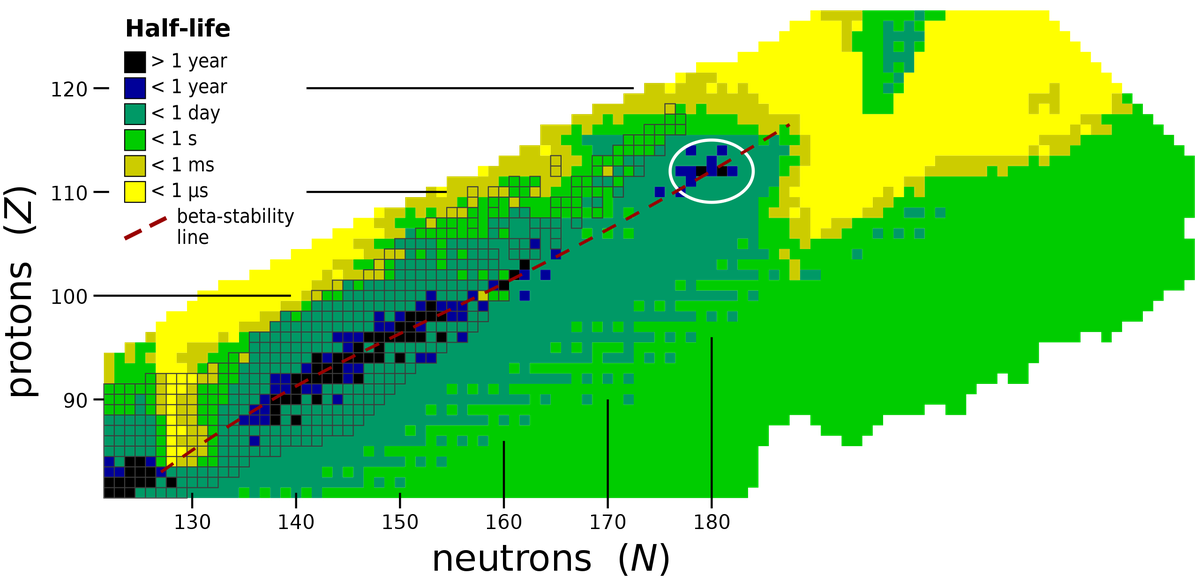
Over the years, physicists have encountered many properties of atoms that emerge from quirks in their nuclei. One example is the ‘island of stability’. Usually, the heavier the nucleus of an unstable element, the faster it will decay via radioactivity. But scientists have found some isotopes that decay slower than their ‘heaviness’ would suggest.

When they plotted a graph with the number of protons on one axis and the number of neutrons on the other, they found that the nuclei of most isotopes lay along a straight line. But they also noticed some isotopes clustered around where the number of protons was 112. This cluster is called the island of stability because these nuclei are unusually more stable. This proton number has become known as the ‘magic number’.

A chart showing the ‘island of stability’ around Z = 112.
| Photo Credit:
Lasunncty (CC BY-SA 4.0)

There are some ideas about how we can explain the existence of the islands – and possibly others like it – but we don’t know for sure. One way physicists hope to fill this gap is by using a femtoscope, like the one the RIKEN team has built, to probe the structures of nuclei that are expected to be oddly shaped.

For example, some unstable nuclei have been hypothesised to have a non-uniform density of protons and neutrons and that they ‘ooze’. With the femtoscope, the hope is that a unifying theory of nuclear structure will be found somewhere in the gaps between expected and unexpected shapes.



Source link

Science Tags:accelerator physics, cesium 137 isotope, collision luminosity, electron scattering, magnetic spectrometer, nuclear structure, RIKEN, RIKEN SCRIT, Self-Confining Radioactive-isotope Ion Target, unstable nuclei

Post navigation

Previous Post: Bihar Education Department Withdraws Order On Curtailing Holidays For School Teachers
Next Post: Rupee falls 13 paise to 82.84 against U.S. dollar

Related Posts

  • How did the Baltimore bridge disaster happen? | Explained
    How did the Baltimore bridge disaster happen? | Explained Science
  • ISRO seeks proposals to study Chandrayaan-3 data  
    ISRO seeks proposals to study Chandrayaan-3 data   Science
  • In China, rocket accidentally lifts off during test and crashes
    In China, rocket accidentally lifts off during test and crashes Science
  • Why has the claimed dark matter discovery sparked debate, caution?
    Why has the claimed dark matter discovery sparked debate, caution? Science
  • Dinosaur collagen used to create one-of-a-kind handbag
    Dinosaur collagen used to create one-of-a-kind handbag Science
  • Why did metal-organic frameworks win the 2025 chemistry Nobel?
    Why did metal-organic frameworks win the 2025 chemistry Nobel? Science

More Related Articles

Evolution can change how an ecosystem collapses, study finds Evolution can change how an ecosystem collapses, study finds Science
Researchers find bacteria that can clean up pesticides from soil to enhance crop yield Researchers find bacteria that can clean up pesticides from soil to enhance crop yield Science
Optical biosensor rapidly detects monkeypox virus Optical biosensor rapidly detects monkeypox virus Science
Global push for cooperation as space traffic crowds earth orbit Global push for cooperation as space traffic crowds earth orbit Science
SpaceX launches its mega Starship rocket on fifth test flight SpaceX launches its mega Starship rocket on fifth test flight Science
Are antibiotics responsible for inflammatory bowel diseases? Are antibiotics responsible for inflammatory bowel diseases? Science
SiteLock

Archives

  • May 2026
  • April 2026
  • March 2026
  • February 2026
  • January 2026
  • December 2025
  • November 2025
  • October 2025
  • September 2025
  • August 2025
  • July 2025
  • June 2025
  • May 2025
  • April 2025
  • March 2025
  • February 2025
  • January 2025
  • December 2024
  • November 2024
  • October 2024
  • September 2024
  • August 2024
  • July 2024
  • June 2024
  • May 2024
  • April 2024
  • March 2024
  • February 2024
  • January 2024
  • December 2023
  • November 2023
  • October 2023
  • September 2023
  • August 2023
  • July 2023
  • June 2023
  • May 2023
  • April 2023
  • March 2023
  • February 2023
  • January 2023
  • December 2022
  • November 2022
  • October 2022
  • September 2022
  • August 2022
  • July 2022
  • June 2022
  • May 2022

Categories

  • Business
  • Nation
  • Science
  • Sports
  • World

Recent Posts

  • Congress MLA-elects make a beeline for Indira Bhavan as AICC inches closer to announcing its Chief Minister pick for Kerala
  • Woman gang-raped in sleeper bus in New Delhi
  • Lebanon, Israel to hold new talks in U.S. as ceasefire nears end
  • Lionel Messi has two goals and an assist as Inter Miami rallies for 5-3 victory over Cincinnati
  • Cuba has run out of diesel and fuel oil amid U.S. oil blockade

Recent Comments

  1. Davidcag on UP Teacher Who Asked Students To Slap Muslim Classmate
  2. OrvalMaync on UP Teacher Who Asked Students To Slap Muslim Classmate
  3. Jeffreyroure on UP Teacher Who Asked Students To Slap Muslim Classmate
  4. Stevemonge on UP Teacher Who Asked Students To Slap Muslim Classmate
  5. RichardClage on UP Teacher Who Asked Students To Slap Muslim Classmate
  • 3 Arrested For Allegedly Strangling Flatmate To Death Post Argument In Gurugram
    3 Arrested For Allegedly Strangling Flatmate To Death Post Argument In Gurugram Nation
  • “Why Aren’t India And Pakistan Getting Banned?” ICC Gets Stern Message Amid Champions Trophy Venue Row
    “Why Aren’t India And Pakistan Getting Banned?” ICC Gets Stern Message Amid Champions Trophy Venue Row Sports
  • Impact On Consumer Behaviour And Your Lifestyle
    Impact On Consumer Behaviour And Your Lifestyle Nation
  • Greatest Catch Ever? Ramandeep Singh’s Effort vs Pakistan A Breaks Internet – Watch
    Greatest Catch Ever? Ramandeep Singh’s Effort vs Pakistan A Breaks Internet – Watch Sports
  • Rajnath Singh On Border Talks With China
    Rajnath Singh On Border Talks With China World
  • Access Denied
    Access Denied Nation
  • Jailed Separatist Amritpal Singh Gets “Mike” Symbol To Fight Lok Sabha Polls
    Jailed Separatist Amritpal Singh Gets “Mike” Symbol To Fight Lok Sabha Polls Nation
  • India Fields 14-Man Contingent At World Wrestling Olympic Qualifiers, Final Chance To Get Paris Olympics Quotas
    India Fields 14-Man Contingent At World Wrestling Olympic Qualifiers, Final Chance To Get Paris Olympics Quotas Sports

Editor-in-Chief:
Mohammad Ariff,
MSW, MAJMC, BSW, DTL, CTS, CNM, CCR, CAL, RSL, ASOC.
editor@artifex.news

Associate Editors:
1. Zenellis R. Tuba,
zenelis@artifex.news
2. Haris Daniyel
daniyel@artifex.news

Photograher:
Rohan Das
rohan@artifex.news

Artifex.News offers Online Paid Internships to college students from India and Abroad. Interns will get a PRESS CARD and other online offers.
Send your CV (Subjectline: Paid Internship) to internship@artifex.news

Links:
Associate Journalism
About Us
Privacy Policy

News Links:
Breaking News
World
Nation
Sports
Business
Entertainment
Lifestyle

Registered Office:
72/A, Elliot Road, Kolkata - 700016
Tel: 033-22277777, 033-22172217
Email: office@artifex.news

Editorial Office / News Desk:
No. 13, Mezzanine Floor, Esplanade Metro Rail Station,
12 J. L. Nehru Road, Kolkata - 700069.
(Entry from Gate No. 5)
Tel: 033-46011099, 033-46046046
Email: editor@artifex.news

Copyright © 2023 Artifex.News Newsportal designed by Artifex Infotech.