



Skip to content
  • Facebook
  • X
  • Linkedin
  • WhatsApp
  • YouTube
  • Associate Journalism
  • About Us
  • Privacy Policy
  • 033-46046046
  • editor@artifex.news
Artifex.News

Artifex.News

Stay Connected. Stay Informed.

  • Breaking News
  • World
  • Nation
  • Sports
  • Business
  • Science
  • Entertainment
  • Lifestyle
  • Toggle search form
  • Wife Held For Conspiracy; Had Extra-Marital Affair
    Wife Held For Conspiracy; Had Extra-Marital Affair Nation
  • Access Denied World
  • Emergency At Thiruvananthapuram Airport Over Bomb Threat On Air India Flight
    Emergency At Thiruvananthapuram Airport Over Bomb Threat On Air India Flight Nation
  • ICC suspension unexpected, but corrective measures under way: Cricket Canada
    ICC suspension unexpected, but corrective measures under way: Cricket Canada Sports
  • Watch: U.K’s new Prime Minister Andy Burnham arrives at 10 Downing Street
    Watch: U.K’s new Prime Minister Andy Burnham arrives at 10 Downing Street World
  • Why STEM isn’t just for Science students anymore
    Why STEM isn’t just for Science students anymore Science
  • Ranji Trophy | Sangwan helps Delhi escape with draw against Tamil Nadu
    Ranji Trophy | Sangwan helps Delhi escape with draw against Tamil Nadu Sports
  • Cannot Trust Congress That Callously Gave Away Key Island To Lanka: PM Modi
    Cannot Trust Congress That Callously Gave Away Key Island To Lanka: PM Modi Nation
Data | The contours of India’s ‘formal jobs’ crisis

Data | The contours of India’s ‘formal jobs’ crisis

Posted on August 3, 2023 By admin


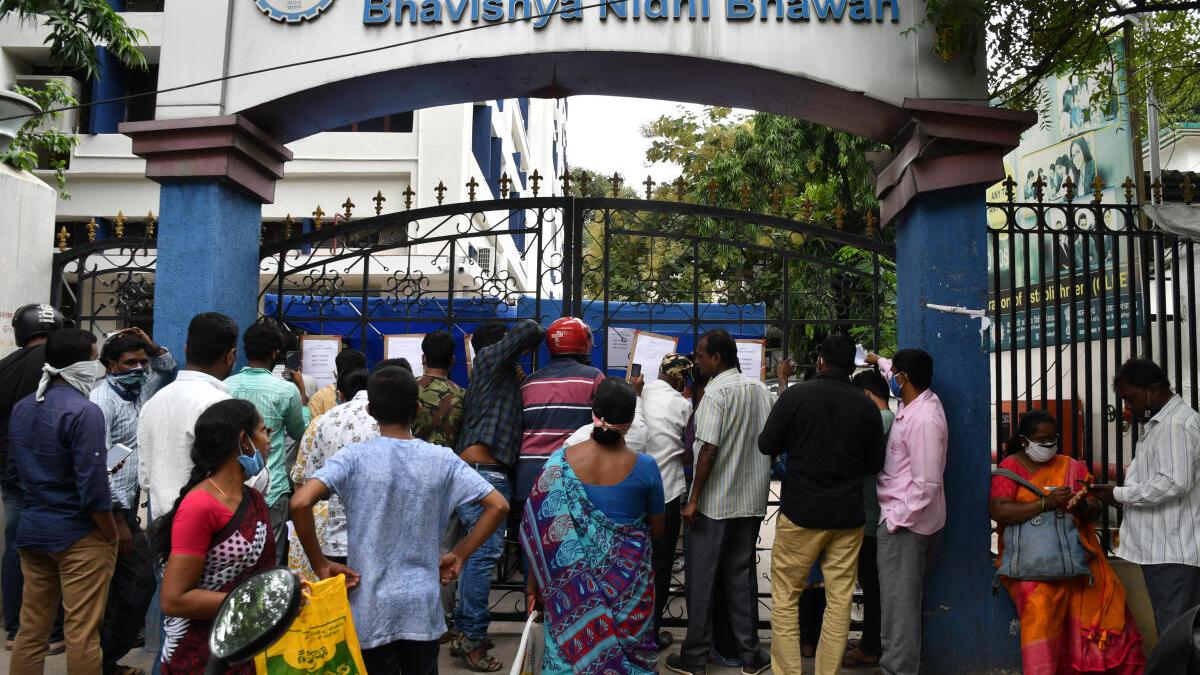
Since 2017, the Indian government has been using the Employees Provident Fund (EPF) scheme’s data as a measure of payroll employment and formal job creation in the country. The monthly data released as part of this initiative has generally shown net increases in the number of contributors and this has been portrayed as evidence of employment creation in the country. However, this is in stark variance with ground reports of unemployment and a dearth of jobs from various parts of the country. So, how does one square these divergent narratives and understand what’s happening to formal jobs in the country? If we move past the basic scheme enrolment numbers, the EPF data, in fact, provide important insights into what’s happening to formal employment in the country. It also reveals why official claims of job creation based on EPF enrolment numbers can be misleading.

Unlike the EPF monthly enrolment data, which generally depicts increases in contributors, the EPF Organisation’s (EPFO) annual reports reveal that the number of regular contributors to the scheme has remained relatively stagnant or even declined in recent years, as shown in Chart 1. Regular contributors to the EPF scheme are those enrolled employees whose PF contributions are made on a regular basis during the year. This is in contrast to those employees who are merely enrolled into the scheme at some point, but whose contributions are irregular or stop shortly after.

Chart appears incomplete? Click to remove AMP mode

Between 2012 and 2022, the number of regular contributors to the EPF increased from 30.9 million to 46.3 million. A significant increase occurred in 2016-17, when the Indian government encouraged firms with private PFs to join the government’s EPF and introduced other incentive schemes that paid the employer’s share of PF contributions. However, in the past five years, when the effects of such incentives and firm enrolments somewhat stabilised, growth in regular contributors slowed down significantly. Between 2017 and 2022, the number of regular contributors increased only from 45.11 million to 46.33 million. Strikingly, this occurred during a time when overall enrolments in the EPF increased from 210.8 million to 277.4 million as shown in Chart 2.

In other words, though the total number of EPF enrolments increased by around 67 million, the corresponding increase in regular contributors within that was only 1.2 million. The number of people enrolled in the EPF can generally be expected to be higher than regular contributors due to issues of duplication and old membership data, but it is concerning that in recent years, the gap between them has been noticeably widening. If the EPF data are to be considered as an indication of formal employment, then there appears to have been a net creation of only 1.2 million formal jobs in the past five years. For perspective, at current participation rates, there were an estimated 20-25 million new entrants into the Indian labour market.

The divergence between EPF enrolments and regular contributors indicates that the majority of enrolments into the EPF are linked to jobs that are of a temporary, subcontracted or casual variety — where PF contributions are irregular or cease shortly. Thus, though the Indian economy appears to be creating jobs – these are not formal, regular well-paid jobs that can provide good quality, long-term employment.

The EPF numbers are broadly in line with longer employment trends of the country, thus indicating that formal employment in India has become increasingly standardised in terms of EPF enrolment, rather than the creation of new formal jobs per se. With the government paying the employer’s share of PF contribution, smaller firms and employers have been enrolling their employees into the EPF scheme in order to avail of its benefits and reduce their wage expenditures. However, many of these incentives are applicable only to employees earning Rs 15,000 or less per month. Preliminary accounts suggest stagnation around this wage level, possibly or at least in part due to such schemes.

Middle-class’s woes

As India overtakes China as the most populous country in the world, it faces an increasingly educated and growing working-age population that requires good-quality employment. However, the relative absence of formal, well-paid, regular employment in the country is striking. This inhibits the expansion of its middle class — a factor that was central to China’s economic growth — but which has largely been missing in India. The lack of quality jobs in the Indian economy gets revealed in instances of large numbers of over-qualified youth applying for a few public or private sector job openings, showing a dissonance with claims of strong economic growth. Despite the Indian government’s outward rhetoric of a strong economy, there are indications that it is cognisant of the lack of job creation in the economy. This is revealed in its promotion of Rozgar Melas (employment fairs), public sector recruitment drives, factory incentives as well as attempts to internationalise skills transferability and worker mobility.

The stagnation in formal employment in India can be partially attributed to the pandemic. In fact, the number of EPF contributors declined (somewhat predictably) during the COVID pandemic. At the time, the EPFO used to publish information on regular contributors on a monthly basis. However, after the decline in EPF contributors was noticed by news media, the EPFO subsequently disputed its own numbers and stopped publishing this monthly data series altogether.

Unfortunately, over time the Indian government has neglected other sources of formal employment and labour data that could have been used to verify these numbers and trends. For instance, the employment market information collected by the Directorate General of Employment and Training (DGET) has not been published since 2013. The DGET data were historically the original source of formal sector payroll employment data in India (since the 1950s). The Reserve Bank of India utilised it as the main source for formal sector employment numbers and related calculations in the country. However, this data are no longer available, even to the country’s central bank.

The EPF scheme is potentially a good alternative source to gauge payroll employment, but it requires significant standardisation and de-duplication. Moreover, it should be recognised that a single data source is insufficient to understand formal employment and jobs in the country. Understanding and addressing issues of job creation or job quality cannot be achieved without a wide range of standardised, stable and publicly available labour statistics. Despite their importance, recent Indian governments have neglected several of the country’s labour and employment statistical sources leading to questionable decision-making, making national labour and employment policies appear inchoate, lacking both, clarity and direction.

Secki P. Jose teaches at the University of the West of England, Bristol, U.K.

Source: EPFO Annual reports

Also read: Keep it simple: On opting for higher pension



Source link

Business Tags:duplication of EPF numbers, employee provident fund monthly data, Employees’ Provident Fund Organisation, enrolments in employee provident fund India, enrolments in EPF India, EPF data India, EPFO annual report, EPFO enrolment data, formal employment data India, formal employment in India, formal job creation in India, formal jobs data India, job creation India, labour data India, lack of jobs in India, lack of quality jobs in India, regular contributors to employee provident fund India, unemployment in India

Post navigation

Previous Post: Temasek to invest ₹1,200 crore in Mahindra’s passenger EV company MEAL
Next Post: MRF Q1 net up fivefold to ₹581 cr. on increase in sales volume

Related Posts

  • Access Denied Business
  • Access Denied Business
  • Wholesale price rise at 4-month low of 1.3% in August
    Wholesale price rise at 4-month low of 1.3% in August Business
  • The hard truth about out-of-pocket health expenditure
    The hard truth about out-of-pocket health expenditure Business
  • Coal India Limited allays coal shortage fears, says 168 MT buffer available to meet rising demand
    Coal India Limited allays coal shortage fears, says 168 MT buffer available to meet rising demand Business
  • BHEL gets 1,600 MW thermal power project from Damodar Valley Corporation
    BHEL gets 1,600 MW thermal power project from Damodar Valley Corporation Business

More Related Articles

Highs and lows: On GST metrics Highs and lows: On GST metrics Business
Senior living market can grow into a .1 bn prospect: ASLI-JLL Senior living market can grow into a $10.1 bn prospect: ASLI-JLL Business
Access Denied Business
IIP growth recovers to four-month high of 3.5% on broad-based growth IIP growth recovers to four-month high of 3.5% on broad-based growth Business
Access Denied Business
SiteLock

Archives

  • September 2026
  • August 2026
  • July 2026
  • June 2026
  • May 2026
  • April 2026
  • March 2026
  • February 2026
  • January 2026
  • December 2025
  • November 2025
  • October 2025
  • September 2025
  • August 2025
  • July 2025
  • June 2025
  • May 2025
  • April 2025
  • March 2025
  • February 2025
  • January 2025
  • December 2024
  • November 2024
  • October 2024
  • September 2024
  • August 2024
  • July 2024
  • June 2024
  • May 2024
  • April 2024
  • March 2024
  • February 2024
  • January 2024
  • December 2023
  • November 2023
  • October 2023
  • September 2023
  • August 2023
  • July 2023
  • June 2023
  • May 2023
  • April 2023
  • March 2023
  • February 2023
  • January 2023
  • December 2022
  • November 2022
  • October 2022
  • September 2022
  • August 2022
  • July 2022
  • June 2022
  • May 2022

Categories

  • Business
  • Nation
  • Science
  • Sports
  • World

Recent Posts

  • IIT Bombay faculty member booked for caste abuse, suicide abetment
  • Arjun finds form as India beats Spain; Savitha stars for women
  • CWC chief flags ‘malpractices’ in phytosanitary certification, pitches integrated logistics to boost agri-exports
  • Handloom weavers block Tenkasi-Madurai road
  • Ecologists urge scientists and policymakers to study imminent ‘Super’ El Niño to prepare for the future

Recent Comments

  1. AlvinNet on UP Teacher Who Asked Students To Slap Muslim Classmate
  2. AlvinNet on UP Teacher Who Asked Students To Slap Muslim Classmate
  3. Jamesslits on UP Teacher Who Asked Students To Slap Muslim Classmate
  4. MichaelClear on UP Teacher Who Asked Students To Slap Muslim Classmate
  5. Jamesslits on UP Teacher Who Asked Students To Slap Muslim Classmate
  • Canada PM Carney’s visit to India built strong foundation for truly renewed partnership: PM Modi
    Canada PM Carney’s visit to India built strong foundation for truly renewed partnership: PM Modi Nation
  • NTPC Ltd’s BESS proposal under active consideration of KSEB
    NTPC Ltd’s BESS proposal under active consideration of KSEB Nation
  • States seek improvements in 50-year interest-free loan scheme
    States seek improvements in 50-year interest-free loan scheme Business
  • Access Denied
    Access Denied Nation
  • Vietnam starts mass evacuations, shuts airports as Typhoon Kajiki approaches
    Vietnam starts mass evacuations, shuts airports as Typhoon Kajiki approaches World
  • Virat Kohli, Rohit Sharma’s ‘Moment Of The Day’ From World Cup Match Against England Makes Fans Nostalgic. Watch
    Virat Kohli, Rohit Sharma’s ‘Moment Of The Day’ From World Cup Match Against England Makes Fans Nostalgic. Watch Sports
  • Access Denied World
  • Germany moves to fast-track geothermal energy projects
    Germany moves to fast-track geothermal energy projects Science

Editor-in-Chief:
Mohammad Ariff,
MSW, MAJMC, BSW, DTL, CTS, CNM, CCR, CAL, RSL, ASOC.
editor@artifex.news

Associate Editors:
1. Zenellis R. Tuba,
zenelis@artifex.news
2. Haris Daniyel
daniyel@artifex.news

Photograher:
Rohan Das
rohan@artifex.news

Artifex.News offers Online Paid Internships to college students from India and Abroad. Interns will get a PRESS CARD and other online offers.
Send your CV (Subjectline: Paid Internship) to internship@artifex.news

Links:
Associate Journalism
About Us
Privacy Policy

News Links:
Breaking News
World
Nation
Sports
Business
Entertainment
Lifestyle

Registered Office:
72/A, Elliot Road, Kolkata - 700016
Tel: 033-22277777, 033-22172217
Email: office@artifex.news

Editorial Office / News Desk:
No. 13, Mezzanine Floor, Esplanade Metro Rail Station,
12 J. L. Nehru Road, Kolkata - 700069.
(Entry from Gate No. 5)
Tel: 033-46011099, 033-46046046
Email: editor@artifex.news

Copyright © 2023 Artifex.News Newsportal designed by Artifex Infotech.