


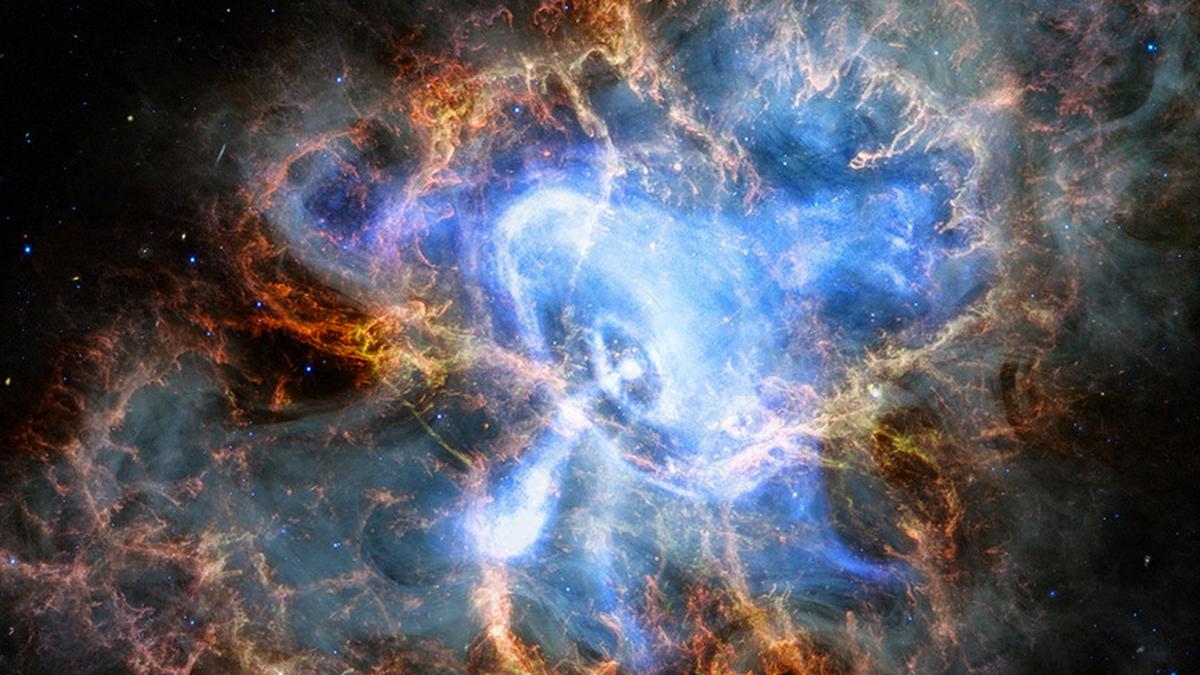
The Crab Nebula, the result of a bright supernova explosion seen by Chinese and other astronomers in the year 1054, 6,500 light-years from Earth, is seen in an image taken by the James Webb Telescope on June 3, 2024. At its center is a neutron star, a super-dense star produced by the supernova. This image shows the X-ray data from Chandra along with infrared data from the Webb space telescope.
| Photo Credit: Reuters
By looking at light from distant exploding stars called supernovas, in 1998 astronomers discovered the universe isn’t just expanding – its expansion is speeding up. But what’s behind this acceleration?
Enter dark energy. It’s one of the most debated and intriguing missing puzzle pieces of modern physics – a mysterious form of energy believed to uniformly permeate all of space. In the current most accepted model of modern cosmology, dark energy is what drives the accelerated expansion of the universe.
But what if there’s another explanation that doesn’t involve dark energy? A recent study using data from supernovas hints there might indeed be one, and it’s called the Timescape model.
This finding could profoundly challenge our understanding of the cosmos, so let’s dive in.
What is dark energy?
The backbone of modern cosmology is the Lambda-Cold Dark Matter (Lambda-CDM) model. It describes a universe where a dark energy – denoted with Λ, the Greek letter Lambda – is the driving mechanism behind the universe’s accelerating expansion.
Under this model, galaxies are dancing together under the effect of an invisible dark matter web made of heavy particles that don’t interact with anything. The effects of this cold dark matter can only be observed through gravity.
Dark energy accounts for nearly 70% of the universe’s total energy budget, but its exact nature remains one of the greatest mysteries in physics.
Some interpretations suggest dark energy could be linked to the energy of the vacuum, while other studies have attempted to describe it as a new, evolving energy field spread across space.
And a recent study from the international DESI collaboration that traces the universe’s expansion hinted dark energy may be weakening over time.
It’s also possible that our current theory of gravity (Einstein’s theory of general relativity) is incomplete. Perhaps it requires an extension to describe gravitational interaction at cosmological scales – distances on the order of millions to billions of light-years.
What is the Timescape model?
Matter – dark matter, gas, galaxies, star clusters and super clusters – is not uniformly spread throughout cosmos.
But for the Lambda-CDM model, we assume the universe is homogeneous and isotropic. This means that, on cosmic scales, the distribution of matter appears smooth and uniform. Any clumps and gaps we might find can be considered insignificant due to the grand scale of the entire thing.
By contrast, the Timescape model takes the uneven distribution of matter into account. It suggests our intricate cosmic web – made up of galaxies, clusters, filaments and vast cosmic voids – directly affects how we interpret the expansion of the universe.
This would mean the universe isn’t stretching out evenly.
According to the Timescape model, the universe’s expansion rate varies across different regions, depending on how dense they are.
The key parameter in the Timescape model is the “void fraction”: it quantifies the proportion of space occupied by expanding voids.
Gravity dictates that voids expand faster than denser regions – they have less matter to hold them back, allowing space to stretch more freely. This creates an average effect that can mimic the accelerated expansion attributed to dark energy in Lambda-CDM.
In short, the Timescape model suggests it might only appear to us that the universe’s expansion is speeding up. The expansion speed depends on where you are in the universe.
What did the study find?
The authors of the new study looked at one of the biggest collections of Type Ia supernovas, called the Pantheon+ dataset. These supernovas are a reliable standard used to test cosmological models.
The team compared two major models: the standard Lambda-CDM (our “vanilla” recipe of the universe), and the Timescape model.
When looking at nearby bright supernovas, the Timescape model explained things better than our standard model. This was only statistical though, with the statistical analysis showing a “very strong” preference.
Even when they examined more distant supernovas, where things should be more evenly spread out, Timescape still held up slightly better than the usual model.
The takeaway? The Timescape model, which focuses on how cosmic “clumps and gaps” change the way we see the universe growing, might be better at capturing the true nature of our universe’s expansion. This would be especially so for the nearby universe – we have a lot of voids and filaments near us, which would affect how we see the expansion.
How strong is the evidence, then?
There are important caveats. The analysis doesn’t account for peculiar velocities – small, random motions of galaxies that can affect supernova measurements. They also don’t account for Malmquist bias, when brighter supernovas are more likely to be included in the data simply because they’re easier to detect.
These potential sources of error could badly affect their results. Additionally, the study didn’t use the latest DES5yr dataset of supernovas. It’s more consistent and uniform in its data collection than Pantheon+, potentially making it more reliable for comparison.
There are other things besides supernovas currently propping up the Lambda-CDM model, most notably baryon acoustic oscillations and gravitational lensing. Future work would need to integrate those into the Timescape model.
But with this new study, the Timescape model offers an intriguing alternative to Lambda-CDM. The bottom line is that our universe’s acceleration is an illusion due to the uneven distribution of matter with large cosmic voids expanding faster than denser regions.
If confirmed, this would represent a revolutionary paradigm shift in cosmology.
This article is republished from The Conversation under a Creative Commons license. Read the original article here.
Published – January 09, 2025 04:31 pm IST