

Skip to content
  • Facebook
  • X
  • Linkedin
  • WhatsApp
  • YouTube
  • Associate Journalism
  • About Us
  • Privacy Policy
  • 033-46046046
  • editor@artifex.news
Artifex.News

Artifex.News

Stay Connected. Stay Informed.

  • Breaking News
  • World
  • Nation
  • Sports
  • Business
  • Science
  • Entertainment
  • Lifestyle
  • Toggle search form
  • G20 Summit, Global Biofuels Alliance: “Biofuels Alliance Will Reduce World Pollution”: Nitin Gadkari To NDTV
    G20 Summit, Global Biofuels Alliance: “Biofuels Alliance Will Reduce World Pollution”: Nitin Gadkari To NDTV Nation
  • Manu Bhaker’s Father Breaks Silence After Olympic Medallist Gets Overlooked For Prestigious Khel Ratna Award
    Manu Bhaker’s Father Breaks Silence After Olympic Medallist Gets Overlooked For Prestigious Khel Ratna Award Sports
  • Char Dham Yatra Temporarily Halted Due To Heavy Rain Forecast In Uttarakhand
    Char Dham Yatra Temporarily Halted Due To Heavy Rain Forecast In Uttarakhand Nation
  • Access Denied
    Access Denied Nation
  • Palestinian factions hand over truckloads of weapons in Lebanon’s largest refugee camp
    Palestinian factions hand over truckloads of weapons in Lebanon’s largest refugee camp World
  • Access Denied
    Access Denied Nation
  • IPL-17: LSG vs KKR | Fresh from a break, Lucknow Super Giants host an in-form Kolkata Knight Riders
    IPL-17: LSG vs KKR | Fresh from a break, Lucknow Super Giants host an in-form Kolkata Knight Riders Sports
  • Government Expects Rs 3.16 Lakh Crore In RBI, Bank Dividends For 2026-27 Business
Quantum gates: Devices that translate quantum effects to computing awesomeness

Quantum gates: Devices that translate quantum effects to computing awesomeness

Posted on August 19, 2023 By admin


Information technology (IT) has become essential to communication, banking, business, health, education, entertainment, and many other walks of our lives. Its prevalence makes us wonder if society can survive without it. IT relies on gadgets that store and process vast amounts of information at humanly impossible speeds.

Gate in computing

A bit is the smallest piece of information storage (it is a portmanteau of binary digit). Often, a large number of bits is required to convey meaningful information. With the advent of modern semiconductor technology, we routinely speak of household computers having a few terabytes (8 trillion bits) of information storage. One terabyte can store 500 hours of high-definition video content.

In a computer, a bit is a physical system with two easily discernible configurations, or states – e.g. high and low voltage. These physical bits are useful to represent and process expressions that involve 0s and 1s: for instance, low voltage can represent 0 and high voltage can represent 1.

A gate is a circuit that changes the states of bits in a predictable way. The speed at which these gates work determines how fast a computer functions.

The quantum gate

Modern computers use semiconductor transistors to build circuits that function as bits. A semiconductor chip hosts more than 100 million transistors on 1 sq. mm. Imagine how small an individual transistor is and how close it is to adjacent transistors. As transistors become smaller, they become more susceptible to quantum effects. This is not desirable as the existing technology will then become unreliable for computational tasks. So there is a limit to how many transistors a computer can have.

Moore’s law, announced in 1965, states that computing power increases tenfold every five years. This law no longer holds as we have already slowed to a two-fold increase every five years. But this doesn’t have to mean we are nearing the end of computing development: the quantum revolution is coming.

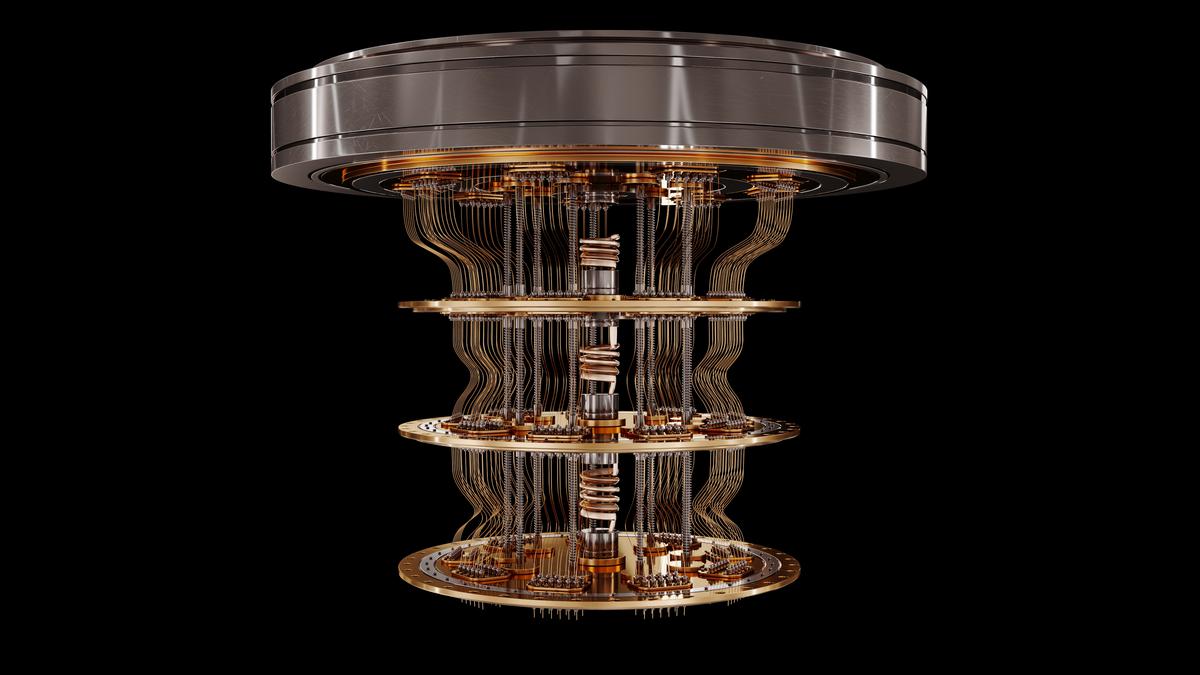
The most basic unit of a quantum computer is a quantum bit, or qubit. Like in a conventional computer, it is a physical object that has two states. For example, the spin of a particle can point along two different directions, so the particle can function as a qubit. Or it can be a superconducting circuit that mimics an atom, and its two states can be a ground state, where it has lower energy, and a higher ‘excited’ state.

A quantum gate is a physical process or circuit that changes the state of a qubit or a collection of qubits.

In the quantum-computing context, if particles or superconducting qubits are the physical qubits, the gate is often an electromagnetic pulse.

Interlude: Superposition

A fundamental limitation of conventional computing architecture is that each bit can exist in only one of the two states, 0 or 1. But according to quantum physics, a qubit can also be in a superposition of its two states at the same time.

Imagine you’re walking in the northeast direction. It is equivalent to moving partly along the north and the rest along the east. Your northeast movement is a superposition of walking along the north and along the east. So by combining different distances along the two directions, you can realise some movement in any direction between the two.

The basis states of the qubit are similar to the north and east directions. A qubit in a superposition has some contributions from each basis state. Different superpositions correspond to different amounts of contributions.

If a qubit is in a superposition, then measuring the qubit will cause it to collapse to one of the two states (i.e. either north or east). However, we can only predict the probability that it will collapse to one state. Quantum computers use this to their advantage.

For example, to perform one calculation that requires 16 different inputs, a classical computer requires a total of four bits and sixteen computations. But with four qubits in superposition, a quantum computer could generate answers corresponding to all 16 inputs in a single computation.

Superposition is one of the main factors responsible for speeding up a quantum computer.

But while superposition provides enormous advantages, it is a fragile effect. It deteriorates when qubits interact with their environment. Identifying ways to sidestep or overcome this fragility is an active area of research today.

What gates do

In quantum computers, quantum gates act on qubits to process information. For example, a quantum NOT gate changes the state of a qubit from 0 to 1 and vice versa. The effect of the NOT gate on a superposition is again a superposition, resulting from the action of the NOT gate on each basis state in the initial superposition.

Notably, this feature is common to all quantum gates: the effect of a quantum gate on a superposition is the superposition of the effects of the quantum gate on the basis states contributing to the initial superposition.

So as the quantum NOT gate inter-converts the states 0 and 1, its action is to swap the contributions of the basis states in the superposition.

The Hadamard gate is a type of gate that acts on a single qubit: it generates a superposition of the basis states.

The controlled-NOT, or CNOT, gate acts on two qubits: a control qubit and a target qubit. The control qubit is unaffected by the CNOT gate. The target qubit flips from 0 to 1 or 1 to 0 if the control qubit state is 1.

CNOT plus a few other gates (that act on single qubits) can perform all possible logical operations on binary information encoded on qubits. That is, they can be combined to form quantum circuits capable of processing information.

Research on reliable quantum computers and suitable quantum algorithms is happening in many institutes, universities, and research labs worldwide. Large-scale, reliable quantum computers will benefit industries ranging from drug design to safe communications.

S. Srinivasan is a professor of physics at Krea University.


Source link

Science Tags:CNOT gate, Hadamard gate, quantum computing, quantum dots, quantum gates, quantum NOT gate, quantum superposition, superconducting qubits, topological qubits

Post navigation

Previous Post: India’s Growth To Outpace All Other G20 Economies For Next 2 Years: Moody’s
Next Post: Adani Group Market Cap Jumps To 3-Month High, Adds Rs 45,200 Crore On Friday

Related Posts

  • Berlin to BITS Pilani: How Nobel-winning Optogenetics connects to parasite research in Hyderabad
    Berlin to BITS Pilani: How Nobel-winning Optogenetics connects to parasite research in Hyderabad Science
  • Newfound brain network ‘SCAN’ implicated in Parkinson’s disease
    Newfound brain network ‘SCAN’ implicated in Parkinson’s disease Science
  • Big Swedish study hints at link between bowel disease, infant diet
    Big Swedish study hints at link between bowel disease, infant diet Science
  • What is ‘Net Zero’, anyway? A short history of a monumental concept
    What is ‘Net Zero’, anyway? A short history of a monumental concept Science
  • BITS Pilani Hyderabad researchers develop graphene electrode for improved supercapacitor performance
    BITS Pilani Hyderabad researchers develop graphene electrode for improved supercapacitor performance Science
  • Hold tight! How two hurricanes forced a lizard to change its grip
    Hold tight! How two hurricanes forced a lizard to change its grip Science

More Related Articles

A tiny insect, a deadly enemy: how medicine’s discovery of its impact shaped health and town planning A tiny insect, a deadly enemy: how medicine’s discovery of its impact shaped health and town planning Science
Sun bears appear so human-like they are mistaken for people in suits – experts explain Sun bears appear so human-like they are mistaken for people in suits – experts explain Science
Russia’s Luna-25 spacecraft enters lunar orbit Russia’s Luna-25 spacecraft enters lunar orbit Science
ISRO 100th mission LIVE: Countdown for ISRO’s satellite launch begins at Sriharikota ISRO 100th mission LIVE: Countdown for ISRO’s satellite launch begins at Sriharikota Science
Science Snapshots: August 23, 2026 Science Snapshots: August 23, 2026 Science
Teaching AI to speak India Teaching AI to speak India Science
SiteLock

Archives

  • October 2026
  • September 2026
  • August 2026
  • July 2026
  • June 2026
  • May 2026
  • April 2026
  • March 2026
  • February 2026
  • January 2026
  • December 2025
  • November 2025
  • October 2025
  • September 2025
  • August 2025
  • July 2025
  • June 2025
  • May 2025
  • April 2025
  • March 2025
  • February 2025
  • January 2025
  • December 2024
  • November 2024
  • October 2024
  • September 2024
  • August 2024
  • July 2024
  • June 2024
  • May 2024
  • April 2024
  • March 2024
  • February 2024
  • January 2024
  • December 2023
  • November 2023
  • October 2023
  • September 2023
  • August 2023
  • July 2023
  • June 2023
  • May 2023
  • April 2023
  • March 2023
  • February 2023
  • January 2023
  • December 2022
  • November 2022
  • October 2022
  • September 2022
  • August 2022
  • July 2022
  • June 2022
  • May 2022

Categories

  • Business
  • Nation
  • Science
  • Sports
  • World

Recent Posts

  • Ahobilam temple photographer bags ‘Best Image of the Year’ award
  • Shooting at elementary school in Oregon leaves several hospitalised, shooter dead
  • GVMC funds not diverted to Amaravati, says Commissioner
  • Tirunelveli reader’s mail – The Hindu
  • Experts’ poll: RBI may hike rates by 0.25% in October policy amid inflationary pressures

Recent Comments

  1. Danielwhipt on UP Teacher Who Asked Students To Slap Muslim Classmate
  2. Danielwhipt on UP Teacher Who Asked Students To Slap Muslim Classmate
  3. CharlesGah on UP Teacher Who Asked Students To Slap Muslim Classmate
  4. Danielwhipt on UP Teacher Who Asked Students To Slap Muslim Classmate
  5. MerleEsozy on UP Teacher Who Asked Students To Slap Muslim Classmate
  • Access Denied Sports
  • The character we showed was amazing: SA skipper Wolvaardt
    The character we showed was amazing: SA skipper Wolvaardt Sports
  • Access Denied
    Access Denied Nation
  • In Israel’s Ashkelon, The Iron Dome At Work
    In Israel’s Ashkelon, The Iron Dome At Work World
  • Access Denied World
  • How Old-Fashioned Joe Root Shunned ‘Bazball’ To Save The Day For England
    How Old-Fashioned Joe Root Shunned ‘Bazball’ To Save The Day For England Sports
  • Access Denied Sports
  • Access Denied
    Access Denied Nation

Editor-in-Chief:
Mohammad Ariff,
MSW, MAJMC, BSW, DTL, CTS, CNM, CCR, CAL, RSL, ASOC.
editor@artifex.news

Associate Editors:
1. Zenellis R. Tuba,
zenelis@artifex.news
2. Haris Daniyel
daniyel@artifex.news

Photograher:
Rohan Das
rohan@artifex.news

Associate Journalists
1. Subrata Paul - AN/2020/01
2. Quamruz Zaman - AN/2021/22
3. Ahmed Sha - AN/2021/035
4. Ajay Kumar Shaw - AN/2021/39
5. Tahqiqul Hoda - AN/2021/21

Artifex.News offers Online Paid Internships to college students from India and Abroad. Interns will get a PRESS CARD and other online offers.
Send your CV (Subjectline: Paid Internship) to internship@artifex.news

Links:
Associate Journalism
About Us
Privacy Policy

News Links:
Breaking News
World
Nation
Sports
Business
Entertainment
Lifestyle

Registered Office:
72/A, Elliot Road, Kolkata - 700016
Tel: 033-22277777, 033-22172217
Email: office@artifex.news

Editorial Office / News Desk:
No. 13, Mezzanine Floor, Esplanade Metro Rail Station,
12 J. L. Nehru Road, Kolkata - 700069.
(Entry from Gate No. 5)
Tel: 033-46011099, 033-46046046
Email: editor@artifex.news

Copyright © 2023 Artifex.News Newsportal designed by Artifex Infotech.