


Genetic studies have painted a neat picture of human evolution and migration around the world. By studying how frequently DNA in the mitochondria (the cellular structure responsible for producing energy) mutates, scientists have found that Homo sapiens evolved in Africa for millennia, then emigrated to different parts of the world.
Scientists mostly agree on this out-of-Africa theory of human evolution and migration, but they frequently disagree on when exactly our ancestors migrated and what routes they took to different parts of the globe.
Several genetic studies have supported the coastal dispersion idea: that migrating humans travelled along the coast, especially in the tropics, where the weather was warm and wet and food was plentiful. In 2005, the mitochondrial genomes from 260 Orang Asli people revealed early humans dispersed rapidly around 65,000 years ago on the coast of the Indian Ocean before reaching Australia. In 2020, the nuclear and mitochondrial DNA from the remains of a 2,700-year-old individual in Japan showed a strong “genetic affinity” with indigenous Taiwanese tribes. The authors of the study concluded the finding supported coastal migration. Human settlements in the Andaman archipelago have also been linked to coastal journeys.
But there’s a problem: archeological evidence has disagreed with the coastal dispersion model. For example, “all Palaeolithic archaeological sites in India are inland,” Michael Petraglia, director of the Australian Research Centre for Human Evolution at Griffith University, said. Along with his team, Petraglia has studied several archeological sites in the country. “There is not a shred of archaeological evidence along the entire Indian Ocean coastline to support this model.”
Instead, Petraglia deferred to the inland dispersal model: the idea that human ancestors took “more interior, terrestrial routes”.
A new study of archeological sites in India’s Saurashtra peninsula, published in the journal Quaternary Environments and Humans in October, has mounted yet another challenge to the coastal dispersion model.
Early humans in Saurashtra
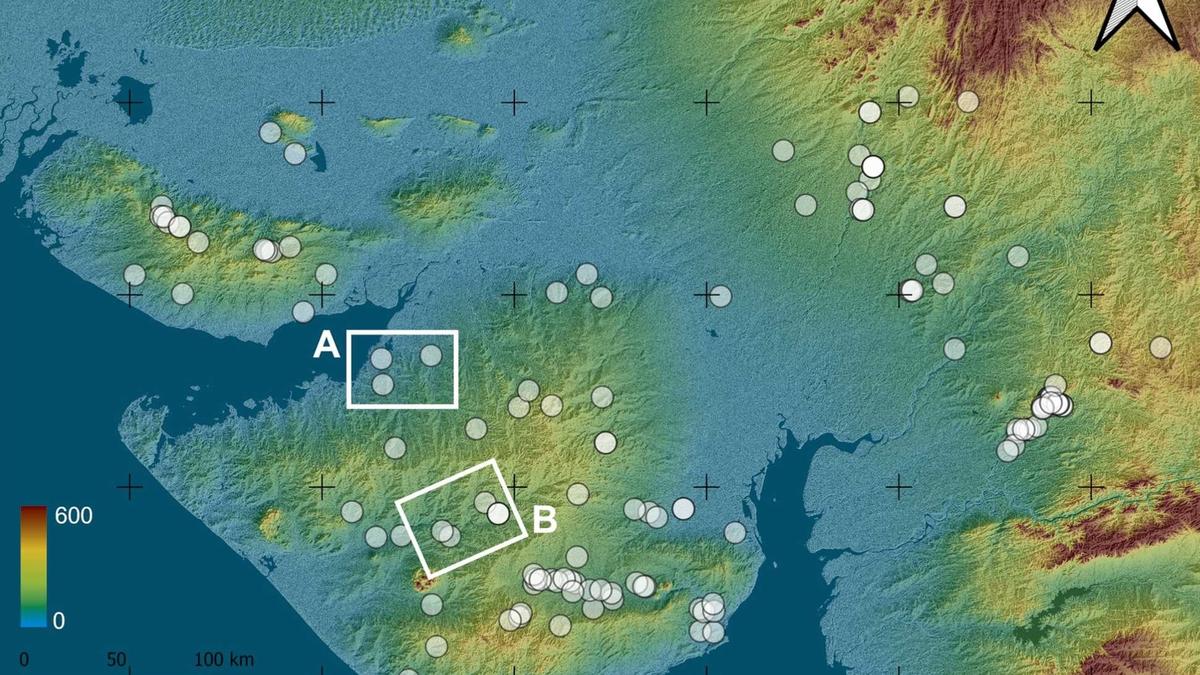
In the study, scientists from the Max Planck Institute for Geoanthropology and the Tübingen University, Germany; the Maharaja Sayajirao University of Baroda, Vadodara; and the University of Philippines investigated the Bhadar and Aji river basins of the Saurashtra peninsula in Gujarat. They discovered artefacts of tools made by early human inhabitants — pieces of chert, jasper, chalcedony, bloodstone, and agate that were chipped again and again to achieve a desired shape and size.
The researchers used a method called relative dating to date these artefacts. In this method, archeologists first identify how deep in the earth an artefact was found. As older civilisations fall and newer ones replace them, the older artefacts become buried deeper. They are thus often found organised in layers. Based on the layer in which an artefact is found, researchers can figure out the layer’s age from older studies that used more precise dating methods (a.k.a. absolute dating).
In this way, the researchers estimated the artefacts found in the Aji and Bhadar river basins were 56,000 to 48,000 years old — around the Middle Palaeolithic age.
Among other things, this period is characterised by an advanced tool-making technique where humans flaked off small pieces from a larger oval piece of stone.
Coast v. hinterland
In 2013, British archaeologist Paul Mellars suggested human ancestors moved from Africa to Australia through coastal routes in the Late Palaeolithic age 40,000-10,000 years ago. If this was true for Saurashtra, the team would have found artefacts indicative of the Late Palaeolithic, particularly sharper blade-like tools. But the researchers wrote in their paper that they found no such tools dating to the Late Palaeolithic.
According to Petraglia, Mellars’s hypothesis “was not based on any convincing archaeological evidence on the coast.”
The researchers also drew on existing models of sea-level changes during the Middle Palaeolithic. From these models, they deduced “Saurashtra would have been a vast landmass connected to Kutch in the north, Makran in the northwest, and the Western Ghats in the southeast,” according to their paper. In other words, the sites the researchers studied would have been much farther from the coast in the Middle Palaeolithic.
Together with the fact that other Middle Palaeolithic sites have been found in “central and peninsular India”, the authors have suggested that human ancestors moved inland to disperse across the Indian subcontinent instead of sticking to the coast.
Petraglia also said that if the humans had indeed stayed on the coast, they would have depended on “marine resources like fish and shellfish” for food — whereas the current study found no such evidence.
Thus, it seems people arrived at the Saurashtra peninsula in the Middle Palaeolithic and explored the Indian landmass — both by dispersing away from the coast and using inland routes.

Beyond the debate
According to Shanti Pappu, visiting professor of archaeology at Krea University, Andhra Pradesh, the study’s strength lies in providing new data from“an important region in Indian prehistory”. At the same time, she said “precise dating must be done to confirm” the age of these artefacts, which the researchers also said in their paper.
Pappu, who is also secretary of the Sharma Centre for Heritage Education, agreed there is mounting evidence disputing a purely coastal migration of human ancestors but she also advised caution: “debates on coastal movements for this time period are difficult to prove or disprove, owing to the lack of securely dated sites on the land and the submergence of other sites” due to the later rise in sea levels.
Like Pappu, Gyaneshwar Chaubey, a professor of biological anthropology at the Banaras Hindu University, said that the study is a prompt to move beyond the “debate on dispersal”. “The current study highlights a broader expansion of Palaeolithic occupation in the Saurashtra region, encompassing coastal margins, hinterlands, and inland areas,” he said.
Sayantan Datta is a science journalist and a faculty member at Krea University.
Published – December 11, 2024 05:30 am IST