


Skip to content
  • Facebook
  • X
  • Linkedin
  • WhatsApp
  • YouTube
  • Associate Journalism
  • About Us
  • Privacy Policy
  • 033-46046046
  • editor@artifex.news
Artifex.News

Artifex.News

Stay Connected. Stay Informed.

  • Breaking News
  • World
  • Nation
  • Sports
  • Business
  • Science
  • Entertainment
  • Lifestyle
  • Toggle search form
  • Access Denied Sports
  • H-1B visa issue: We’re going to keep using our visa programmes, says U.S. Department of Homeland Security
    H-1B visa issue: We’re going to keep using our visa programmes, says U.S. Department of Homeland Security World
  • Access Denied Sports
  • Access Denied Sports
  • Access Denied
    Access Denied Nation
  • SBI MF to take at least 10% of Adani Group’s biggest rupee bond issue, bankers say
    SBI MF to take at least 10% of Adani Group’s biggest rupee bond issue, bankers say Business
  • Actor Allu Sirish flags late-night loud music, complaint sparks debate
    Actor Allu Sirish flags late-night loud music, complaint sparks debate Nation
  • Thai Woman Endures 18 Years Of Pain; X-Ray Reveals Needle Lodged In Her Vagina
    Thai Woman Endures 18 Years Of Pain; X-Ray Reveals Needle Lodged In Her Vagina World
New tests confirm antiquity of ancient human footprints in New Mexico

New tests confirm antiquity of ancient human footprints in New Mexico

Posted on October 6, 2023 By admin


This October 2023 photo made available by the National Park Service shows Human footprints filled with white gypsum sand. at the White Sands National Park in New Mexico. Fossil human footprints discovered in White Sands, New Mexico likely date back to between 21,000 and 23,000 years ago, according to two lines of scientific evidence published Thursday, Oct. 5, 2023.
| Photo Credit: AP

Humans trod the landscape of North America thousands of years earlier than previously thought, according to new research that confirms the antiquity of fossilised footprints at White Sands National Park in New Mexico using two further dating approaches.

The footprints date to about 21,000 to 23,000 years ago, based on radiocarbon and optically stimulated luminescence dating techniques, researchers said on Thursday, showing that our species Homo sapiens already had a foothold in North America during the most-inhospitable conditions of the last Ice Age.

Massive ice sheets covered wide swathes of the continent – reaching as far south as Illinois – amid extensive glaciation.

A 2021 study by these researchers also dated the footprints, based on tiny plant seeds embedded in the sediment alongside them, to about 21,000 to 23,000 years ago. This was met with scepticism from some scientists who questioned the dating conclusion.

Also Read | Genome data sheds light on how Homo sapiens arose in Africa

“Every dating technique has strengths and weaknesses, but when three different techniques all converge on the same age range, then the resulting ages are exceptionally robust,” said Jeff Pigati, a research geologist at the U.S. Geological Survey (USGS) in Denver and co-lead author of the research published in the journal Science.

“Our original results were controversial, and we knew all along that we needed to independently evaluate the seed ages to develop community confidence in them. This paper is that corroborative exercise,” added study co-lead author Kathleen Springer, also a USGS research geologist in Denver.

Homo sapiens arose in Africa more than 300,000 years ago and later spread worldwide. Scientists believe our species entered North America from Asia by trekking across a land bridge that once connected Siberia to Alaska.

Previous archaeological evidence had suggested that human occupation of North America started roughly 16,000 years ago, according to study co-author Matthew Bennett, a professor of environmental and geographical sciences at Bournemouth University in England.
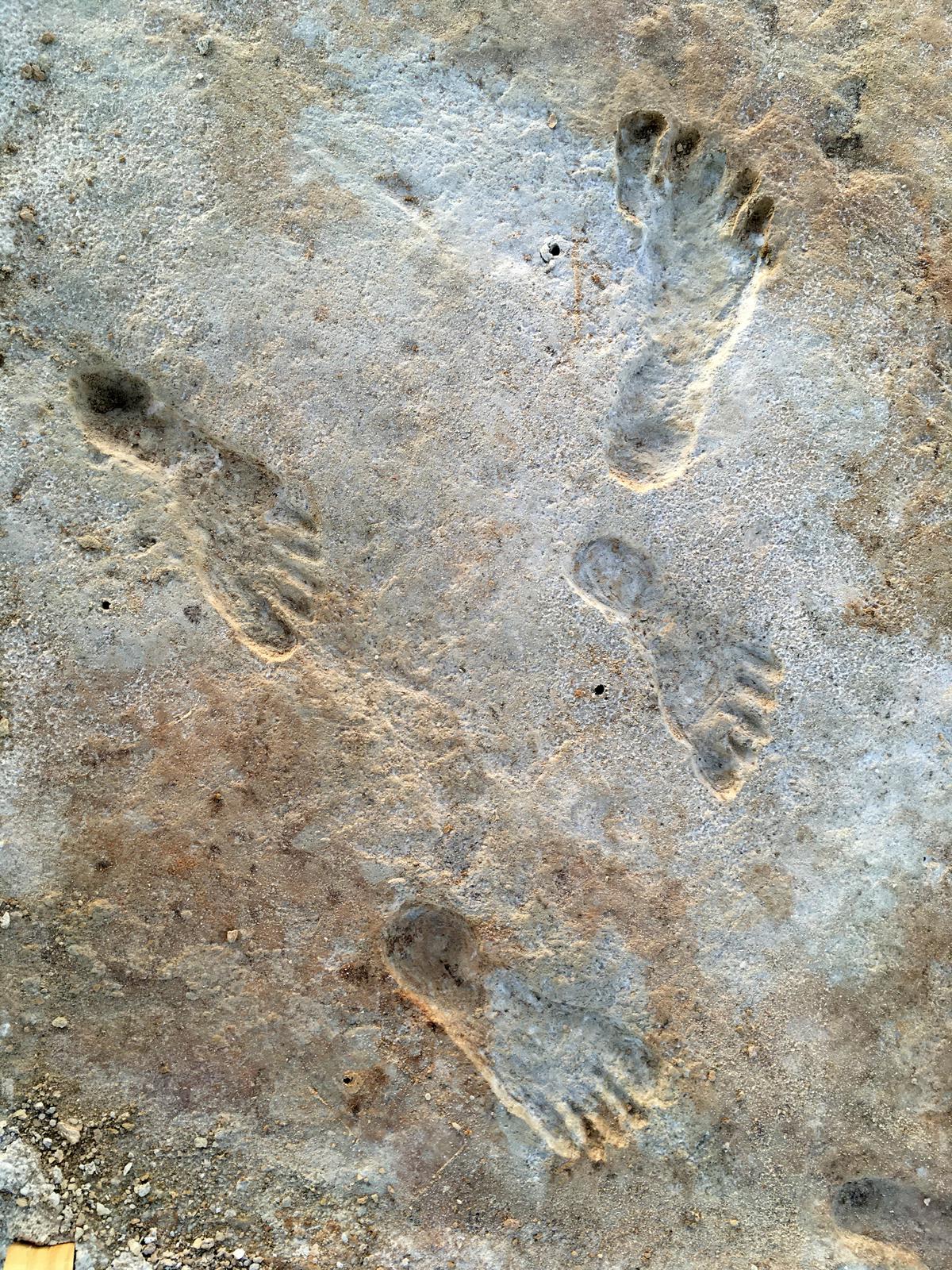
Ancient human footprints at White Sands National Park in New Mexico, U.S., are seen in this undated handout photograph obtained by Reuters on October 5, 2023.

Ancient human footprints at White Sands National Park in New Mexico, U.S., are seen in this undated handout photograph obtained by Reuters on October 5, 2023.
| Photo Credit:
Reuters

“Indigenous peoples were there earlier than thought, before the great ice barrier at the height of the last glacial maximum closed the way south from Alaska. By what route and how they got there is yet to be determined. White Sands is just one point on the map for now,” Bennett said.

The 2021 study dated the footprints using radiocarbon dating to determine the age of seeds of a common aquatic plant called spiral ditchgrass found alongside the fossilized foot impressions.

The technique is used to determine the age of organic material as old as roughly 60,000 years based on the decay of an isotope called carbon-14, a variant of the element carbon. Living organisms absorb carbon-14 into their tissue. After an organism dies, this isotope changes into other atoms over time, providing a metric for determining age.

The fact that aquatic plants can acquire carbon from dissolved carbon atoms in the water, potentially throwing off a dating estimate, caused controversy over the 2021 conclusions.

Also Read | A cooling event 1.1 million years ago doomed early human in Europe

This time, the researchers used radiocarbon dating on conifer pollen, avoiding any concerns about aquatic plants. They isolated thousands of conifer pollen grains from the same sediment layers as the ditchgrass seeds. The pollen age statistically matched the seed age.

The researchers also used optically stimulated luminescence dating to determine the age of quartz grains within the footprint-bearing sediments. This method establishes an object’s age by measuring the amount of energy it has trapped since being buried. It found that the footprint-bearing sediment layers had a minimum age of about 21,500 years.

“The work confirms the chronology we set out in 2021 for the site using independent methods, labs and approaches,” Bennett said.

The footprints – 61 in total – were found at what was a lakeshore.

“People walked on a mosaic of wet and dry ground. There was mud, silt and sand in this lake-edge environment,” Pigati said.

“And just like today, if anyone walks in a similar setting, their footprints are preserved if they are covered with another layer of sediment,” Springer added.


Source link

Science Tags:homo sapiens, human footprints at white sands, Human footprints in new mexico, humans in americas, science, science news

Post navigation

Previous Post: Lens Aim To Build On Memorable Champions League Victory
Next Post: First Heritage Train Starts Operations In Rajasthan, Tickets Priced At…

Related Posts

  • Why scientists are rethinking the chemical ‘arms race’ against fungi
    Why scientists are rethinking the chemical ‘arms race’ against fungi Science
  • ISRO carries out demonstration of restarting Vikas liquid engine
    ISRO carries out demonstration of restarting Vikas liquid engine Science
  • ISRO chief Somnath says space agency prefers woman fighter test pilots for its crewed mission, possible in future
    ISRO chief Somnath says space agency prefers woman fighter test pilots for its crewed mission, possible in future Science
  • Science Quiz: Of things that are, or ought to be, black
    Science Quiz: Of things that are, or ought to be, black Science
  • The “biggest blunder” of Einstein’s life
    The “biggest blunder” of Einstein’s life Science
  • Mummified American climber found 22 years later in Peru as glaciers retreat
    Mummified American climber found 22 years later in Peru as glaciers retreat Science

More Related Articles

Quantum gates: Devices that translate quantum effects to computing awesomeness Quantum gates: Devices that translate quantum effects to computing awesomeness Science
Publish or perish: making sense of India’s research fraud epidemic Publish or perish: making sense of India’s research fraud epidemic Science
What remote-sensing reveals about plants, forests, and minerals from space What remote-sensing reveals about plants, forests, and minerals from space Science
Improving the compatibility of pig organs for transplantation into humans Improving the compatibility of pig organs for transplantation into humans Science
150% customs duty on lab chemicals alarms scientists 150% customs duty on lab chemicals alarms scientists Science
The hidden polluter in your wardrobe: How fast fashion is fuelling the next pollution crisis The hidden polluter in your wardrobe: How fast fashion is fuelling the next pollution crisis Science
SiteLock

Archives

  • October 2026
  • September 2026
  • August 2026
  • July 2026
  • June 2026
  • May 2026
  • April 2026
  • March 2026
  • February 2026
  • January 2026
  • December 2025
  • November 2025
  • October 2025
  • September 2025
  • August 2025
  • July 2025
  • June 2025
  • May 2025
  • April 2025
  • March 2025
  • February 2025
  • January 2025
  • December 2024
  • November 2024
  • October 2024
  • September 2024
  • August 2024
  • July 2024
  • June 2024
  • May 2024
  • April 2024
  • March 2024
  • February 2024
  • January 2024
  • December 2023
  • November 2023
  • October 2023
  • September 2023
  • August 2023
  • July 2023
  • June 2023
  • May 2023
  • April 2023
  • March 2023
  • February 2023
  • January 2023
  • December 2022
  • November 2022
  • October 2022
  • September 2022
  • August 2022
  • July 2022
  • June 2022
  • May 2022

Categories

  • Business
  • Nation
  • Science
  • Sports
  • World

Recent Posts

  • Private bus operators to begin indefinite hunger strike on October 27
  • Yemen’s Houthis vow more attacks on Saudi airports, oil facilities after Aramco HQ hit
  • Ranji Trophy | Assam weathers Punjab’s push for an outright win
  • BJP party worker killed in Bengaluru as high-end car rams gas tanker near Devanahalli; three injured
  • Rupee rises 19 paise to close at 95.17 against U.S. dollar

Recent Comments

  1. RobertTes on UP Teacher Who Asked Students To Slap Muslim Classmate
  2. Manuelret on UP Teacher Who Asked Students To Slap Muslim Classmate
  3. RobertTes on UP Teacher Who Asked Students To Slap Muslim Classmate
  4. RobertTes on UP Teacher Who Asked Students To Slap Muslim Classmate
  5. BrentWes on UP Teacher Who Asked Students To Slap Muslim Classmate
  • Access Denied Sports
  • Indian women vs South Africa women second ODI: India will look for unassailable lead against South Africa
    Indian women vs South Africa women second ODI: India will look for unassailable lead against South Africa Sports
  • Two Smugglers Arrested With Opium Worth Rs 2.35 Crore In Rajasthan: Cops
    Two Smugglers Arrested With Opium Worth Rs 2.35 Crore In Rajasthan: Cops Nation
  • Access Denied Sports
  • Access Denied Sports
  • Access Denied Sports
  • Access Denied Business
  • Majority blue-collar jobs pay less than Rs 20,000 per month: Report
    Majority blue-collar jobs pay less than Rs 20,000 per month: Report Business

Editor-in-Chief:
Mohammad Ariff,
MSW, MAJMC, BSW, DTL, CTS, CNM, CCR, CAL, RSL, ASOC.
editor@artifex.news

Associate Editors:
1. Zenellis R. Tuba,
zenelis@artifex.news
2. Haris Daniyel
daniyel@artifex.news

Photograher:
Rohan Das
rohan@artifex.news

Associate Journalists
1. Subrata Paul - AN/2020/01
2. Quamruz Zaman - AN/2021/22
3. Ahmed Sha - AN/2021/035
4. Ajay Kumar Shaw - AN/2021/39
5. Tahqiqul Hoda - AN/2021/21

Artifex.News offers Online Paid Internships to college students from India and Abroad. Interns will get a PRESS CARD and other online offers.
Send your CV (Subjectline: Paid Internship) to internship@artifex.news

Links:
Associate Journalism
About Us
Privacy Policy

News Links:
Breaking News
World
Nation
Sports
Business
Entertainment
Lifestyle

Registered Office:
72/A, Elliot Road, Kolkata - 700016
Tel: 033-22277777, 033-22172217
Email: office@artifex.news

Editorial Office / News Desk:
No. 13, Mezzanine Floor, Esplanade Metro Rail Station,
12 J. L. Nehru Road, Kolkata - 700069.
(Entry from Gate No. 5)
Tel: 033-46011099, 033-46046046
Email: editor@artifex.news

Copyright © 2023 Artifex.News Newsportal designed by Artifex Infotech.