



Most of us aren’t spending our days watching our houseplants grow. We see their signs of life only occasionally – a new leaf unfurled, a stem leaning toward the window.
But in the summer of 1863, Charles Darwin lay ill in bed, with nothing to do but watch his plants so closely that he could detect their small movements to and fro. The tendrils from his cucumber plants swept in circles until they encountered a stick, which they proceeded to twine around.
“I am getting very much amused by my tendrils,” he wrote.
This amusement blossomed into a decades-long fascination with the little-noticed world of plant movements. He compiled his detailed observations and experiments in a 1880 book called “The Power of Movement in Plants.”
In one study, he traced the motion of a carnation leaf every few hours over the course of three days, revealing an irregular looping, jagged path. The swoops of cucumber tendrils and the zags of carnation leaves are examples of inherent, ubiquitous plant movements called circumnutations – from the Latin circum, meaning circle, and nutare, meaning to nod.
Circumnutations vary in size, regularity and timescale across plant species. But their exact function remains unclear.
I’m a physicist interested in understanding collective behavior in living systems. Like Darwin, I’m captivated by circumnutations, since they may underlie more complex phenomena in groups of plants.
Sunflower patterns
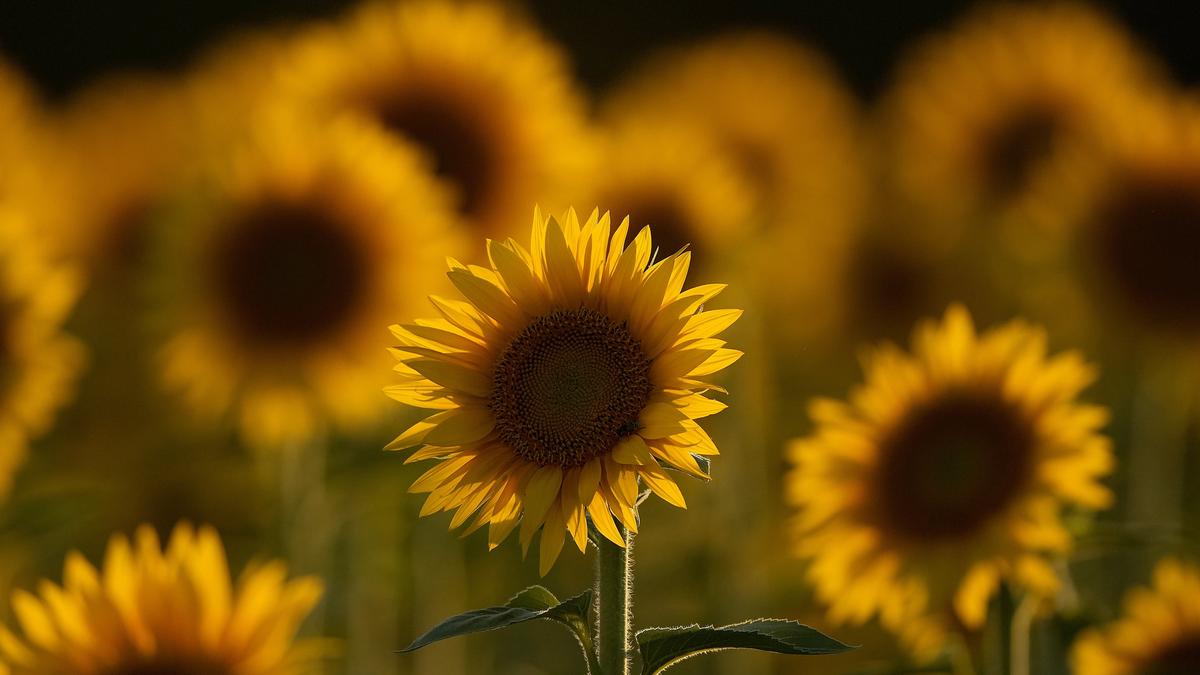
A 2017 study revealed a fascinating observation that got my colleagues and me wondering about the role circumnutations could play in plant growth patterns. In this study, researchers found that sunflowers grown in a dense row naturally formed a near-perfect zigzag pattern, with each plant leaning away from the row in alternating directions.
This pattern allowed the plants to avoid shade from their neighbors and maximize their exposure to sunlight. These sunflowers flourished.
Researchers then planted some plants at the same density but constrained them so that they could grow only upright without leaning. These constrained plants produced less oil than the plants that could lean and get the maximum amount of sun.
While farmers can’t grow their sunflowers quite this close together due to the potential for disease spread, in the future they may be able to use these patterns to come up with new planting strategies.
Self-organization and randomness
This spontaneous pattern formation is a neat example of self-organization in nature. Self-organization refers to when initially disordered systems, such as a jungle of plants or a swarm of bees, achieve order without anything controlling them. Order emerges from the interactions between individual members of the system and their interactions with the environment.
Somewhat counterintuitively, noise – also called randomness – facilitates self-organization. Consider a colony of ants.
Ants secrete pheromones behind them as they crawl toward a food source. Other ants find this food source by following the pheromone trails, and they further reinforce the trail they took by secreting their own pheromones in turn. Over time, the ants converge on the best path to the food, and a single trail prevails.
But if a shorter path were to become possible, the ants would not necessarily find this path just by following the existing trail.
If a few ants were to randomly deviate from the trail, though, they might stumble onto the shorter path and create a new trail. So this randomness injects a spontaneous change into the ants’ system that allows them to explore alternative scenarios.
Eventually, more ants would follow the new trail, and soon the shorter path would prevail. This randomness helps the ants adapt to changes in the environment, as a few ants spontaneously seek out more direct ways to their food source.
In biology, self-organized systems can be found at a range of scales, from the patterns of proteins inside cells to the socially complex colonies of honeybees that collectively build nests and forage for nectar.
Randomness in sunflower self-organization
So, could random, irregular circumnutations underpin the sunflowers’ self-organization?
My colleagues and I set out to explore this question by following the growth of young sunflowers we planted in the lab. Using cameras that imaged the plants every five minutes, we tracked the movement of the plants to see their circumnutatory paths.
We saw some loops and spirals, and lots of jagged movements. These ultimately appeared largely random, much like Darwin’s carnation. But when we placed the plants together in rows, they began to move away from one another, forming the same zigzag configurations that we’d seen in the previous study.
We analyzed the plants’ circumnutations and found that at any given time, the direction of the plant’s motion appeared completely independent of how it was moving about half an hour earlier. If you measured a plant’s motion once every 30 minutes, it would appear to be moving in a completely random way.
We also measured how much the plant’s leaves grew over the course of two weeks. By putting all of these results together, we sketched a picture of how a plant moved and grew on its own. This information allowed us to computationally model a sunflower and simulate how it behaves over the course of its growth.
A sunflower model
We modeled each plant simply as a circular crown on a stem, with the crown expanding according to the growth rate we measured experimentally. The simulated plant moved in a completely random way, taking a “step” every half hour.
We created the model sunflowers with circumnutations of lower or higher intensity by tweaking the step sizes. At one end of the spectrum, sunflowers were much more likely to take tiny steps than big ones, leading to slow, minimal movement on average. At the other end were sunflowers that are equally as likely to take large steps as small steps, resulting in highly irregular movement. The real sunflowers we observed in our experiment were somewhere in the middle.
Plants require light to grow and have evolved the ability to detect shade and alter the direction of their growth in response.
We wanted our model sunflowers to do the same thing. So, we made it so that two plants that get too close to each other’s shade begin to lean away in opposite directions.
Finally, we wanted to see whether we could replicate the zigzag pattern we’d observed with the real sunflowers in our model.
First, we set the model sunflowers to make small circumnutations. Their shade avoidance responses pushed them away from each other, but that wasn’t enough to produce the zigzag – the model plants stayed stuck in a line. In physics, we would call this a “frustrated” system.
Then, we set the plants to make large circumnutations. The plants started moving in random patterns that often brought the plants closer together rather than farther apart. Again, no zigzag pattern like we’d seen in the field.
But when we set the model plants to make moderately large movements, similar to our experimental measurements, the plants could self-organize into a zigzag pattern that gave each sunflower optimal exposure to light.
So, we showed that these random, irregular movements helped the plants explore their surroundings to find desirable arrangements that benefited their growth.
Plants are much more dynamic than people give them credit for. By taking the time to follow them, scientists and farmers can unlock their secrets and use plants’ movement to their advantage.
This article is republished from The Conversation under a Creative Commons license. Read the original article.
Published – September 18, 2024 12:41 pm IST