




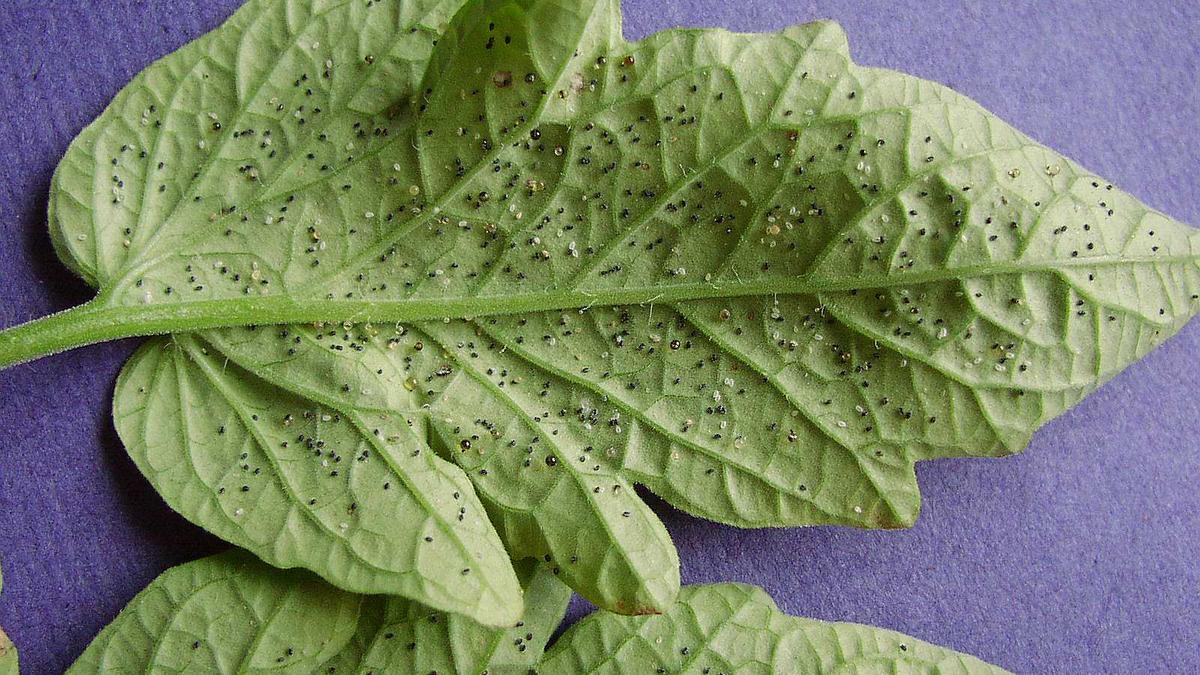
Tomato leaf with whitefly nymphs (white) parasitised by Encarsia formosa wasps (black), May 17, 2003. These wasps were among the world’s first agents of biological pest control.
| Photo Credit: Goldlocki (CC BY-SA 3.0)
A hundred years ago, two American researchers named Marshall Hertig and Simeon Burt Wolbach discovered that mosquitoes harboured bacteria within their cells. Other researchers later found similar bacteria in the cells of most insects and many other arthropods. The genus to which the bacteria belonged was named Wolbachia.
Wolbachia bacteria are also present in insect eggs but they are absent in the sperm. This means females can transmit Wolbachia to their offspring whereas males can’t — from the bacteria’s point of view, an evolutionary dead-end. As a result, Wolbachia have evolved ways to manipulate their insect hosts to produce more female than male progeny.
A new study reports that the bacteria may have taken it a bit too far this time. Researchers from Shenyang Agricultural University (SAU), China, published a paper in the June 3 issue of the journal Current Biology showing that Wolbachia bacteria had manipulated the wasp Encarsia formosa to entirely get rid of its males.
The farmer-friendly amazon
E. formosa wasps are of interest to agricultural scientists because they provide an efficient way to control whiteflies. Whiteflies feed on the sap of plant leaves, causing productivity losses, and are thus a major agricultural pest. Whiteflies belong to the insect order Hemiptera whereas wasps belong to the insect order Hymenoptera. The wasp seeks out the nymphs (or larvae) of whiteflies and lays its eggs on them. When the eggs hatch, the larvae that emerge penetrate the nymph, feed on its tissues, grow to adulthood, and in the process kill the nymph.
The progeny wasps emerge from the nymph’s carcass. As a parasitoid of whiteflies, the female wasp is in effect a search and destroy weapon. The male wasps are superfluous to this role.
Doubling up with Wolbachia
Generally, among hymenopterans such as ants, bees, and wasps, the eggs fertilised by sperm cells develop into females while unfertilised eggs develop into males. The males contain only one set of chromosomes, derived from the egg, and are thus said to be haploid. In contrast, the females are diploid because they contain two sets of chromosomes: one set derived from the egg and the other from the sperm.
The females use a specialised form of cell division called meiosis to transmit only one set of chromosomes to their eggs, while the males transmit their single chromosome set to all of their sperm by the more general cell-division process called mitosis. This, in a nutshell, is how haplo-diploid sex determination works.
The SAU researchers noticed that in the wild the E. formosa wasp almost never produced males. In the laboratory, however, they found that if the female wasp was treated with an antibiotic (usually tetracycline), almost 70% of the progeny were male.
(They are easy to identify with the eye. The females are tiny — about 0.6 mm long — and are black with a yellow abdomen; the males are only slightly larger but completely black.)
The reason for this was that antibiotic treatment reduced the titre, or concentration, of the Wolbachia bacteria. As a result, the chromosome number remained un-doubled and the eggs developed into males.
That is, normal titres of Wolbachia bacteria could induce unfertilised eggs to somehow double the chromosome number and enable the development of female wasps. We don’t (yet) know how the bacteria do this, but again this action rendered the males superfluous.
The findings are of interest even to scientists whose primary interest is not whitefly control.
A coleoptera gene to the rescue
A gene named tra has an evolutionarily conserved role in promoting female development in insects. (‘Evolutionarily conserved’ means all insects have it.) That is, if the tra gene mutates, cells won’t be able to make a functional Tra protein, and progeny development proceeds along the default mode towards male production.
The SAU researchers found that the tra gene in the E. formosa genome was missing some ‘pieces’ important for its function. How then did the female wasps develop?
The researchers found the genome of the wasp’s Wolbachia bacteria contained a functional version of tra. Ordinarily, bacteria don’t have any reason to possess a tra gene. But the wasp’s Wolbachia acquired one from a distantly related insect, one belonging to the order coleoptera, which includes beetles. That is, the bacteria had acquired the gene through horizontal gene transfer.
Having lost its own tra gene, the E. formosa wasps had to rely on their Wolbachia’s tra gene to allow its eggs to develop into females. This is the first example of a bacterium using a horizontally transferred gene to manipulate female production in an insect.
No males, no species
The males produced by the SAU researchers after antibiotic treatment didn’t mate with females and didn’t inseminate them. This could be because the males were absent from E. formosa populations for so long that they have now lost their ability to mate. An alternative possibility is that the inability to mate was an unintended consequence of antibiotic treatment.
To resolve these two possibilities, scientists will now need to examine those rare naturally produced males to know whether at least a fraction of them can engage in sex with females. If sexual exchange is absolutely missing in the wasp, the species will no longer have the ability to purge bad mutations that accumulate in its genome. In this case, the wasp-Wolbachia duo faces a relatively early extinction.
The Wolbachia bacteria were shown to be smart enough to double the chromosome number in their host’s unfertilised eggs and to supply them with tra. But are they also smart enough to occasionally allow a few males to emerge and enable sexual exchange and thus delay their own extinction?
D.P. Kasbekar is a retired scientist.