





The year was 1948. It had only been about half a century since scientists had rediscovered Gregor Mendel’s work on inheritance in pea plants. This year, a scientist working on the genetics of the maize plant would challenge the then prevailing concept that genes are stable and arranged in an orderly manner on the chromosome. Barbara McClintock at the Carnegie Institution found that some genes were able to move around within the genome. These genes were called mobile elements or transposons.
Prof. McClintock also made another significant observation: depending on where the mobile elements were inserted, they had the ability to reversibly alter gene expression. She used corn kernels’ colours as a surrogate to understand hereditary characteristics, and this way figured out transposons moved about in the genome of the maize plant. She was awarded the Nobel Prize in Physiology or Medicine in 1983 for this work.
Between 1948 and 1983, researchers found transposons in an array of life-forms, including bacteriophages, bacteria, plants, worms, fruit flies, mosquitos, mice, and humans. They were nicknamed ‘jumping genes’.
‘Sleeping beauty’ transposon
The discovery of transposons revolutionised our understanding of genetics, in particular their role in enabling nature’s wondrous diversity. Transposons influence the effects of genes by turning ‘on’ or ‘off’ their expression using a variety of epigenetic mechanisms. They are thus rightly called the tools of evolution, for their ability to rearrange the genome and introduce changes.
More than 45% of the human genome consists of transposable elements. Just as they create diversity, they also create mutations in genes and lead to diseases. However, most of the transposons have themselves inherited mutations and have become inactive, and thus can’t move around within the gnome.
Over the years, researchers have attempted to resurrect inactive transposons from the genomes of the animal kingdom, hoping that the results will be useful in biomedical applications like genetic correction to cure a disease or for gene therapy.
For example, in 1997, researchers studied the genomes of fish and reconstructed a transposon called ‘sleeping beauty’ at the molecular level. This transposon became dormant in vertebrates millions of years ago. The researchers elegantly reprogrammed the synthetic avatar to work in human cells. In future, a similar synthetic transposon inspired by nature may be able to turn off a problem gene or over-express another to accentuate some desirable characteristic.
Researchers have already discovered several naturally occurring vertebrate transposons and continue to look for more.
RNA-guided transposons
On June 26, Naturepublished a paper by researchers at the University of California, Berkeley, and the Arc Institute in the U.S. describing a new RNA-guided gene editing system. This tool builds on an older discovery: that one of the genes in the IS110 family of bacterial transposons contains the instructions for cells to make an RNA molecule with two loops.
Scientists found this RNA could bind to two pieces of DNA, rather than the usual one piece, and form a bridge between them. This is a very useful ability.
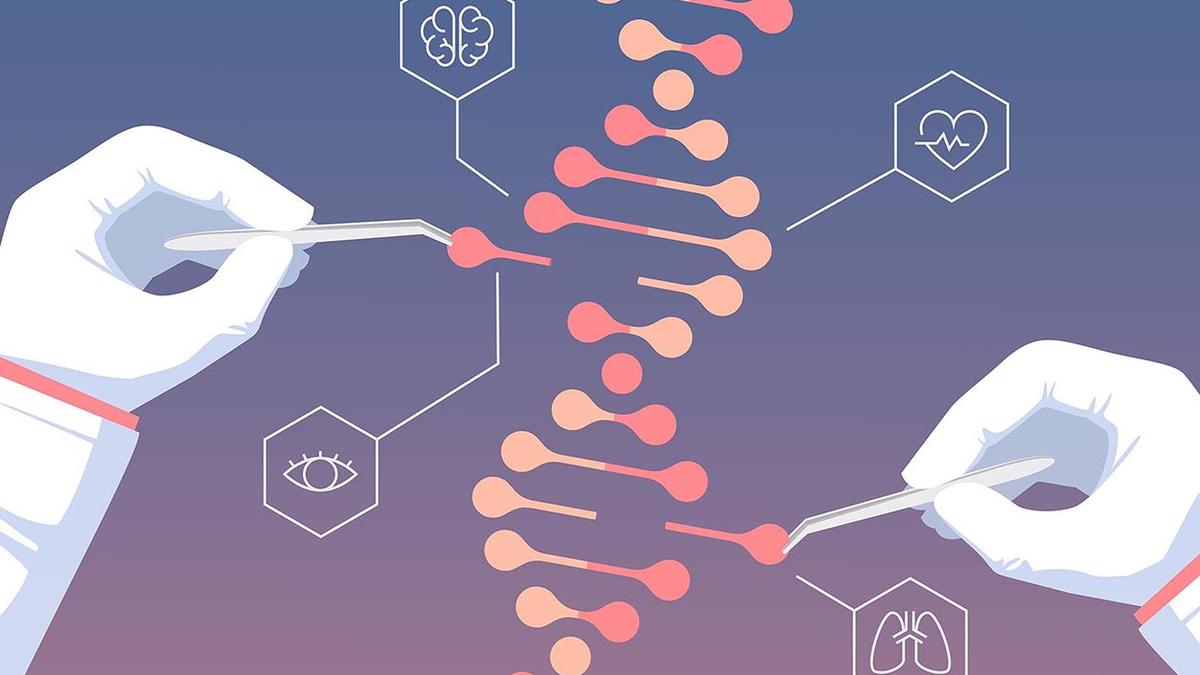
In the new study, the researchers used the bridge RNA to edit the DNA. The two loops of the RNA can independently bind to two separate pieces of DNA. One of the loops identifies the target site in the genome that needs to be altered. The other loop specifies the DNA to be inserted in its place. Each loop is independently programmable, which means researchers can mix and match any target and donor DNA sequences of interest.
In their paper, they reported that in Escherichia coli bacteria, the bridge RNA had more than 60% insertion efficiency (i.e. ability to introduce a desired gene) and a 94% specificity (ability to target the intended location on the genome).

Boon for synthetic biology
In a separate paper published on the same day, researchers from the University of Tokyo described the structural and molecular mechanisms of genome modification guided by bridge RNA. The researchers used cryo-electron microscopy to study the IS110 transposons. They found that it works as a dimer — a complex compound formed by bonding two copies of a simpler compound. One copy binds to the target DNA and the other binds to the donor DNA, bridged by the bridge RNA.
This alternative form of genome-editing has many advantages. CRISPR-mediated editing sometimes leaves small bits of nucleotides added/deleted during the repair process. DNA recombination mediated by bridge RNA on the other hand makes a clean cut, making the edit specific and tidy. Equally importantly, the latter can facilitate the addition, deletion or inversion of DNA sequences of virtually any length. Researchers can exploit this feature by inserting any desirable genetic cargo — such as a functional copy of a faulty, disease-causing gene — into any location on a genome.
Such an ability spells a big boon for synthetic biology, where entire sets of genes need to be inserted or removed from organisms. Similarly, the technique can be used to manage, or even treat, a wide variety of genetic diseases: a functional copy of a gene can be replaced in a given genomic location. Researchers may also be able to treat chromosomal inversions or deletions, which are currently beyond the reach of any of the editing tools we have.
As Prof. McClintock said in her Nobel Prize lecture in 1983: “Unquestionably we will emerge from this revolutionary period with modified views of components of cells and how they operate, but only, however, to await the emergence of the next revolutionary phase that again will bring startling changes in concepts.”
The authors are senior consultants at the Vishwanath Cancer Care Foundation and adjunct professors at IIT, Kanpur and the Dr. D.Y. Patil Medical College, Hospital and Research Center, Pune.