



The story so far:
China, at the start of this month announced more measures to revive its flagging economy with major banks clearing the path for additional cuts in lending rates and the amount of funds institutions require to hold in foreign exchange reserves, hoping to prevent a further downturn in the ailing property sector. The Communist Party government seems to be scrambling to ramp up economic support and stimulus amid tumbling exports, a slide into deflation, record-high youth unemployment, and a battered real-estate sector.
How bad is China’s slowdown?
Economic data coming out of Beijing over the past months indicate that all is not well with the world’s second largest economy, which was expected to spring back and drive global growth after three years of grinding restrictions under President Xi-Jinping’s zero-COVID policy. GDP grew just 0.8% in the second quarter as against the first three months of this year, and the projected annual growth now seems to be closer to 3%, among the weakest in the last three decades.
As China reopened in late 2022 with the lifting of strict pandemic curbs, economists expected Chinese consumers to engage in a spending spree and private businesses to pump in money resulting in a rebound to pre-pandemic growth levels and a ripple effect on the global economy. Notably, the Chinese economy did show initial signs of recovery in the first few months of this year with pent up demand manifesting in local tourism, retail and export growth, with even the ailing real-estate sector seeming to have bottomed out.
However, economic indicators by the end of the second quarter told a different story — figures on August 8 showed that the country suffered its biggest fall in exports in more than three years. China’s exports declined from a record high of $340 billion in December 2021 to $284 billion in May 2023. The July export numbers were even more alarming, having plunged by 14.5% compared to the year-ago period. Exports fell to $281.8 billion as the decline widened from June’s 12.4% fall, customs data showed. Imports too tumbled 12.4% from a year earlier to $201.2 billion in a sign of weak domestic demand, widening from the previous month’s 6.8% contraction. The country’s global trade surplus narrowed by 20.4% from a record high a year ago to $80.6 billion.
Then came the grim Consumer Price Index (CPI) figures. China slipped into deflation as consumer prices contracted in July for the first time in more than two years with the CPI falling 0.3% after flatlining in June. Deflation refers to falling prices of goods and services and is caused by a number of factors, including waning consumption. And while cheaper goods may appear beneficial for purchasing power, a lack of demand forces companies to reduce production, freeze hiring or lay off workers, and agree to new discounts to sell off their stocks.
Another sign of the slowdown was evident when youth unemployment hit a record high of almost 21% in June, which is four times the national urban rate. Notably, Beijing suspended the publication of the youth unemployment rate this month. Meanwhile, national debt and that at the local government level is piling up.
How did it get here?
Analysts say that while the harsh curbs under the zero-COVID policy may have been the catalysing force behind the deceleration of the economy, the unravelling of China’s 40-year-old economic model driven by debt-fuelled investments and exports was a long time coming.
About five decades ago, China’s economy was considered, as the Centre on Foreign Relations put it, an “economic afterthought”. Decades of state ownership and central planning under Mao Zedong left China rural and impoverished. During the 1970s, when the country was facing acute underinvestment across multiple sectors, Deng Xiaoping’s reforms opened up the economy. This encouraged the formation of rural enterprises and private businesses, and liberalised foreign trade and investment. Post-1978 China saw average real growth of more than 9% and in several peak years, the economy grew more than 13%, in what was referred to as Beijing’s growth miracle.
However, the policy focused predominantly on supply, not demand, meaning the growth in China’s GDP was fuelled by investments, not domestic consumption. Notably, unlike major economies, where GDP growth is conventionally perceived as an indicator of economic performance, China’s growth target is a predetermined objective set by Beijing at the outset of each year, which local governments, the property sector and other sectors have to meet through delivering enough economic activity. Michael Pettis, professor of finance at Peking University in Beijing said that, “filling this gap was easy during the period from the late 1970s to the 2000s when the economy opened up and there was underinvestment in various sectors.” The government spent money on roads, railways and airports, while banks lent more to state-dominated industries than to consumers. Mr. Pettis notes that more than a decade ago, the gap between the investment China had and the investment its economy could constructively absorb was mostly filled, which is when measures to bring down production and reshape the economy to widen consumption should have been taken.
Mr. Pettis also points out that while many economies have followed an investment-driven development model, China’s reliance on it was extreme. Investment was nearly 50% of its GDP, while household consumption in 2010 was just 34%. Globally, the average for household consumption in GDP is about 60%, being around 70% in the U.S. World Bank data shows that investment as a share of China’s GDP is almost 20 percentage points above the global average, while household consumption is almost 20 points below.
In fact, the Communist Party under President Xi has acknowledged this. In an essay last year, the Chinese President called for more “genuine,” not “inflated,” growth. A Carnegie Endowment paper notes that “genuine growth can be thought of as sustainable growth generated largely by consumption, exports, and business investment (with the last of these elements aimed mostly at serving the first two), whereas “inflated” growth consists mainly of nonproductive, or insufficiently productive, investment in infrastructure and real estate”. Analysts say the government will have to pivot towards a consumption-led model in order to manoeuvre out of the slowdown, which means putting more money in the hands of consumers instead of mobilising it for investments.
The inflated growth through mobilisation of resources and debt has in turn led to more debt. While this debt was not alarming, since the investments were productive, it began to accumulate when investments became unproductive, ballooning to 300% of the GDP. Besides, the trade war between the U.S. and China and policies such as ‘de-risking’ and ‘China +1’ (that seeks alternate production destinations for investments accelerated the slowdown.
What does China’s real estate sector have to do with the slowdown?
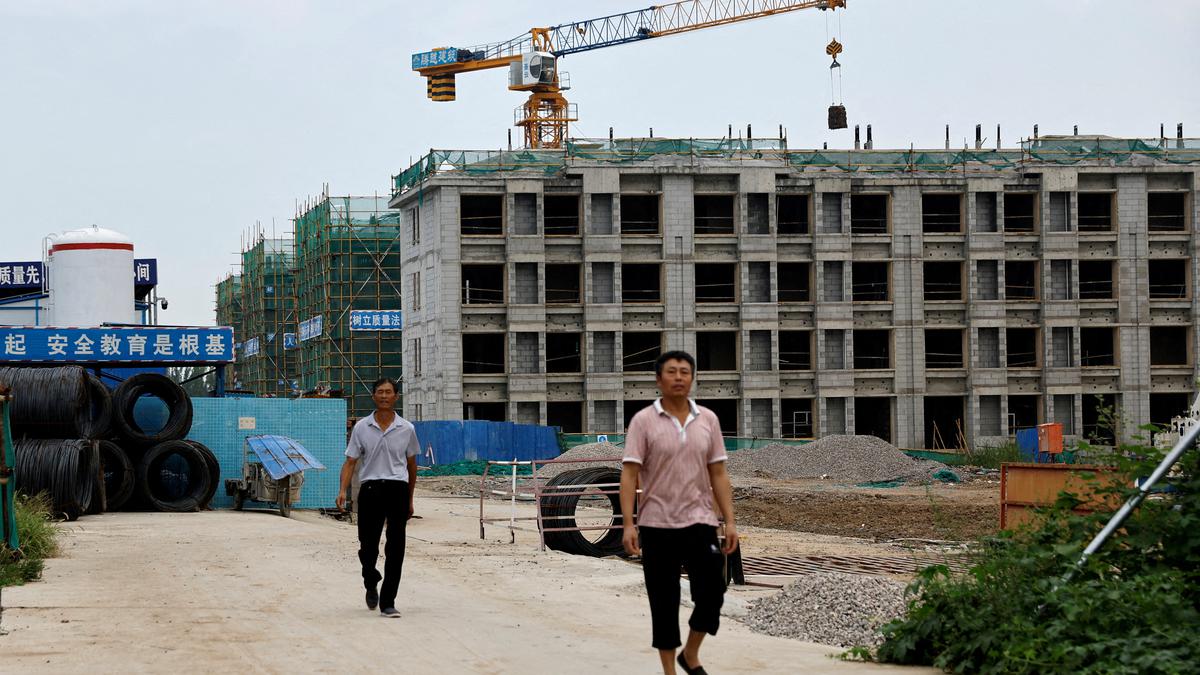
The unravelling of the economic model is most visible in the debt spiral and slump of China’s property sector, which followed the same growth path as the economy. Statistical estimates from America’s National Bureau of Economic Research indicate that real estate, including allied activities, contributes as much as 29% to China’s GDP and has been a key driver of its sustained economic growth. Thus, as the growth model of the economy began to falter, the bubble in one of its key driving sectors, real estate, also burst.
Around 70% of household wealth in China is stored in property. Speculating consumer demand in this sector, property developers in China over the decades, used the method of buying land, getting loans on it to start construction, and then secured money from home buyers in pre-sales of unfinished homes, allowing those funds to fund other projects. However, companies had borrowed alarming amounts by 2020, raising fears of repayment and their ability to deliver unfinished houses to consumers who had been paying mortgages. The government that year cracked down on overleveraged developers through its “three red lines” regulation, which categorised developers based on how much debt they hold.
However, in 2021, when demand for property and new sales dropped drastically, developers were left cash strapped while homeowners boycotted mortgage payments and creditors demanded to be repaid. The snowballing of the current housing crisis can be traced back to the fall of China’s second-largest real estate developer in terms of total sales — the Evergrande Group in 2021. The conglomerate breached all three debt thresholds in the red lines system and defaulted on its $300 billion debt. Since then, companies accounting for 40% of Chinese home sales have defaulted, most of them private property developers.
The most recent manifestation of China’s real estate troubles is in the liquidity crisis at Country Garden, once the country’s largest property developer. Country Garden has nearly one million homes to complete, according to Japanese investment bank Nomura. While its total liabilities of 1.4 trillion yuan ($191.7 billion) are only 59% as big as those at Evergrande, the world’s most indebted developer, it has 3,121 projects across all China’s provinces, compared to around 800 for Evergrande. The crisis comes at a time when the sector is in worse shape and the economy is flagging, meaning any default the firm makes raises fears of financial contagion.
While the Communist Party Government has rolled out piecemeal measures to encourage house sales and provide stimulus to the sector, full scale bailouts for embattled developers have not been announced so far. While the government has reiterated its stance that “house are for living in, not for speculation”, analysts expect drastic policy measures to contain the downward spiral in the property sector.
What did government control have to do with the current economic slowdown?
Since the early 1980s, subsequent governments under the Chinese Communist Party (CCP) have held an implicit policy of “no politics, no problem”, notes Peterson Institute for International Economics President Adam Posen in the Foreign Affairs magazine. This meant that “as long as people stayed out of politics, the party would stay out of their economic life”. However, most scholars of China have doubted the Chinese economy’s ability to be truly innovative while the party wants to control what the capitalists can and cannot do. When Mr. Xi took office in 2013, while making the promise of allowing the markets play a greater role in the allocation of resources during the third plenum of the 18th Central Committee, he also embarked on an aggressive anti-corruption campaign. Observers say the government has rolled back many of the promises made then. It was hoped then that political interventions in loans and investment decisions would reduce. A few years later came the President’s crackdown on the tech industry. Then came China’s harsh zero-COVID policy and until now, the general populace which remained to an extent directly unaffected by the earlier crackdowns was now forced to let the decide for itself in the very fundamental economic spheres.
While Chinese consumer behaviour started showing a shift since 2015 in that consumers were more wary of letting go of their cash as the state extended its control, the breaking point came during the pandemic. Private-sector consumption of durable goods is down by around a third versus early 2015, continuing to decline since reopening rather than reflecting pent-up demand. Private investment is even weaker, down by a historic two-thirds since the first quarter of 2015, including a decrease of 25 percent since the pandemic started. Recent data from the second quarter of the year also suggests that people and companies have become even more cash conscious and are holding onto their cash. This has impacted consumer spending and domestic demand has not been able to contribute heavily to the economic output.
Why is China’s slowdown a concern?
Dhaval Joshi of BCA Research pointed out in a report by The Guardian that China has generated 41% of the world’s growth in the past decade, nearly twice the 22% contribution from the U.S., and way more than the 9% contribution from the euro area. This means that China has generated 1.1 percentage points of the 2.6% real growth rate of the world economy. It made up this big chunk of the global growth because its economy was growing at about 8-9% a year. Now that its growth rate is half of that — its contribution would also be halved to about 0.5 points.