



Skip to content
  • Facebook
  • X
  • Linkedin
  • WhatsApp
  • YouTube
  • Associate Journalism
  • About Us
  • Privacy Policy
  • 033-46046046
  • editor@artifex.news
Artifex.News

Artifex.News

Stay Connected. Stay Informed.

  • Breaking News
  • World
  • Nation
  • Sports
  • Business
  • Science
  • Entertainment
  • Lifestyle
  • Toggle search form
  • Teenager becomes first Congo virus fatality in Pakistan’s Karachi
    Teenager becomes first Congo virus fatality in Pakistan’s Karachi World
  • Hundreds Feared Trapped As Massive Landslides Hit Kerala’s Wayanad
    Hundreds Feared Trapped As Massive Landslides Hit Kerala’s Wayanad Nation
  • Access Denied
    Access Denied Nation
  • Access Denied
    Access Denied Nation
  • People jump into sea to escape raging ferry fire in Gulf of Thailand; all 108 on board safe
    People jump into sea to escape raging ferry fire in Gulf of Thailand; all 108 on board safe World
  • 2 Wickets In 2 Balls: Venkatesh Iyer Guides Lancashire To Thrilling Win vs Worcestershire
    2 Wickets In 2 Balls: Venkatesh Iyer Guides Lancashire To Thrilling Win vs Worcestershire Sports
  • Access Denied Sports
  • Access Denied World
Laser strums atoms trillions of times in search for better computers

Laser strums atoms trillions of times in search for better computers

Posted on June 22, 2026 By admin


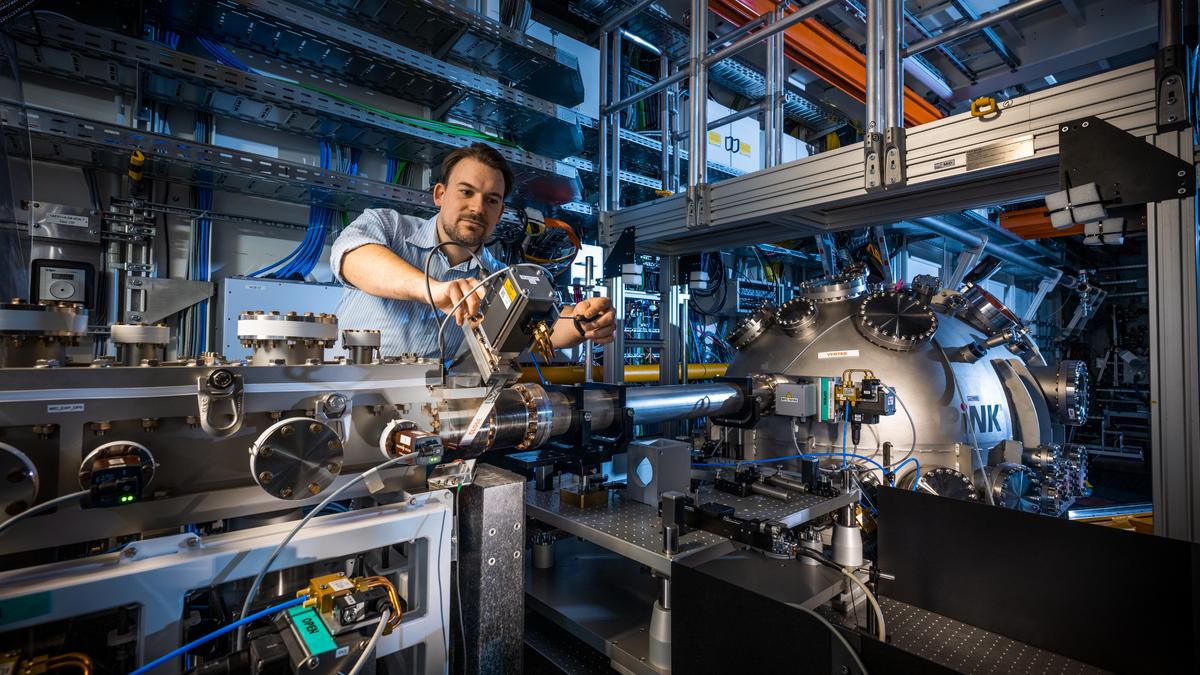
A scientist works on the MID instrument that researchers used in a new study to ‘see’ atoms vibrated by a laser pulse.
| Photo Credit: European XFEL/Jan Hosan

The world is constantly looking for faster and more efficient computers. Since the technologies of today have nearly maximised the use of electric currents for this purpose, scientists are looking beyond. One critical area that may fit our needs is called strain engineering: it uses mechanical pressure at the atomic level to alter a material’s properties.

That is, by physically squeezing or stretching the grid of atoms — called the lattice — scientists can change how a material conducts electricity or stores magnetic information.

To reach the speeds required for next-generation technology, however, these mechanical changes must happen trillions of times per second, or at terahertz (THz) frequencies.

The main challenge to high-frequency strain engineering in metals is the behaviour of free electrons. When a metal is struck by a fast laser pulse, the electrons absorb the energy. In most metals, these electrons move so quickly that they spread the energy across the material before the pulse can exert a localised mechanical force. This delocalisation prevents the formation of high-frequency strain waves.

In particular, THz-frequency vibrations are needed for advanced applications like spintronics — a field that uses the magnetic spin of electrons rather than their charge to store and move data.

‘That surprised us’

A new study by researchers from France, Germany, and Sweden, published in Nature Communications, has reported a way to use laser pulses to induce THz waves. The researchers used a superlattice: atoms of platinum and copper atoms arranged in alternating layers, each just a few nanometres thick. They chose these metals because of their contrasting electronic properties: platinum can hold a large amount of electronic energy while copper allows electrons to move quickly.

Using ultrafast X-ray diffraction, the team observed the atoms moving in real-time following a laser pulse. And they found that they could set the atoms vibrating in a coherent way at a frequency of 1 THz with a strain amplitude of 1%. That is, the atoms were displaced by 1% on average from their original positions. This is considered large.

Crucially, the team found that electron pressure, rather than heat, to be the driving force. When the laser hit the platinum layers, the electrons gained energy and immediately exerted a physical pressure against the atomic lattice.

“That surprised us. The oscillation is not caused by the pressure of the heated lattice, but by electron pressure, particularly in the platinum layers,” Jan-Etienne Pudell of European XFEL, the facility that provided the ultrafast X-ray diffraction, said in a press note.

The study showed that electron pressure is a dominant and engineerable mechanism that can be used to rapidly ‘kick’ atoms into motion.

Nanostructured materials

The discovery is an advance in the broader field of thermoacoustic metamaterials. These are nanostructured materials designed to manipulate sound and heat in ways that do not occur in nature.

The study also demonstrated that these effects can be achieved in materials created by sputtering. Sputtering is a standard industrial process used to coat everything from microchips to glass. That thermoacoustic metamaterials can be produced using cost-effective, scalable manufacturing suggests the technology could move from the laboratory to the factory floor relatively quickly.

Published – June 22, 2026 10:32 am IST



Source link

Science

Post navigation

Previous Post: One more shigella death, seven fresh cases reported in Kerala
Next Post: Rupee falls 15 paise to 94.48 against U.S. dollar in early trade

Related Posts

  • Chandrayaan-3 | ISRO one step away from landing on Moon as Lander Module completes second deboost operation  
    Chandrayaan-3 | ISRO one step away from landing on Moon as Lander Module completes second deboost operation   Science
  • Can use genomic labs set up during pandemic to measure antimicrobial resistance: Soumya Swaminathan
    Can use genomic labs set up during pandemic to measure antimicrobial resistance: Soumya Swaminathan Science
  • A new era of Indian ecology looks to its horizons, and to the ground
    A new era of Indian ecology looks to its horizons, and to the ground Science
  • Union Minister Suresh Gopi meets ISRO officials in Bengaluru 
    Union Minister Suresh Gopi meets ISRO officials in Bengaluru  Science
  • PM Modi I-Day speech: India working towards having its own space station, says Modi
    PM Modi I-Day speech: India working towards having its own space station, says Modi Science
  • Science quiz | Poisons that became medicines
    Science quiz | Poisons that became medicines Science

More Related Articles

Science quiz on holiday spots for the really, really brave Science quiz on holiday spots for the really, really brave Science
Traditional diets shape unique gut microbes of Indian tribes Traditional diets shape unique gut microbes of Indian tribes Science
Shielding humans alone won’t prevent pandemics if animals can fall ill Shielding humans alone won’t prevent pandemics if animals can fall ill Science
Study says microbes, not fossil fuels, produced most new methane Study says microbes, not fossil fuels, produced most new methane Science
Vymaanika Shastra, Pushpakavimana in reading module on Chandrayaan-3 Vymaanika Shastra, Pushpakavimana in reading module on Chandrayaan-3 Science
ISRO conducts experimental flight of Air Breathing Propulsion System ISRO conducts experimental flight of Air Breathing Propulsion System Science
SiteLock

Archives

  • September 2026
  • August 2026
  • July 2026
  • June 2026
  • May 2026
  • April 2026
  • March 2026
  • February 2026
  • January 2026
  • December 2025
  • November 2025
  • October 2025
  • September 2025
  • August 2025
  • July 2025
  • June 2025
  • May 2025
  • April 2025
  • March 2025
  • February 2025
  • January 2025
  • December 2024
  • November 2024
  • October 2024
  • September 2024
  • August 2024
  • July 2024
  • June 2024
  • May 2024
  • April 2024
  • March 2024
  • February 2024
  • January 2024
  • December 2023
  • November 2023
  • October 2023
  • September 2023
  • August 2023
  • July 2023
  • June 2023
  • May 2023
  • April 2023
  • March 2023
  • February 2023
  • January 2023
  • December 2022
  • November 2022
  • October 2022
  • September 2022
  • August 2022
  • July 2022
  • June 2022
  • May 2022

Categories

  • Business
  • Nation
  • Science
  • Sports
  • World

Recent Posts

  • The price of AI is falling; why are enterprises still spending more? Explained
  • ABVP wins 3 DUSU posts; independent candidate Deepanshu Shokeen gets vice-president’s position
  • Zuccaro bags the President Of India Gold Cup
  • Dismembered parts of a woman’s body found in canal on Vijayawada outskirts
  • ‘Major problems’ at Riyadh airport, with flights cancelled, delayed: Flightradar24

Recent Comments

  1. AlvinNet on UP Teacher Who Asked Students To Slap Muslim Classmate
  2. AlvinNet on UP Teacher Who Asked Students To Slap Muslim Classmate
  3. Jamesslits on UP Teacher Who Asked Students To Slap Muslim Classmate
  4. MichaelClear on UP Teacher Who Asked Students To Slap Muslim Classmate
  5. Jamesslits on UP Teacher Who Asked Students To Slap Muslim Classmate
  • Access Denied
    Access Denied Nation
  • Israel strikes Lebanon while Hezbollah calls talks ‘dead end’
    Israel strikes Lebanon while Hezbollah calls talks ‘dead end’ World
  • Cuba restores power to most of country after another blackout
    Cuba restores power to most of country after another blackout World
  • Access Denied
    Access Denied Nation
  • North Korea says Kim Jong-un supervised tests of rocket launchers targeting Seoul
    North Korea says Kim Jong-un supervised tests of rocket launchers targeting Seoul World
  • Access Denied Sports
  • Access Denied World
  • Access Denied World

Editor-in-Chief:
Mohammad Ariff,
MSW, MAJMC, BSW, DTL, CTS, CNM, CCR, CAL, RSL, ASOC.
editor@artifex.news

Associate Editors:
1. Zenellis R. Tuba,
zenelis@artifex.news
2. Haris Daniyel
daniyel@artifex.news

Photograher:
Rohan Das
rohan@artifex.news

Artifex.News offers Online Paid Internships to college students from India and Abroad. Interns will get a PRESS CARD and other online offers.
Send your CV (Subjectline: Paid Internship) to internship@artifex.news

Links:
Associate Journalism
About Us
Privacy Policy

News Links:
Breaking News
World
Nation
Sports
Business
Entertainment
Lifestyle

Registered Office:
72/A, Elliot Road, Kolkata - 700016
Tel: 033-22277777, 033-22172217
Email: office@artifex.news

Editorial Office / News Desk:
No. 13, Mezzanine Floor, Esplanade Metro Rail Station,
12 J. L. Nehru Road, Kolkata - 700069.
(Entry from Gate No. 5)
Tel: 033-46011099, 033-46046046
Email: editor@artifex.news

Copyright © 2023 Artifex.News Newsportal designed by Artifex Infotech.