


Skip to content
  • Facebook
  • X
  • Linkedin
  • WhatsApp
  • Associate Journalism
  • About Us
  • Privacy Policy
  • 033-46046046
  • editor@artifex.news
Artifex.News

Artifex.News

Stay Connected. Stay Informed.

  • Breaking News
  • World
  • Nation
  • Sports
  • Business
  • Science
  • Entertainment
  • Lifestyle
  • Toggle search form
  • Pat Cummins ‘Robs’ Alex Carey Of His Century, Then Issues Clarification Sports
  • “Bit Nervous Before The Match”: Quinton de Kock After Scoring 174 vs Bangladesh Sports
  • Ahead of election, President Vladimir Putin’s programmes occupy most of TV shows in Russia World
  • Budget 2023 | Lab Grown Diamond segment gets leg up with duty cut, R&D support Business
  • Why spacesuits need a major upgrade for the next phase of exploration Science
  • Ravindra Jadeja’s Wife Rivaba Shares Fiery Post As India ‘Settle Score’ With Australia Sports
  • Trump accuses Biden of siding with Hamas World
  • US Urges Citizens In Haiti As Gang War Rages World

What helped Vikram lander to soft-land on the moon

Posted on September 9, 2023 By admin


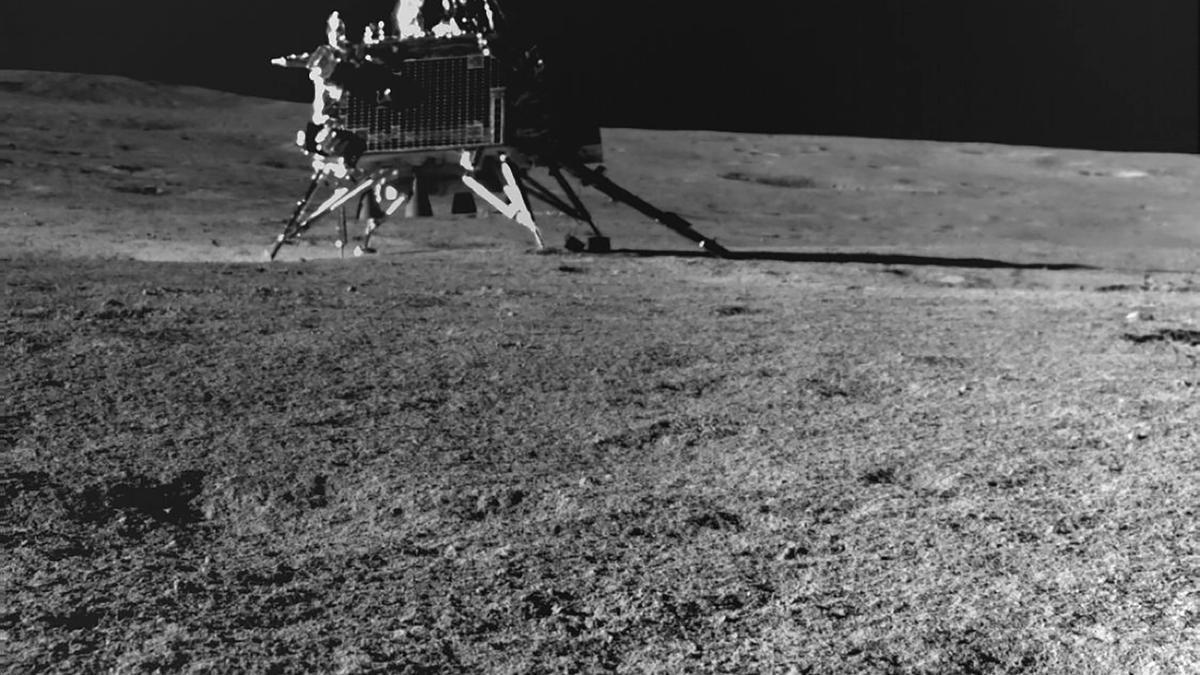
On July 22, 2019, India successfully launched Chandrayaan-2, the second mission to the moon. Twenty-two days later (August 14), after a series of orbit raising manoeuvres, the spacecraft finally escaped the earth’s gravity and followed a path towards the moon. Six days later, Chandrayaan-2 was successfully inserted into lunar orbit. Finally, on September 2, the Vikram lander separated from the Orbiter, performed two de-orbit manoeuvres and on September 6, began its descent to the moon’s surface. The descent went as planned up to an altitude of 2.1 km from the Moon’s surface before communication from the lander to the ground stations was lost. The Vikram lander had apparently crash-landed on the Moon. 

Soon a national-level failure analysis committee headed by Dr. V. Narayanan, Director of the Liquid Propulsion Systems Centre (LPSC), was formed with experts drawn from national institutes and ISRO to study the cause of failure and to propose necessary corrections. The committee pinpointed three crucial mistakes that had happened in succession resulting in the crash.

There are four important phases before the touchdown on the moon — the rough braking phase, the attitude-hold (orientation) phase, the fine braking phase, and the landing phase.

Cause of crash

During the rough braking phase, the velocity of the lander was successfully reduced to a maximum. The problem with the touchdown began when the Vikram lander entered the second phase — the attitude-hold (orientation) phase. During this phase, the thrust had to be maintained at half the level. “But when the engines were commanded to provide half the thrust, the achieved thrust was more than half. The dispersion level [variation in the thrust] was more than what we had assumed during the pre-flight simulations,” explains Dr. K. Sivan, former Chairman of ISRO under whose watch the Chandrayaan-2 was launched in 2019.

The guidance system was supposed to have halved the thrust but it malfunctioned. “The guidance system was not designed to handle large dispersions, and this resulted in the guidance system malfunctioning leading to full thrust being given to the lander,” says Dr. Sivan. “At the end of the attitude-hold phase, the altitude and velocity were very different from the expected values. The guidance-system malfunction was the second crucial error.” 

According to Dr. Sivan, during the fine braking phase, the system was trying to correct the large errors. The large-scale corrections to velocity and altitude demanded large orientation manoeuvres. Changes to orientation are carried out by the control system, but unfortunately the control system was not designed to produce large changes. “Even though there was a large demand for orientation change, the control system restricted the rate. As a result, the control system was unable to provide the necessary large corrections to orientation,” Dr. Sivan says. “The control system was taking more time to correct the orientation due to rate restriction. But by that time the lander had reached the moon’s surface.” This resulted in the lander crashing on the moon.

The crash was caused by three mistakes — the thrust (dispersion level) was more than assumed for design, the flaw in the guidance system resulted in more thrust being given, and the rate restriction in the control system failed to make large-scale changes in the orientation. “The Chandrayaan-2 mission would have been a success if any of the three errors was not there. The three cumulative errors led to the failure,” he says.

Correcting the mistakes

Taking the learnings from Chandrayaan-2 failure, ISRO corrected for all the three major mistakes in the latest mission — the system was corrected to ensure extra dispersion does not happen, the guidance system was corrected, and the restriction in the control system was removed. “These were the major corrections in Chandrayaan-3 lander.

Redundancy was also built into Chandrayaan-3 lander in terms of extra sensors, and extra propellant to allow it to travel to an alternate landing site, if required. And the landing area was expanded from a narrow patch of 500 metres x 500 metres to a 4 km x 2.4 km region.

In addition, other improvements suggested by the failure analysis committee were also incorporated in the Chandrayaan-3 mission.

Extra fuel, sensors and stronger lander legs designed for higher landing velocity led to a net increase in the weight (about 250 kg) of the lander. Since Chandrayaan-3 was not carrying an orbiter like its predecessor, it became possible to accommodate the increased weight.

“Increased weight of the lander meant that a single engine was not sufficient. So the central engine was removed and two engines were used for landing,” Dr. Sivan says. “The central engine was added in the earlier mission as it was suspected that dust stirred by other engines would affect the electronic components. But our analysis found that dust wasn’t a problem.”

Source link

Science Tags:Chandrayaan 3, chandrayaan 3 vikram lander, moon landing india, Soft-landing, vikram lander, Vikram lander to soft-land

Post navigation

Previous Post: Adani Ports, Adani Enterprises’ Promoters Raise Stake
Next Post: India reports far fewer people with orphan diseases

Related Posts

  • How various coffee varieties differ in taste Science
  • The Science Quiz | Leap Days Science
  • Science This Week | India launches Aditya-L1 to study the sun, Pragyan safely parked and more Science
  • Sci-Five | The Hindu Science Quiz: On Venus Science
  • Africa dramatically dried out 5,500 years ago Science
  • Endemic dengue may have helped stem severity of early COVID wave in India: study Science

More Related Articles

Russian cosmonaut sets record for most time in space – more than 878 days Science
Private US moon lander still working after breaking leg and falling, but not for long Science
Sex differences don’t disappear as a country’s equality develops: study Science
Pollen in pee: fossilised urine from a small African mammal helps us understand past environments Science
Parched Philippine dam reveals centuries-old town, luring tourists Science
What is the legal framework for space missions like the Chandrayaan 3 and Aditya L-1? | Explained Science
SiteLock

Archives

  • July 2024
  • June 2024
  • May 2024
  • April 2024
  • March 2024
  • February 2024
  • January 2024
  • December 2023
  • November 2023
  • October 2023
  • September 2023
  • August 2023
  • July 2023
  • June 2023
  • May 2023
  • April 2023
  • March 2023
  • February 2023
  • January 2023
  • December 2022
  • November 2022
  • October 2022
  • September 2022
  • August 2022
  • July 2022
  • June 2022
  • May 2022

Categories

  • Business
  • Nation
  • Science
  • Sports
  • World

Recent Posts

  • “Jo Gaali De Rahe Hain…”: India Star Reveals How Hardik Pandya Dealt With Booing
  • Unable To Afford Treatment, Pakistan Man Buries 15-Day-Old Daughter Alive
  • Who Is Mihir Shah? Shiv Sena Leader’s Son Accused In Mumbai BMW Hit-And-Run
  • Video Of Sena Leader’s Son Leaving Pub Just Before BMW Crash Goes Viral
  • Air India welcomes first narrow body aircraft in Delhi

Recent Comments

  1. GkJwRWEAbS on UP Teacher Who Asked Students To Slap Muslim Classmate
  2. xreDavBVnbGqQA on UP Teacher Who Asked Students To Slap Muslim Classmate
  3. aANVRzfUdmyb on UP Teacher Who Asked Students To Slap Muslim Classmate
  4. YQCyszVBmIP on UP Teacher Who Asked Students To Slap Muslim Classmate
  5. aiXothgwe on UP Teacher Who Asked Students To Slap Muslim Classmate
  • Suryakumar Yadav’s “Little Correction Mate” Comment For An X User Is Viral Sports
  • 8,000-Page Chargesheet Filed In NewsClick Case, Founder Prabir Purkayastha Named As Accused Nation
  • Mainz Suspend Anwar El Ghazi For ‘Unacceptable’ Israel-Gaza Post Sports
  • Air India Express Takes Delivery Of First 2 New Boeing 737 MAX-8 Aircraft Nation
  • India keeping tabs on investigation into Kuchipudi dancer’s killing in the U.S. World
  • Apple Supplier Pegatron iPhone Factory Shutdown To Go Into Day 3 After Fire: Report Nation
  • India vs Pakistan, World Cup 2023: Shubman Gill Is Back, India Star Begins Batting Practice Ahead Of Pakistan Clash Sports
  • Kohli gets into the act again as India makes light of yet another chase Sports

Editor-in-Chief:
Mohammad Ariff,
MSW, MAJMC, BSW, DTL, CTS, CNM, CCR, CAL, RSL, ASOC.
editor@artifex.news

Associate Editors:
1. Zenellis R. Tuba,
zenelis@artifex.news
2. Haris Daniyel
daniyel@artifex.news

Photograher:
Rohan Das
rohan@artifex.news

Artifex.News offers Online Paid Internships to college students from India and Abroad. Interns will get a PRESS CARD and other online offers.
Send your CV (Subjectline: Paid Internship) to internship@artifex.news

Links:
Associate Journalism
About Us
Privacy Policy

News Links:
Breaking News
World
Nation
Sports
Business
Entertainment
Lifestyle

Registered Office:
72/A, Elliot Road, Kolkata - 700016
Tel: 033-22277777, 033-22172217
Email: office@artifex.news

Editorial Office / News Desk:
No. 13, Mezzanine Floor, Esplanade Metro Rail Station,
12 J. L. Nehru Road, Kolkata - 700069.
(Entry from Gate No. 5)
Tel: 033-46011099, 033-46046046
Email: editor@artifex.news

Copyright © 2023 Artifex.News Newsportal designed by Artifex Infotech.