

Skip to content
  • Facebook
  • X
  • Linkedin
  • WhatsApp
  • Associate Journalism
  • About Us
  • Privacy Policy
  • 033-46046046
  • editor@artifex.news
Artifex.News

Artifex.News

Stay Connected. Stay Informed.

  • Breaking News
  • World
  • Nation
  • Sports
  • Business
  • Science
  • Entertainment
  • Lifestyle
  • Toggle search form
  • Ireland Claim First T20I After Afghanistan Fall Short In Run Chase Sports
  • What is the ‘responsible quantum technologies’ movement? | Explained Science
  • Nirmala Sitharaman Slams Siddaramaiah Over Bengaluru Water Crisis Nation
  • Anti Terror Agency Files Chargesheet Against 14th Accused In Coimbatore Blast Case Nation
  • “Bet On Russia As Long-Term, Reliable Partner Not A Good One”: US Official to India Nation
  • Video Shows Taiwan Nurses Grabbing Incubators To Save Newborns During Earthquake World
  • US “Deeply Alarmed” As Thousands Protest Georgia’s “Foreign Agent” Bill World
  • To curb evasion, EU report calls for 2% global wealth tax on billionaires World

Bird species exploded after dinos’ doom, largest yet bird genetics study says

Posted on April 2, 2024 By admin


The largest-ever study of bird genomes has produced a remarkably clear picture of the bird family tree. 
| Photo Credit: Special Arrangement

The largest-ever study of bird genomes has produced a remarkably clear picture of the bird family tree. Published in the journal Nature today, our study shows that most of the modern groups of birds first appeared within 5 million years after the extinction of the dinosaurs.

Birds are a large part of our lives, a sign of nature even in cities. They are popular among the general public and well studied by scientists. But placing all of these birds into a family tree has been frustratingly difficult.

By analysing the genomes of more than 360 bird species, our study has identified the fundamental relationships among the major groups of living birds.

The new family tree overturns some previous ideas about bird relationships, while also revealing some new groupings.

Resolving a messy relationship

Previous studies showed the bird family tree has three major branches. The first branch contains the tinamous and ratites, which include flightless birds such as the emu, kiwi and ostrich.

The second branch holds the landfowl and waterfowl – chickens, ducks and so on. All other birds sit on the third branch, known as the Neoaves, which include 95% of bird species.

The Neoaves branch includes ten groups of birds. Most of these are what biologists have named the “Magnificent Seven”: landbirds, waterbirds, tropicbirds, cuckoos, nightjars, doves and flamingos. The other three groups are known as the “orphans” and include the shorebirds, cranes and hoatzin, a species from South America.

The relationships among these ten groups, especially the orphans, have been incredibly difficult to resolve. Our genome study shows a resolution is within reach.

Meet the ‘Elementaves’

Our genome study revealed a new grouping of birds we have named “Elementaves”. With a name inspired by the four ancient elements of earth, air, water and fire, this group includes birds well adapted for success on land, in the sky and in the water. Some of the birds have names relating to the sun, representing the element of fire. The Elementaves group includes hummingbirds, shorebirds, cranes, penguins and pelicans.

Our study also confirms a close relationship between two of the most familiar groups of birds in Australia, the passerines (songbirds and relatives) and parrots. These popular birds dominate the Australian Bird of the Year polls.

Also Read | A brief guide to bird-watching spots and species in India

Songbirds make up nearly 50% of all bird species and include birds like magpies, finches, honeyeaters and fairywrens. They had their humble beginnings in Australia about 50 million years ago, then spread across the globe to become the most successful group of birds.

When did birds really emerge?

A further goal of our study was to place a timescale on the bird family tree. We did this by modelling the evolution of genomes using a tool known as the “molecular clock”. By drawing on information from nearly 200 fossils, we were able to constrain the ages of some of the branches in the bird family tree.

Our study shows all living birds share an ancestor that lived just over 90 million years ago. But most groups of modern birds emerged about 25 million years later, within a small window of just a few million years after the end of the Cretaceous period around 66 million years ago.

This coincides with the mass extinction of dinosaurs and other organisms caused by an asteroid striking Earth. So it seems birds made the most of the opportunities that became available after these other dominant life forms were wiped out.

One mystery remains

The genome study is the product of nearly a decade of research, conducted as part of the Bird 10,000 Genomes Project. The ultimate goal of this project is to sequence the genomes of all 10,000 living bird species.

The current phase of the project focused on including species from every major group, or family, of birds. The study of these 363 genomes was a truly international effort led by researchers at the University of Copenhagen, University of California San Diego and Zhejiang University in China.

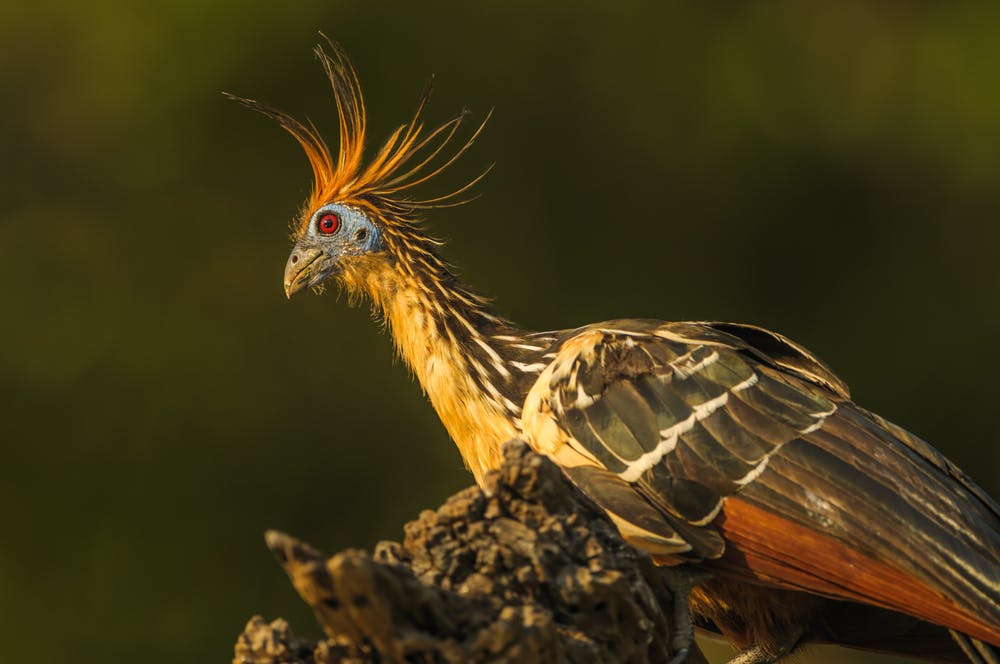
Even with such a huge amount of genome data, one branch of the bird family tree remains a mystery. Our analysis could not confidently determine the relationships of one of the orphans, the hoatzin. Found in South America, the hoatzin is a highly distinctive bird and the sole survivor of its lineage.

Our study shows that some relationships in the tree of life can only be determined using huge amounts of genome data. But our study also demonstrates the power of studying genomes and fossils together to understand the evolutionary history of life on Earth.

The Conversation

A bird with a longish neck and orange tufts on its head that looks a bit like a pigeon.
The hoatzin, one of the ‘orphan’ branches of the bird family tree, remains a mystery.Marcos Amend/Shutterstock

Jacqueline Nguyen, Scientific Officer in Ornithology, Australian Museum, and ARC DECRA Fellow, Flinders University and Simon Ho, Professor of Molecular Evolution, School of Life and Environmental Sciences, University of Sydney

This article is republished from The Conversation under a Creative Commons license. Read the original article.




Source link

Science Tags:animal news, animal science, Birds, Did birds come after dinosaurs, When did birds first appear

Post navigation

Previous Post: AAP Leader Sanjay Singh Mother Radhika Singh To NDTV After Son Gets Bail
Next Post: India, Australia and England cricket boards in talks to revive Champions League T20

Related Posts

  • Muscle, wood, coal, oil: what earlier energy transitions tell us about renewables Science
  • How do birds fly in a coordinated and seemingly effortless fashion? Science
  • How various coffee varieties differ in taste Science
  • First Indian space tourist to fly on Jeff Bezos’s Blue Origin’s NS-25 mission Science
  • The Science Quiz: The Russell-Einstein manifesto Science
  • The Hindu Daily Quiz | On balancing rocks- Feb 29, 2024 Science

More Related Articles

Acclaimed primatologist Frans de Waal dies at 75 Science
Managing our resources with AI Science
What is photocopying and how does it work? | Explained Science
Can ‘good sounds’ help coral islands recover from bleaching? Science
Watch | Chandrayaan-3’s journey from the Moon’s orbit to its surface Science
The Hindu Daily Quiz, April 8 2024 | On Superconductors Science
SiteLock

Archives

  • July 2024
  • June 2024
  • May 2024
  • April 2024
  • March 2024
  • February 2024
  • January 2024
  • December 2023
  • November 2023
  • October 2023
  • September 2023
  • August 2023
  • July 2023
  • June 2023
  • May 2023
  • April 2023
  • March 2023
  • February 2023
  • January 2023
  • December 2022
  • November 2022
  • October 2022
  • September 2022
  • August 2022
  • July 2022
  • June 2022
  • May 2022

Categories

  • Business
  • Nation
  • Science
  • Sports
  • World

Recent Posts

  • U.S. and South Korea sign joint nuclear deterrence guidelines in face of North Korean threats
  • India to clock GDP growth of 7% in FY25: NITI Aayog member Arvind Virmani
  • Rupee trades flat at 83.53 against U.S. dollar in early trade
  • 6 Indians Missing In Nepal After Landslide Pushes Their Bus Into River
  • India abstains on UNGA resolution against Russian offensive in Ukraine

Recent Comments

  1. ywdVpqHiNZCtUDcl on UP Teacher Who Asked Students To Slap Muslim Classmate
  2. bRstIalYyjkCUJqm on UP Teacher Who Asked Students To Slap Muslim Classmate
  3. GkJwRWEAbS on UP Teacher Who Asked Students To Slap Muslim Classmate
  4. xreDavBVnbGqQA on UP Teacher Who Asked Students To Slap Muslim Classmate
  5. aANVRzfUdmyb on UP Teacher Who Asked Students To Slap Muslim Classmate
  • Mallikharjun Kharge On PM Modi’s Claims Nation
  • Madhya Pradesh Elections On November 17, Result On December 3 Nation
  • Netherlands vs England Live Streaming Euro 2024 Semifinal Live Telecast: When And Where To Watch Sports
  • Shashank Singh Overshadows Shubman Gill’s Knock To Hand Punjab Kings A Famous Win Over Gujarat Titans Sports
  • Player Gives Tribute To Shikhar Dhawan After Taking Sensational Catch In Bengal Pro League. Watch Sports
  • ‘Watching On TV To Sharing Dressing Room’: CSK Youngster’s Heartfelt Post For MS Dhoni Sports
  • Google Restricts Gemini AI From Answering Questions On Global Elections World
  • “Awarding On Basis Of Rankings…”: Afghanistan Pacer On India Winning Asian Games Gold After Washout Sports

Editor-in-Chief:
Mohammad Ariff,
MSW, MAJMC, BSW, DTL, CTS, CNM, CCR, CAL, RSL, ASOC.
editor@artifex.news

Associate Editors:
1. Zenellis R. Tuba,
zenelis@artifex.news
2. Haris Daniyel
daniyel@artifex.news

Photograher:
Rohan Das
rohan@artifex.news

Artifex.News offers Online Paid Internships to college students from India and Abroad. Interns will get a PRESS CARD and other online offers.
Send your CV (Subjectline: Paid Internship) to internship@artifex.news

Links:
Associate Journalism
About Us
Privacy Policy

News Links:
Breaking News
World
Nation
Sports
Business
Entertainment
Lifestyle

Registered Office:
72/A, Elliot Road, Kolkata - 700016
Tel: 033-22277777, 033-22172217
Email: office@artifex.news

Editorial Office / News Desk:
No. 13, Mezzanine Floor, Esplanade Metro Rail Station,
12 J. L. Nehru Road, Kolkata - 700069.
(Entry from Gate No. 5)
Tel: 033-46011099, 033-46046046
Email: editor@artifex.news

Copyright © 2023 Artifex.News Newsportal designed by Artifex Infotech.