



“… for the first time in world history, mechanical reproduction emancipates the work of art from its parasitical dependence on ritual. To an ever greater degree the work of art reproduced becomes the work of art designed for reproducibility.”Walter Benjamin
The German philosopher Walter Benjamin wrote these words in his landmark 1935 essayThe Work of Art in the Age of Mechanical Reproduction. While Benjamin’s thesis centred on the character of art in a capitalist society and the effects of mass reproduction – and reproducibility – on it, it’s tempting to see parallels to the effect that photocopying had on the production and availability of textual material in the modern era.
What is photocopying?
Broadly, photocopying is a set of techniques with which to duplicate some content using, among other things, light. However, the contemporary colloquial use of the word ‘photocopying’ refers almost exclusively to xerography.
Both the word ‘xerography’ and the name ‘Xerox’ come from the Greek root-word ‘xero’, meaning ‘dry’. This is because xerography is a type of photocopying method whose process doesn’t involve messy liquid chemicals. Xerographic machines are in ubiquitous use around the world today to quickly and cheaply reproduce printed material.
How does xerography work?
Xerography has a few basic elements.
The first is the photoconductive surface – a surface coated with a photoconductive material. Such a material, when exposed to light, allows electrons to flow through it (i.e. conducts electricity) but blocks them when it’s dark.
This surface is negatively charged by placing a thin negatively charged wire with a high voltage next to it.
Then, the sheet of paper to be copied is illuminated with a bright light. The darker parts of the paper – where something is printed, i.e. – don’t reflect the light whereas the unmarked parts do.
This reflected light is carried by lenses and mirrors to fall on the photoconductive surface. In the parts of the surface where light falls, the photoconducting material will become conductive and allow the electrons near its surface to dissipate downwards (into a grounding). So the parts that remain negatively charged at the end of this step will correspond to parts of the paper-to-be-copied (TBC) where something was printed.
Next, a powdery substance called toner is applied to the surface. The toner is positively charged, so it will settle where negative charge persists on the surface. The surface then transfers the pattern of toner on it to a sheet of paper. The paper has a stronger negative charge that causes the toner to jump.
Finally, the toner is heated so that it melts and fuses with the paper. This is the paper that rolls out of the photocopying machine, the whole process having been completed in a few seconds.
In practice, a rotating drum is used instead of a flat surface, and the paper TBC is illuminated by a flashing or stroboscopic light or a moving scanner.
There have been many innovations since the idea of a dry photocopying technique first took shape in the 1930s to improve the xerographic process, including the way the toner is supplied, the unit cost of materials, the development of colour-copying, the use of lasers, and the overall user experience.
Who invented xerography?
Inspired by the work of the Hungarian engineer Paul Selenyi, an American attorney named Chester F. Carlson came up with a rudimentary version of xerography by 1938. Seven years later, he sold his idea to a non-profit organisation called the Battelle Memorial Institute in Ohio, where researchers refined the technique.
A year later, in 1946, the small New York-based Haloid Photographic Company purchased a licence from Battelle to build a machine based on the technique. The company trademarked the name for this machine as the “Xerox machine” in 1948 and availed the first model for sale in 1949.
(Haloid’s managers were responsible for coining the word ‘xerography’, replacing Carlson’s ‘electrophotography’.)
Haloid itself changed its name to Haloid Xerox in 1958 and to Xerox Corporation in 1961. Two particular models accelerated the adoption of this technology worldwide: the Xerox 914 in 1959, which was marketed as being very simple to use, and the Xerox 813 in 1963, as being able to fit on a table.
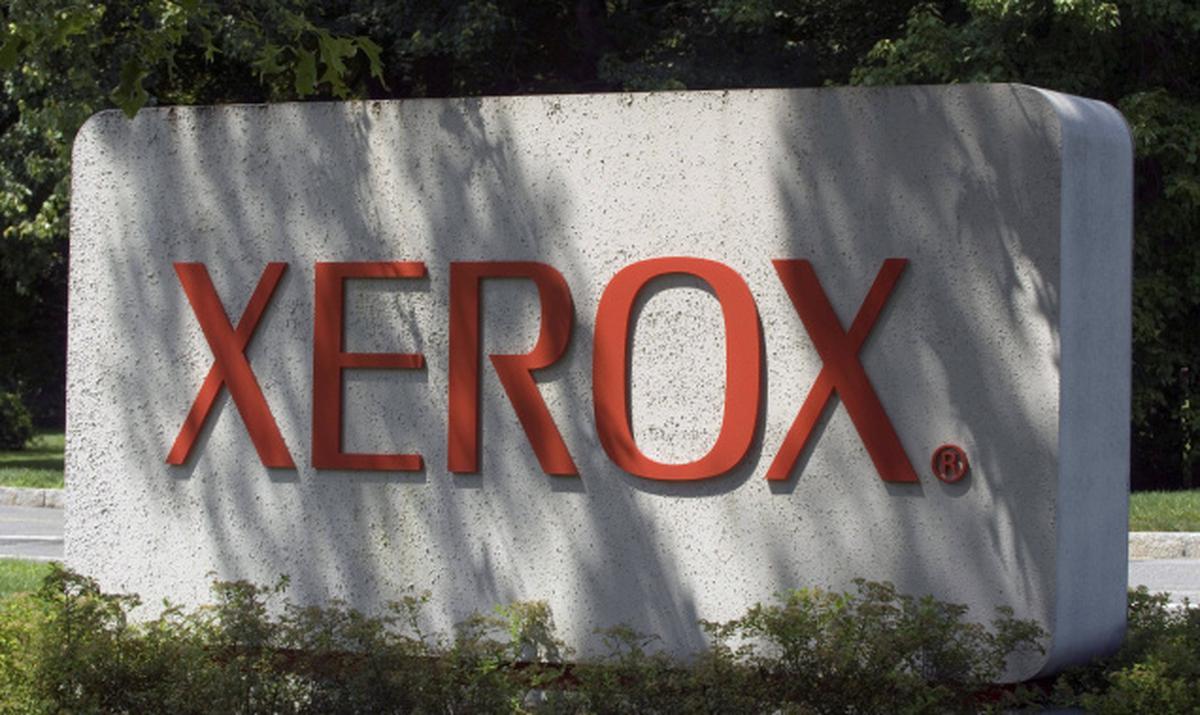
The Xerox logo outside the company’s Stamford, Connecticut, corporate headquarters as seen on July 25, 2007. In 2008, Xerox unveiled a new logo intended to scuttle its old image as a photocopier manufacturer and highlight its software, colour printers and other technologically updated products.
| Photo Credit:
Douglas Healey/AP
About a decade later, Xerox also introduced the laser-based photocopier. Instead of using a lamp to reflect light off the document to be copied to the drum, the data to be copied – or printed – was encoded as a bitmap that was fed to a laser, which then inscribed the requisite shapes onto the drum.
By the second half of the 20th century, Xerox wasn’t the sole maker of photocopier machines, even if it was the dominant supplier. Companies like Kodak made and released devices based on patents they owned. Xerox remained ahead because its patents ensured that its competitors’ products had to use specially prepared paper (on which to print) rather than plain paper.
IBM was able to overcome this when one of its researchers developed a process based on an organic photoconducting material in the late 1960s, among other changes.
How did xerography change the world?
Three examples illustrate xerography’s wide-ranging impact.
(i) Counterfeiting: In 2002, people discovered that Xerox machines refused to copy banknotes that included a particular marking – of five small rings positioned like stars in the Orion constellation. Similar markings have since been found on the banknotes of at least 35 national banks. A 2005 statement from the Reserve Bank of India, accompanying the release of new Rs 50 notes, called it the “Omron anti-photocopying feature”, suggesting that a Japanese corporation named Omron was responsible for designing the rings to prevent counterfeiters from duplicating or printing currency notes using xerographic machines.
(ii) Copyright and surveillance: In 2012, a raft of academic publishers, including Oxford University Press, filed a suit alleging copyright infringement against a photocopy shop and the University of Delhi. The suit claimed that teachers at the university had picked pages from books published by the publishers to be copied and bound together at the shop, and sold to university students at Rs 0.50 per page. The matter famously concluded in the university’s favour, highlighting the rights that attend to and the benefits that accrue from being able to make numerous copies of educational material at a low cost.
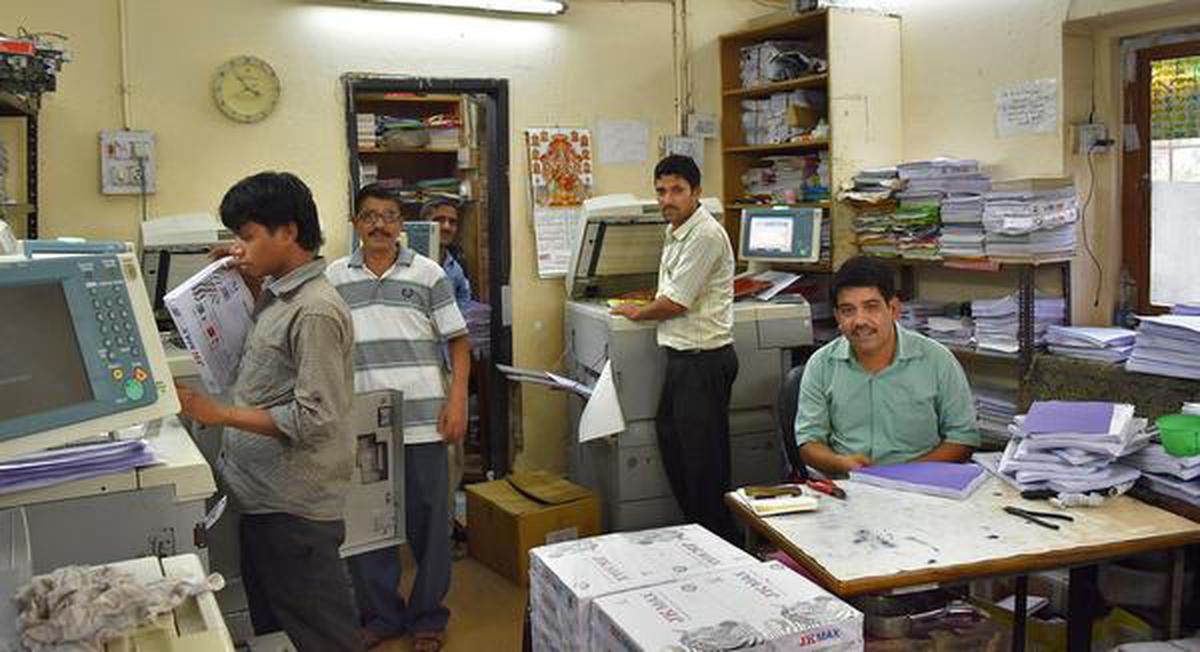
A view of Rameshwari Photocopy Service, the shop implicated in the DU photocopy case.
| Photo Credit:
Jaideep Deo Bhanj/The Hindu
Similarly, Katherine Eichhorn, an associate professor at The New School University, New York, wrote in a 2016 book: “the spread of copy machines made copying an increasingly independent practice … As a result, these machines enabled the reproduction of texts that would never have passed the censors,” such as “militant manifestos, … DIY guides on how to build your own bombs or grow your own marijuana.”
(iii) Art: Walter Benjamin contended that by taking away the ritual of producing art, mechanical reproduction had rerooted art’s value in politics instead. But transformative technologies like xerography never have simple consequences. As Dr. Eichhorn wrote in the same book, a “vibrant arts scene” that emerged in 1970s’ New York created “a generation of innovative artists, writers, and musicians” who benefited as much from low rent in some areas as xerography, allowing “musicians without agents” to print “homemade posters advertising upcoming gigs”, artists “to move their art out of the gallery and museum and into the street”, and writers to “self-publish zines, broadsides, and even books.”