Skip to content
  • Facebook
  • X
  • Linkedin
  • WhatsApp
  • YouTube
  • Associate Journalism
  • About Us
  • Privacy Policy
  • 033-46046046
  • editor@artifex.news
Artifex.News

Artifex.News

Stay Connected. Stay Informed.

  • Breaking News
  • World
  • Nation
  • Sports
  • Business
  • Science
  • Entertainment
  • Lifestyle
  • Toggle search form
  • Access Denied
    Access Denied Nation
  • Maduro decries U.S.-Trinidad and Tobago military exercises as ‘irresponsible’
    Maduro decries U.S.-Trinidad and Tobago military exercises as ‘irresponsible’ World
  • Assam’s Bodoland becomes first tribal council to digitise land records
    Assam’s Bodoland becomes first tribal council to digitise land records Nation
  • Access Denied Sports
  • What the 14-point MoU between Iran and the U.S. means for shipping
    What the 14-point MoU between Iran and the U.S. means for shipping Business
  • Access Denied Business
  • Send robots into space rather than people, says Britain’s Astronomer Royal
    Send robots into space rather than people, says Britain’s Astronomer Royal Science
  • Iceland’s Social Democrats win election, unseating ruling coalition
    Iceland’s Social Democrats win election, unseating ruling coalition World
Ariel, Umbriel and the man who made them real

Ariel, Umbriel and the man who made them real

Posted on October 17, 2026 By admin


You know the difference between inventions and discoveries, don’t you? While both of them are fundamental processes that have shaped the course of human history, there’s a difference between them. In simple terms, inventions correspond to coming up with something new based on experimentation and study. Discoveries, meanwhile, are the process of finding something that already exists, especially for the first time.

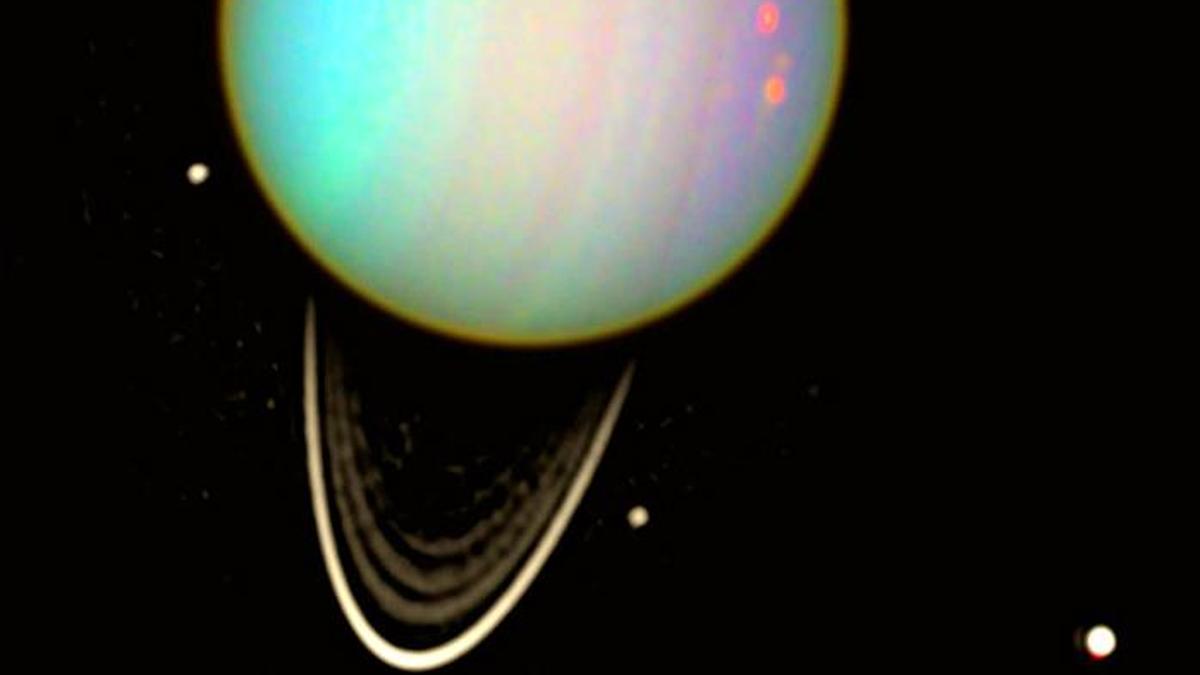
When we speak of Ariel and Umbriel, two of Uranus’ many moons (29 officially as of August 2026), it is their discovery that we talk about. This is because these satellites have existed for a very long time, and it was only their existence that was revealed in reality when English astronomer William Lassell discovered them.

Shakespeare has a say

The naming conventions of celestial bodies can be a topic unto itself. There’s a fair bit of mythology involved, with planets in our solar system bearing names reflecting mythological characters. As for their satellites, it was either named after mythological figures related to the planet’s namesake, or had literary links. In the case of Ariel and Umbriel, it was the latter.

Following his discoveries, Lassell requested Sir John Herschel to name these two moons. It is worth noting that John was the son of Sir William Herschel, the discoverer of the planet Uranus. John decided to name both satellites based on the works of English poet Alexander Pope and English playwright and poet William Shakespeare.

Both Ariel and Umbriel are names that appear in Pope’s “The Rape of the Lock” and the former appears in Shakespeare’s “The Tempest” as well.

Umbriel is named for a malevolent spirit in the 18ᵗʰ Century poem. While Ariel is a sylph who narrates the poem in Pope’s work, the character is a spirit who serves a magician in Shakespeare’s work. The magician, Prospero, rescues Ariel from a tree in which he had been held in prison by Sycorax, a witch. Incidentally, both Prospero and Sycorax were also chosen as names for other satellites of Uranus.

Born in Bolton, England on June 18, 1799, Lassell belonged to a family that was fairly well-off. The boy born close to the turn of the century turned into a teen who moved from Rochdale, Manchester to Toxteth, Liverpool in 1815. Here, he apprenticed in a local merchant’s office until 1822. His life was just about to hit the fast-forward button.

Beer brewer turns astronomer

He set out as a beer brewer on Milton Street in Liverpool by November 1824 and business soon flourished. Riches led him to leisure, leisure lent him time, and time turned into newfound interests. Astronomy turned out to be the unexpected beneficiary due to the wealth that he accumulated.

Portrait of William Lassell.
| Photo Credit:
Wikimedia Commons

He made so much money that he was able to build an observatory at his own home! By the summer of 1839, ‘Starfield’ on West Derby Road was established with a 9-inch diameter telescope that Lassell built on his own. This only served to whet his appetite and he paid a visit to Irish engineer and astronomer William Parsons, 3ʳᵈ Earl Rosse. Lord Rosse was the designer of the Leviathan of Parsonstown, the largest telescope of the time — a record it held into the next century.

The Grand Amateurs

Returning to Liverpool with more knowledge of the subject, Lassell went on to build a successful partnership with two others. Fellow English amateur astronomer William Rutter Dawes also had his own observatory in Ormskirk, and he had a keen eye for testing calibrating telescopes. James Nasmyth, a Scottish engineer and the inventor of the steam hammer, turned to astronomy following retirement from business as a mechanical engineer. All three of them — Lassell, Dawes, and Nasmyth — were recognised as the “Grand Amateurs” of astronomy.

The trio built a telescope with a diameter of 24 inches that was constructed in Lassell’s workshops at Starfield. The 20-foot-long tube with a mirror that ran two feet across was polished using a machine of Lassell’s own design and was the first telescope of its size to achieve equatorial mounting. This enabled them to not only track down specific objects, but also observe and follow them for a longer period. The discoveries were just around the corner.

Four moons in five years

In a period of five years, Lassell discovered four satellites in the solar system using this telescope. The first of these discoveries took place on October 10, 1846, when Lassell discovered Triton. The largest of Neptune’s satellites was discovered by Lassell just 17 days after Neptune itself had been discovered! If Neptune were the size of a basketball, then Triton would be as small as a bead that is one-and-a-half centimetres across — an indicator of how good Lassell’s telescope was.

This image taken by Voyager 2 in 1986 shows Umbriel, one of the two moons of Uranus that Lassell discovered.

This image taken by Voyager 2 in 1986 shows Umbriel, one of the two moons of Uranus that Lassell discovered.
| Photo Credit:
NASA / Wikimedia Commons

In 1848, Lassell discovered Hyperion, the largest of Saturn’s irregular, non-spherical moons. Lassell shares this discovery with William Cranch Bond and his son George Phillips Bond — an American father-son duo who independently discovered the same moon.

On October 24, 1851, Lassell doubled the number of satellites he had discovered from two to four. Using the same telescope that had yielded success, Lassell discovered Ariel and Umbriel. The discovery of these two new moons of Uranus added to the two moons (Titania and Oberon in 1787) that had already been discovered shortly after the planet itself had been discovered in 1781.

An eventful October

In addition to the discovery of Ariel and Umbriel, October 1851 turned out to be special for Lassell for another reason as well.

In case you are wondering what could be more special than discovering two moons, it was the chance of meeting someone whom you don’t get to meet easily.

In October 1851, Queen Victoria made a visit and tour of Liverpool. Lassell’s astronomical work was so highly regarded that he was apparently the only person to meet the Queen by her own request.

In the years that followed, Lassell made more observations, built a third and final great telescope (a Newtonian Reflecting Telescope that was 48 inches wide and 37 feet long), and did some back and forth between Liverpool and Malta in search of better viewing conditions. His contributions naturally led to a number of recognitions. He won the Royal Astronomical Society Gold Medal in 1849 and went on to serve as the society’s president between 1870 and 1872. He was also elected as a fellow of the Royal Society in 1849 and was awarded the Royal Medal in 1858. Belonging to the last generation of great amateur astronomers, Lassell had done everything that he could before his death in 1880 to set the stage for the professional astronomers to take over.

Published – October 24, 2026 07:22 am IST


Source link

Science Tags:Big telescopes built in the Victorian era, How many satellites did Lassell discover?, Shakespeare link with moons of Uranus, The age of great gentlemen astronomers, Who is William Lassell?

Post navigation

Previous Post: Union Minister meets start-up leaders over NCR pollution
Next Post: When Chief Minister C. Joseph Vijay made it to the Navarathri Golu

Related Posts

  • Award-winning theoretical physicist Ashoke Sen has focused on string theory
    Award-winning theoretical physicist Ashoke Sen has focused on string theory Science
  • Agnikul eyes to launch satellites by 2025: start-up CEO Ravichandran
    Agnikul eyes to launch satellites by 2025: start-up CEO Ravichandran Science
  • How does the Indian harmonium produce its lively music?
    How does the Indian harmonium produce its lively music? Science
  • How do we know the speed of light?
    How do we know the speed of light? Science
  • What do leading scientists make of the R&D Budget in Modi’s third term?
    What do leading scientists make of the R&D Budget in Modi’s third term? Science
  • Drought, degrading land take centrestage at UN talks in Riyadh
    Drought, degrading land take centrestage at UN talks in Riyadh Science

More Related Articles

What the ‘science’ of delimitation and fertility struggles to capture What the ‘science’ of delimitation and fertility struggles to capture Science
New type of host defence against Zika, dengue infections revealed New type of host defence against Zika, dengue infections revealed Science
New dragonfly species discovered in Kerala, named Lyriothemis keralensis New dragonfly species discovered in Kerala, named Lyriothemis keralensis Science
How AI helped promote community-led development in Rajasthan How AI helped promote community-led development in Rajasthan Science
NASA shifts UFO debate from sensationalism to science | Data NASA shifts UFO debate from sensationalism to science | Data Science
‘Gorillas are what we want to be’: conservation leader Gladys Kalema-Zikusoka ‘Gorillas are what we want to be’: conservation leader Gladys Kalema-Zikusoka Science
SiteLock

Archives

  • October 2026
  • September 2026
  • August 2026
  • July 2026
  • June 2026
  • May 2026
  • April 2026
  • March 2026
  • February 2026
  • January 2026
  • December 2025
  • November 2025
  • October 2025
  • September 2025
  • August 2025
  • July 2025
  • June 2025
  • May 2025
  • April 2025
  • March 2025
  • February 2025
  • January 2025
  • December 2024
  • November 2024
  • October 2024
  • September 2024
  • August 2024
  • July 2024
  • June 2024
  • May 2024
  • April 2024
  • March 2024
  • February 2024
  • January 2024
  • December 2023
  • November 2023
  • October 2023
  • September 2023
  • August 2023
  • July 2023
  • June 2023
  • May 2023
  • April 2023
  • March 2023
  • February 2023
  • January 2023
  • December 2022
  • November 2022
  • October 2022
  • September 2022
  • August 2022
  • July 2022
  • June 2022
  • May 2022

Categories

  • Business
  • Nation
  • Science
  • Sports
  • World

Recent Posts

  • Netanyahu and rival each claim mandate after tight Israel election
  • Tamil Nadu government revises auto-rickshaw fares in Chennai, other regions
  • The Madras Gate at Pondicherry
  • Trump drastically loosens oil and gas methane rules
  • More than 100 people killed in Sudanese army drone attack on market, says Sudanese rights group

Recent Comments

  1. ArnoldCit on UP Teacher Who Asked Students To Slap Muslim Classmate
  2. RodneyEvoli on UP Teacher Who Asked Students To Slap Muslim Classmate
  3. RodneyEvoli on UP Teacher Who Asked Students To Slap Muslim Classmate
  4. RobertErync on UP Teacher Who Asked Students To Slap Muslim Classmate
  5. Oliverfoepe on UP Teacher Who Asked Students To Slap Muslim Classmate
  • South Africa wins 3rd straight match to beat Australia 3-2 in ODI series ahead of Cricket World Cup
    South Africa wins 3rd straight match to beat Australia 3-2 in ODI series ahead of Cricket World Cup Sports
  • South Africa will not receive invitation for 2026 G20 summit, says Trump
    South Africa will not receive invitation for 2026 G20 summit, says Trump World
  • Access Denied
    Access Denied Nation
  • Age just a number? Chinese elderly dance, play ping-pong and do callisthenics in parks
    Age just a number? Chinese elderly dance, play ping-pong and do callisthenics in parks World
  • Four more arrested in 2 million Louvre jewel heist, says Paris prosecutor
    Four more arrested in $102 million Louvre jewel heist, says Paris prosecutor World
  • Access Denied Business
  • Zelenskyy says Ukraine faces choice of losing dignity or risking loss of key partner with U.S. plan
    Zelenskyy says Ukraine faces choice of losing dignity or risking loss of key partner with U.S. plan World
  • Noida Court Grants Bail To YouTuber Elvish Yadav In Suspected Drugs Case
    Noida Court Grants Bail To YouTuber Elvish Yadav In Suspected Drugs Case Nation

Editor-in-Chief:
Mohammad Ariff,
MSW, MAJMC, BSW, DTL, CTS, CNM, CCR, CAL, RSL, ASOC.
editor@artifex.news

Associate Editors:
1. Zenellis R. Tuba,
zenelis@artifex.news
2. Haris Daniyel
daniyel@artifex.news

Photograher:
Rohan Das
rohan@artifex.news

Associate Journalists
1. Subrata Paul - AN/2020/01
2. Quamruz Zaman - AN/2021/22
3. Ahmed Sha - AN/2021/035
4. Ajay Kumar Shaw - AN/2021/39
5. Tahqiqul Hoda - AN/2021/21

Artifex.News offers Online Paid Internships to college students from India and Abroad. Interns will get a PRESS CARD and other online offers.
Send your CV (Subjectline: Paid Internship) to internship@artifex.news

Links:
Associate Journalism
About Us
Privacy Policy

News Links:
Breaking News
World
Nation
Sports
Business
Entertainment
Lifestyle

Registered Office:
72/A, Elliot Road, Kolkata - 700016
Tel: 033-22277777, 033-22172217
Email: office@artifex.news

Editorial Office / News Desk:
No. 13, Mezzanine Floor, Esplanade Metro Rail Station,
12 J. L. Nehru Road, Kolkata - 700069.
(Entry from Gate No. 5)
Tel: 033-46011099, 033-46046046
Email: editor@artifex.news

Copyright © 2023 Artifex.News Newsportal designed by Artifex Infotech.