



Skip to content
  • Facebook
  • X
  • Linkedin
  • WhatsApp
  • YouTube
  • Associate Journalism
  • About Us
  • Privacy Policy
  • 033-46046046
  • editor@artifex.news
Artifex.News

Artifex.News

Stay Connected. Stay Informed.

  • Breaking News
  • World
  • Nation
  • Sports
  • Business
  • Science
  • Entertainment
  • Lifestyle
  • Toggle search form
  • China Tests Strategies To Counter Starlink Satellites Amid Taiwan Tensions
    China Tests Strategies To Counter Starlink Satellites Amid Taiwan Tensions World
  • Sikkim mandates tourist vehicles to carry garbage bags
    Sikkim mandates tourist vehicles to carry garbage bags Nation
  • Access Denied
    Access Denied Nation
  • Access Denied World
  • Ind vs Zim 4th T20I: Yashasvi Jaiswal, Shubman Gill Smash Zimbabwe Bowlers; India Secure Series With 3-1 Lead
    Ind vs Zim 4th T20I: Yashasvi Jaiswal, Shubman Gill Smash Zimbabwe Bowlers; India Secure Series With 3-1 Lead Sports
  • U.S. rejects WHO non-communicable diseases declaration: Robert F. Kennedy Jr.
    U.S. rejects WHO non-communicable diseases declaration: Robert F. Kennedy Jr. World
  • “Tantrums Just Don’t End”: Pakistan Great Drops ‘Teach India A Lesson’ Bombshell Amid Champions Trophy Row
    “Tantrums Just Don’t End”: Pakistan Great Drops ‘Teach India A Lesson’ Bombshell Amid Champions Trophy Row Sports
  • Chinese fossil reveals evolution of skin in feathered dinosaurs
    Chinese fossil reveals evolution of skin in feathered dinosaurs Science
Moon Base | India’s lunar future

Moon Base | India’s lunar future

Posted on August 15, 2026 By admin


“The past is a foreign country; they do things differently there,” the English novelist L.P. Hartley wrote famously in his 1953 novel The Go-Between. In a peculiar twist, the same cannot be said of the Moon. It is not a foreign country, or even a foreign world: the U.S.’s manoeuvring to beat China to the satellite has increasingly meant the Moon is an extension of the Earth’s geopolitics and political culture.

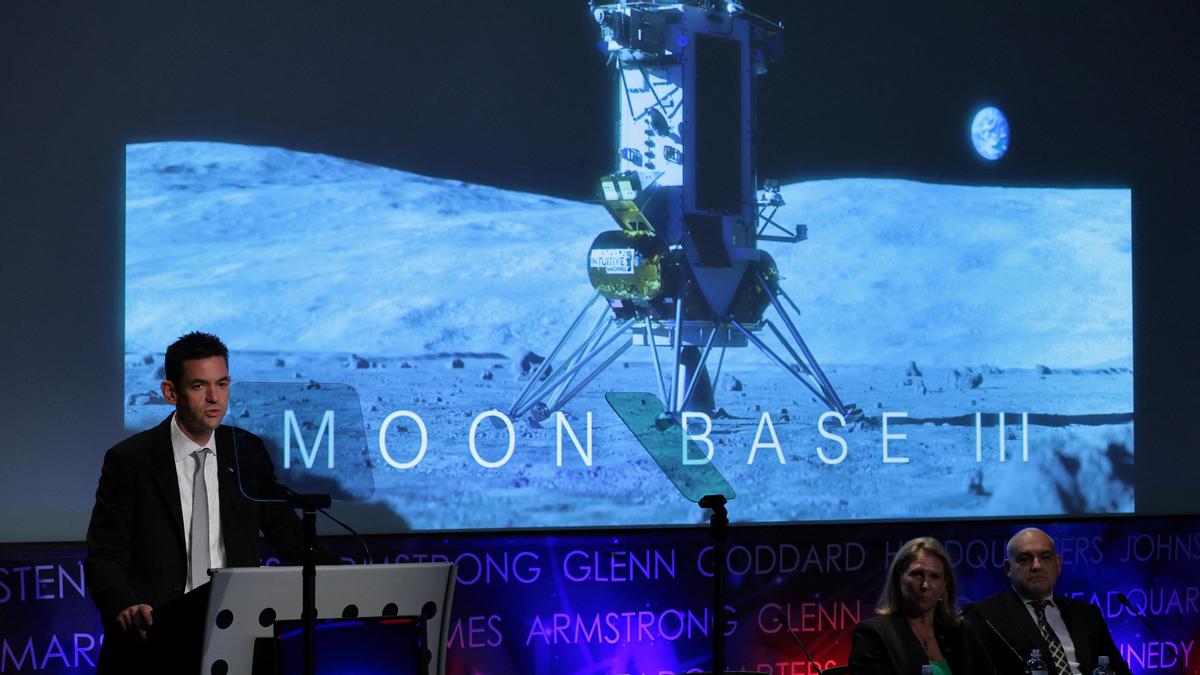
At the ninth India-U.S. Civil Space Joint Working Group meeting at Indian Space Research Organisation (ISRO) headquarters last week, NASA invited the organisation to participate in its ‘Moon Base’ programme, ostensibly as part of the two countries’ Artemis Accords partnership. According to NASA, the facility will be built piece by piece near the Moon’s south pole, where sunlight is available for longer durations and where permanently shadowed craters hold significant water-ice deposits. The target is for it to be humankind’s first outpost on a new celestial body, taking shape around 2030.

NASA is leaning heavily on private industry for this, having already awarded contracts to Astrolab (worth $219 million) and Lunar Outpost ($220 million) for lunar terrain vehicles, Blue Origin ($188 million) for delivery task orders, and Astrobotic, Firefly Aerospace, and Intuitive Machines ($600 million) for four robotic missions to the Moon to deliver equipment. Intuitive is also developing a relay satellite under a separate contract.

Further, as part of NASA chief Jared Isaacman’s overhaul of the Artemis programme earlier this year, in no small part responding to the Trump administration’s December 2025 space policy calling for securing U.S. interests in cislunar space, the profiles of the Artemis III and IV Missions changed. Now, Mission III will be a crewed test flight in Earth orbit in 2027 and Mission IV will attempt the first lunar landing under the programme in 2028. Taken together, the ‘Moon Base’ is effectively the next phase of the new Artemis programme, tasked with keeping — intermittently at first, and eventually continuously — Artemis astronauts on the Moon.

Deepening partnership

Since India signed the Artemis Accords in 2023, NASA and ISRO have engaged regularly across several areas. NASA has trained India’s astronaut candidates for the ‘Gaganyaan’ human spaceflight mission. In 2025, Prime Minister Narendra Modi and U.S. President Donald Trump jointly announced a broader strategic technologies framework, including spaceflight.

ISRO also launched the NASA-ISRO Synthetic Aperture Radar, a major scientific mission that has been a decade in the making. NASA instruments are slated to fly on forthcoming Chandrayaan missions just as they did on the first three.

While it seems almost facile to suggest the U.S. also engage with China considering the latter’s formidable spaceflight capabilities — many industry experts agree the age of U.S. dominance in spaceflight is in its twilight years — the two countries’ actions mean that the lines they have drawn on the Earth are set to be extended to the Moon, and that will pose new challenges for India.

In 2021, China and Russia announced plans to cooperate on an ‘International Lunar Research Station’ (ILRS), which China described as a long-term lunar science and technology facility, also to be built near the south pole and with a targeted deadline of 2035. Like the Artemis Accords, the ILRS is an international effort, currently involving 17 countries and organisations and more than 50 research institutions worldwide.

Earlier this year, when NASA solicited proposals for payloads to send to the Moon, it said it welcomed foreign entities “except those with bilateral ties to China”. NASA’s FY2027 budget request has also described the ‘Moon Base’ as a means to establish U.S. “superiority on the Moon” and to preserve U.S. leadership in space — language with more strategic overtones relative to the agency’s pre-Trump rhetoric.

Given how much of U.S. policy is shaped by out-competing China, India’s gains or losses will not be restricted to its space programme either. For instance, ISRO’s engagement with NASA has arguably become more politicised thanks to NASA’s own politicisation by virtue of having to respond to China’s ILRS plans. Contrary to the focus areas of these bodies through much of their histories, future discussions would be poorly served by treating their engagement on the Moon as purely exploratory.

For example, the Artemis Accords do not say a signatory cannot cooperate with non-signatory countries. (In June, ISRO also hosted the BRICS Heads of Space Agencies meeting in Bengaluru with China among the participants). However, the Artemis programme itself is increasingly concerned with infrastructure, and building one’s components, equipment, tools, etc. to be interoperable with that infrastructure will thus extend geopolitical alignments on the Earth to the Moon.

Suppose China invites India to join the ILRS in 2035. (In fact, the Moon could become one of the few domains in which India and China may have a practical incentive to cooperate on the Moon even while competing on the Earth, and India should endeavour to preserve rather than foreclose that possibility.) The government can say ‘yes’, but if China uses different communication protocols, data formats or operational procedures, India will face a tough choice: to build a second, expensive set of capabilities with China or to persuade China to change its systems to be interoperable with American designs.

Different ecosystems

That is, the U.S.-China competition means India’s increasing embedding in one technological ecosystem will also increase the cost of engaging with the other in future. At the same time, India will be mistaken to avoid deepening ISRO’s relationship with NASA. The U.S.-led ecosystem is much larger and more technologically diverse than the one led by China. But India may nonetheless have to reconsider its strategic autonomy in the spaceflight domain — particularly if the U.S.-China rivalry changes substantially over the next two or three decades. It should certainly steer clear of any dependencies that could hold back its own space programme because of U.S. objections.

In fact, one useful way to achieve this that also presents yet another opportunity for Indian leadership in space is to push for open international standards that allow nations to retain sovereign control over specific hardware and software components without hampering collaborations in space. Such diplomacy could foster interoperability between the lunar blocs and allow India to retain its strategic autonomy.

If it does not, the Moon may cease to be a foreign world but India may find itself a foreigner there.

Published – August 16, 2026 03:00 am IST


Source link

Science Tags:chandrayaan, gaganyaan, india moon mission, india space diplomacy, india space program, india us space partnership, space race

Post navigation

Previous Post: Bishnoi comes out in support of Rao Inderjit, says ignoring seniors will weaken BJP
Next Post: Nihang Sikhs | The warrior tradition

Related Posts

  • Pipeline work leads to vast megalithic site in Kerala
    Pipeline work leads to vast megalithic site in Kerala Science
  • Climate change risk hits oil market
    Climate change risk hits oil market Science
  • Interview | Shubhanshu Shukla on his new book, ‘The Second Orbit’
    Interview | Shubhanshu Shukla on his new book, ‘The Second Orbit’ Science
  • Trump asks Musk to bring back stranded NASA astronauts Sunita Williams and Butch Wilmore home
    Trump asks Musk to bring back stranded NASA astronauts Sunita Williams and Butch Wilmore home Science
  • Moon was formed around 4.51 billion years ago: study
    Moon was formed around 4.51 billion years ago: study Science
  • Sci-Five | The Hindu Science Quiz: On Hills
    Sci-Five | The Hindu Science Quiz: On Hills Science

More Related Articles

ICMR and Zydus Lifesciences initiate second phase proof-of-concept trial for Desidustat in patients with sickle cell disease ICMR and Zydus Lifesciences initiate second phase proof-of-concept trial for Desidustat in patients with sickle cell disease Science
ICMR study finds the drivers of COVID-19 vaccine hesitancy ICMR study finds the drivers of COVID-19 vaccine hesitancy Science
New study unravels why chronic pain, depression go hand in hand New study unravels why chronic pain, depression go hand in hand Science
Eye donation and corneal transplant Eye donation and corneal transplant Science
Education: Why India needs to radically think its doctoral education programmes Education: Why India needs to radically think its doctoral education programmes Science
Study shows video games can improve mental wellbeing — up to a point Study shows video games can improve mental wellbeing — up to a point Science
SiteLock

Archives

  • August 2026
  • July 2026
  • June 2026
  • May 2026
  • April 2026
  • March 2026
  • February 2026
  • January 2026
  • December 2025
  • November 2025
  • October 2025
  • September 2025
  • August 2025
  • July 2025
  • June 2025
  • May 2025
  • April 2025
  • March 2025
  • February 2025
  • January 2025
  • December 2024
  • November 2024
  • October 2024
  • September 2024
  • August 2024
  • July 2024
  • June 2024
  • May 2024
  • April 2024
  • March 2024
  • February 2024
  • January 2024
  • December 2023
  • November 2023
  • October 2023
  • September 2023
  • August 2023
  • July 2023
  • June 2023
  • May 2023
  • April 2023
  • March 2023
  • February 2023
  • January 2023
  • December 2022
  • November 2022
  • October 2022
  • September 2022
  • August 2022
  • July 2022
  • June 2022
  • May 2022

Categories

  • Business
  • Nation
  • Science
  • Sports
  • World

Recent Posts

  • Jharkhand students demand CM Soren’s resignation, ask Congress to ‘withdraw support’ from JMM coalition
  • Magnitude 6.0 earthquake strikes Minahassa Peninsula; third to strike Indonesia
  • Nihang Sikhs | The warrior tradition
  • Moon Base | India’s lunar future
  • Bishnoi comes out in support of Rao Inderjit, says ignoring seniors will weaken BJP

Recent Comments

  1. GoodiniAbelp on UP Teacher Who Asked Students To Slap Muslim Classmate
  2. Kennethbuh on UP Teacher Who Asked Students To Slap Muslim Classmate
  3. BradleyLem on UP Teacher Who Asked Students To Slap Muslim Classmate
  4. DavidJup on UP Teacher Who Asked Students To Slap Muslim Classmate
  5. BradleyLem on UP Teacher Who Asked Students To Slap Muslim Classmate
  • South Korea investigators arrive in new attempt to arrest President Yoon
    South Korea investigators arrive in new attempt to arrest President Yoon World
  • Access Denied
    Access Denied Nation
  • Access Denied
    Access Denied Nation
  • Rupee crashes 82 paise to close at all-time low of 95.31 against U.S. dollar
    Rupee crashes 82 paise to close at all-time low of 95.31 against U.S. dollar Business
  • Access Denied
    Access Denied Nation
  • Pakistani-American Businessman Sajid Tarar Praises PM Narendra Modi, Hopes Pak Too Gets Such Leader
    Pakistani-American Businessman Sajid Tarar Praises PM Narendra Modi, Hopes Pak Too Gets Such Leader World
  • Access Denied Sports
  • Gautam Gambhir Not 1st Choice Coach, Only A ‘Compromise’: BCCI Official Drops Bomb
    Gautam Gambhir Not 1st Choice Coach, Only A ‘Compromise’: BCCI Official Drops Bomb Sports

Editor-in-Chief:
Mohammad Ariff,
MSW, MAJMC, BSW, DTL, CTS, CNM, CCR, CAL, RSL, ASOC.
editor@artifex.news

Associate Editors:
1. Zenellis R. Tuba,
zenelis@artifex.news
2. Haris Daniyel
daniyel@artifex.news

Photograher:
Rohan Das
rohan@artifex.news

Artifex.News offers Online Paid Internships to college students from India and Abroad. Interns will get a PRESS CARD and other online offers.
Send your CV (Subjectline: Paid Internship) to internship@artifex.news

Links:
Associate Journalism
About Us
Privacy Policy

News Links:
Breaking News
World
Nation
Sports
Business
Entertainment
Lifestyle

Registered Office:
72/A, Elliot Road, Kolkata - 700016
Tel: 033-22277777, 033-22172217
Email: office@artifex.news

Editorial Office / News Desk:
No. 13, Mezzanine Floor, Esplanade Metro Rail Station,
12 J. L. Nehru Road, Kolkata - 700069.
(Entry from Gate No. 5)
Tel: 033-46011099, 033-46046046
Email: editor@artifex.news

Copyright © 2023 Artifex.News Newsportal designed by Artifex Infotech.