



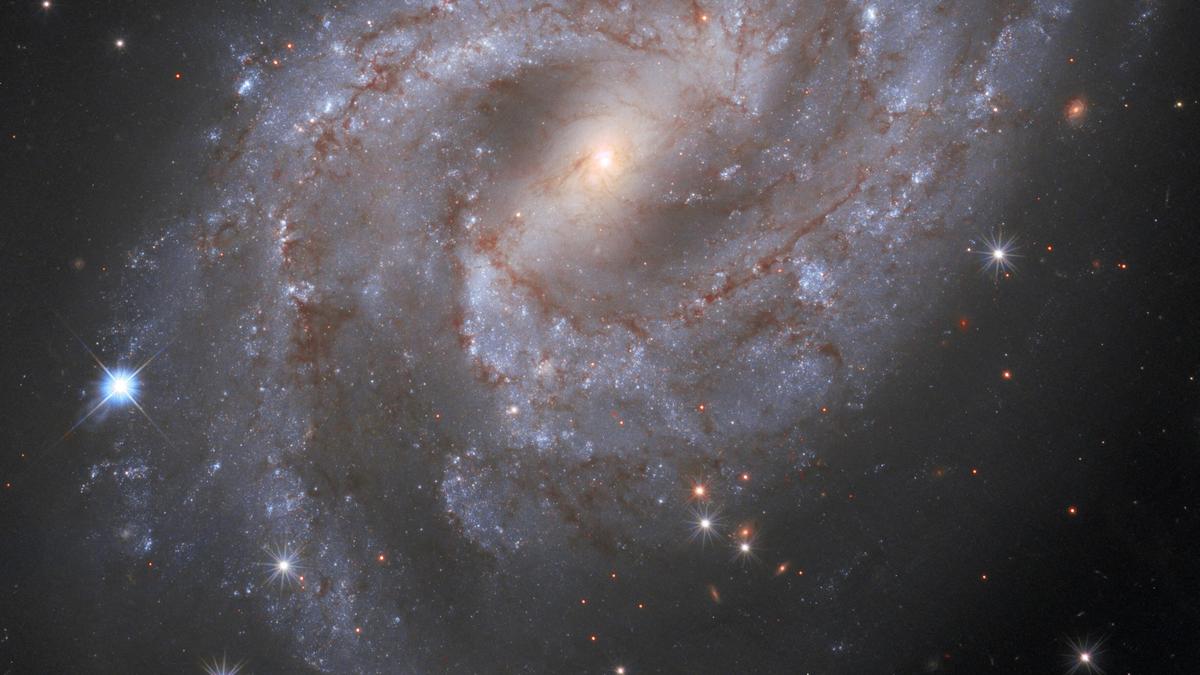
The galaxy NGC 2525 located nearly 70 million light-years from earth. It is famous for its supernova SN 2018gv, which the Hubble space telescope, among others, captured in 2018. The supernova is visible in the image’s left-centre.
| Photo Credit: ESA/NASA
Taking a fresh look at data involving a type of exploding stars, a team of researchers says it has confirmed the notion that the universe is expanding at an accelerated rate – the very observation that led to the identification in the 1990s of an enigmatic cosmic force called dark energy.
The study’s results rebut research published last year that concluded that this cosmic expansion is no longer speeding up – a finding that had challenged the basic understanding of the universe.
“The universe is still accelerating,” said astrophysicist Brodie Popovic of the University of Southampton in England, one of the leaders of the study published this month in the journal Monthly Notices of the Royal Astronomical Society.
The study’s findings, by a team that included two Nobel Prize recipients, were guided by observations in two different datasets of a type of stellar explosion called a Type Ia supernova in order to calculate vast cosmic distances. These supernovae cause the destruction of an object called a white dwarf, the dense remnant of a low- to intermediate-mass star at the end of its lifecycle.

This type of supernova has proven valuable in investigating the universe’s structure based on evidence that all of these explosions have roughly the same luminosity. Their observed brightness differs depending upon their distance from earth, making them useful as cosmic mile markers.
By measuring the brightness of these supernovae as seen from earth, scientists can gauge the universe’s expansion rate and its change over time. The Big Bang event roughly 13.8 billion years ago initiated the universe, and it has been expanding ever since. Scientists in 1998 disclosed that this expansion is accelerating, with an invisible force called dark energy as the hypothesised reason.
The universe’s contents include ordinary matter – stars, planets, gas, dust and all the familiar stuff on earth – and dark matter and dark energy. Ordinary matter represents an estimated 5% of the contents. Dark matter, which is known from its gravitational influences on galaxies and stars, makes up an estimated 27%. Dark energy makes up an estimated 68%.
The authors of the 2025 study, which was published in the same journal as the new study, concluded that dark energy is weakening and has stopped accelerating the universe’s expansion.
“Over the past decade, a group at Yonsei University has argued that supernova distances should be calibrated differently by accounting for the ages of the stars that eventually explode, and that this ‘age effect’ could substantially alter the evidence for acceleration. In our study, we found no evidence for the claimed ‘age effect’ in the largest calibrated supernova samples used by the cosmology community over the last decade,” Riess said.
Astrophysicist Young-Wook Lee of Yonsei University, located in Seoul, was one of the leaders of the 2025 study. Lee defended the findings of his team, and said the main arguments made by the researchers in the new study have “serious methodological flaws or lead to conclusions that are internally inconsistent by their own logic.”
The researchers in the new study expressed confidence in their methodology and their conclusions confirming acceleration.
Published – June 17, 2026 02:16 pm IST