


Skip to content
  • Facebook
  • X
  • Linkedin
  • WhatsApp
  • YouTube
  • Associate Journalism
  • About Us
  • Privacy Policy
  • 033-46046046
  • editor@artifex.news
Artifex.News

Artifex.News

Stay Connected. Stay Informed.

  • Breaking News
  • World
  • Nation
  • Sports
  • Business
  • Science
  • Entertainment
  • Lifestyle
  • Toggle search form
  • Maharashtra Boy Goes In For Leg Surgery, Comes Out Circumcised, Probe On
    Maharashtra Boy Goes In For Leg Surgery, Comes Out Circumcised, Probe On Nation
  • Access Denied World
  • Babar Azam Wins Hearts With His Gesture For Hyderabad Ground Staff. Watch
    Babar Azam Wins Hearts With His Gesture For Hyderabad Ground Staff. Watch Sports
  • UPSC for the first time releases provisional answer key for Civil Services Prelims exam
    UPSC for the first time releases provisional answer key for Civil Services Prelims exam Nation
  • India’s coal production rises 14 per cent in June
    India’s coal production rises 14 per cent in June Business
  • Access Denied
    Access Denied Nation
  • Pat Cummins Withdraws Run Out Appeal vs Ravindra Jadeja For Field Obstruction. Sparks Massive Debate. Watch
    Pat Cummins Withdraws Run Out Appeal vs Ravindra Jadeja For Field Obstruction. Sparks Massive Debate. Watch Sports
  • Access Denied Sports
370 billion crickets are farmed for food every year; scientists have found they may feel pain

370 billion crickets are farmed for food every year; scientists have found they may feel pain

Posted on May 29, 2026 By admin


You’re cooking dinner, distracted, and your hand brushes a hot pan. Nerve signals race to your spinal cord and back to yank your arm away in a fraction of a second, with no thought required.

Then comes the pain. A sharp, spreading sting gives way to a pulsing ache, and you cradle your hand and run it under cold water until it subsides. That felt experience is distinct from the reflex that preceded it. While the reflex moved your body out of danger, pain drives you to protect the wound, recover, and learn to avoid similar mistakes in the future.

We readily accept that other people feel pain by reading cues in their behaviour, like the inspection and nursing of an injury. We extend this to some animals too – a dog licking its paw or a cat favouring a limb rightly stir our sympathies. But what happens when we turn that lens on animals far less like us?

In our new study, published in Proceedings of the Royal Society B, we searched for behavioural signs of pain in house crickets, one of the most widely farmed insects. After applying heat to an antenna, we found that crickets didn’t just reflexively flinch and recover. They nursed the harm, returning again and again to groom the affected site, much as we rub a burned hand.

The frontiers of feeling

French philosopher René Descartes considered animals unfeeling biological machines, and for centuries the circle of moral concern barely extended beyond our own species.

But the boundaries have steadily crept outward. Recognition that mammals experience pain came first, followed by birds. Fish too, once assumed to lack the necessary brain structures, are now widely accepted as capable of pain-like states.

The leap into invertebrates has been greater and more contentious. Their nervous systems bear little resemblance to our own, so arguments from brain anatomy alone don’t carry us far. Instead, we look to behaviour. Does the animal respond to harm in ways that go beyond reflex, ways that are flexible, persistent, and sensitive to context?

Over the past decade, testable indicators for pain in non-humans have been developed and are increasingly accepted. These include learning from unpleasant events, trading off harms against rewards, and actively protecting the site of injury. Evidence meeting these criteria helped crabs and lobsters gain legal recognition as sentient under United Kingdom law in 2022.

Among insects, the evidence has been accumulating fast. Yet most of this evidence comes from bees. Bumblebees weigh the risk of harm against the richness of a food reward, and groom the site of an injury. Honeybees learn to associate particular smells with harmful stimuli and avoid them.

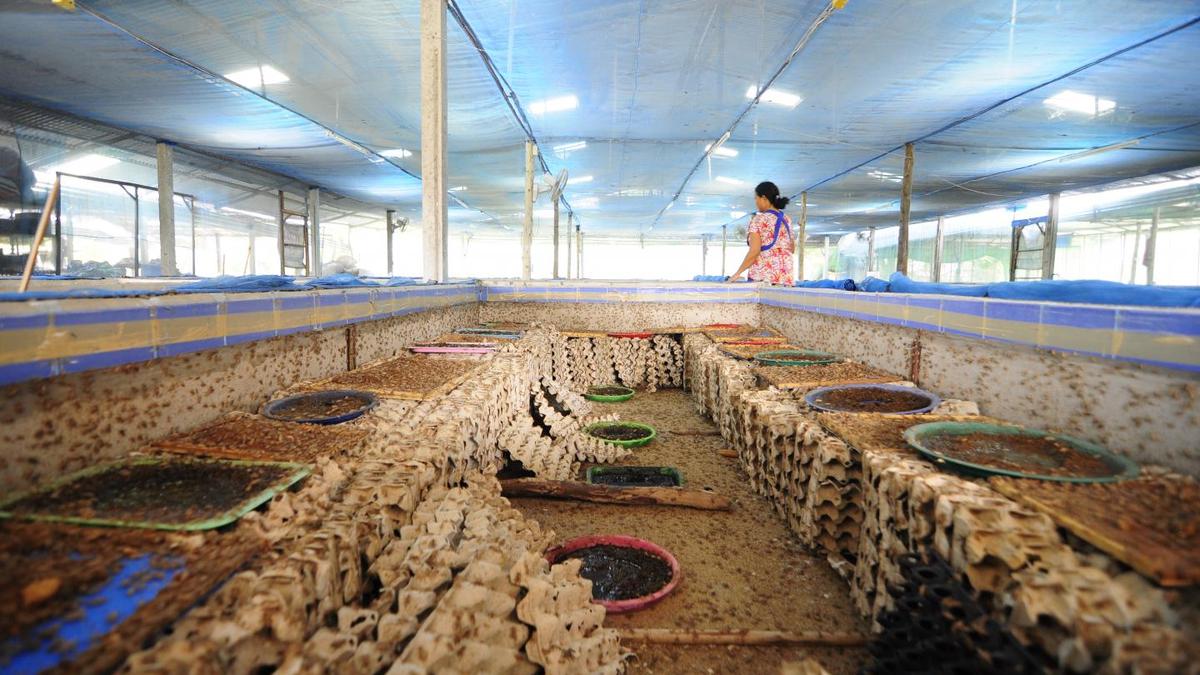
Far less attention has been paid to Orthoptera, the group that includes grasshoppers, locusts and crickets. That gap matters, because the house cricket (Acheta domesticus) is the world’s most widely farmed insect, with more than 370 billion reared annually.

Do crickets feel pain?

We tested 40 male and 40 female crickets, each experiencing three conditions in random order: a hot probe to a single antenna (65 °C, to activate damage receptors but not cause lasting injury), the same probe unheated, or no contact at all.

We filmed their behaviour for ten minutes. Observers scoring the footage did not know which treatment any animal had received.

The results were clear. After the hot probe, crickets were more than twice as likely to groom the affected antenna compared to controls, and spent roughly four times longer doing so.

Could this simply reflect general disturbance rather than targeted care? Unlikely: grooming was directed specifically at the heated side, not spread evenly across both antennae as it was after gentle touch or no contact.

And the behaviour wasn’t a brief, reflexive reaction. It was elevated from the outset and tapered gradually over minutes, much like rubbing a burned hand as the felt sting slowly fades.

Small minds, big feelings

Subjective experience cannot be directly observed in any animal, not even humans.

But we have shown crickets respond to harm in a way that satisfies a key criterion many scientists and philosophers use to infer pain: flexible, directed self-protection. Combined with the knowledge that crickets possess damage receptors, can learn to avoid harms, and respond less to injury under morphine, the weight of evidence for an inner life is growing.

The practical stakes are real. Hundreds of billions of farmed insects are slaughtered each year by freezing, boiling and baking. Pesticides kill trillions more, optimised for lethality with no consideration of potential suffering.

If we take a precautionary approach, credible evidence of suffering should motivate proportionate protections well before we are certain.

Insects have been around for more than 400 million years and are far more behaviourally and cognitively sophisticated than once assumed. The question, then, may not be whether some insects feel, but why we ever assumed they couldn’t.

Thomas White is associate professor, School of Life and Environmental Sciences, University of Sydney. Kate Lynch is senior lecturer in Philosophy of Science, University of Sydney. This article is republished from The Conversation.

Published – May 30, 2026 09:00 am IST



Source link

Science

Post navigation

Previous Post: Siddaramaiah, a trenchant critic of Hindutva politics
Next Post: OMCs asked to maintain LPG reserves to meet at least thirty days of demand: Official

Related Posts

  • 75 years since Assam quake, Himalayas prep for large hydro projects
    75 years since Assam quake, Himalayas prep for large hydro projects Science
  • Putin aims to have Russian space station by 2027
    Putin aims to have Russian space station by 2027 Science
  • Microbe might spark first stages of ulcerative colitis: new study
    Microbe might spark first stages of ulcerative colitis: new study Science
  • Nipah infection possible in more places in Southeast Asia, says Nature article
    Nipah infection possible in more places in Southeast Asia, says Nature article Science
  • Precision biotherapeutics | Explained – The Hindu
    Precision biotherapeutics | Explained – The Hindu Science
  • Constant mechanical force may be why heart cancer is so rare
    Constant mechanical force may be why heart cancer is so rare Science

More Related Articles

What are Milankovitch Cycles? – The Hindu What are Milankovitch Cycles? – The Hindu Science
The Science Quiz | Security features of rupee notes The Science Quiz | Security features of rupee notes Science
India home to 191 species of cockroaches, 60% of them are endemic, says ZSI study India home to 191 species of cockroaches, 60% of them are endemic, says ZSI study Science
Imperial College London and Science Gallery Bengaluru announce joint fellowship programme, co-development of research facilities Imperial College London and Science Gallery Bengaluru announce joint fellowship programme, co-development of research facilities Science
Who are the winners of the 2025 Nobel Prize in Physiology or Medicine? Who are the winners of the 2025 Nobel Prize in Physiology or Medicine? Science
Nuclear fusion cost models too optimistic to be viable, experts warn Nuclear fusion cost models too optimistic to be viable, experts warn Science
SiteLock

Archives

  • June 2026
  • May 2026
  • April 2026
  • March 2026
  • February 2026
  • January 2026
  • December 2025
  • November 2025
  • October 2025
  • September 2025
  • August 2025
  • July 2025
  • June 2025
  • May 2025
  • April 2025
  • March 2025
  • February 2025
  • January 2025
  • December 2024
  • November 2024
  • October 2024
  • September 2024
  • August 2024
  • July 2024
  • June 2024
  • May 2024
  • April 2024
  • March 2024
  • February 2024
  • January 2024
  • December 2023
  • November 2023
  • October 2023
  • September 2023
  • August 2023
  • July 2023
  • June 2023
  • May 2023
  • April 2023
  • March 2023
  • February 2023
  • January 2023
  • December 2022
  • November 2022
  • October 2022
  • September 2022
  • August 2022
  • July 2022
  • June 2022
  • May 2022

Categories

  • Business
  • Nation
  • Science
  • Sports
  • World

Recent Posts

  • LUCC scam: CBI arrests two masterminds
  • Canada is failing Jewish community and Jews are being targeted: PM Carney
  • Trump administration proposes 25% tariff to punish Brazil over trade practices
  • Fire breaks out at steel plant in Chhattisgarh, no casualties
  • Heavy smoke emanate from Chennai Port as sulphur particles react to heat

Recent Comments

  1. BrandonGoori on UP Teacher Who Asked Students To Slap Muslim Classmate
  2. JamesGog on UP Teacher Who Asked Students To Slap Muslim Classmate
  3. Arthurswoks on UP Teacher Who Asked Students To Slap Muslim Classmate
  4. Charlesled on UP Teacher Who Asked Students To Slap Muslim Classmate
  5. WaltonSkedy on UP Teacher Who Asked Students To Slap Muslim Classmate
  • Access Denied World
  • Access Denied Business
  • Highway collapse in China’s southern Guangdong province leaves at least 19 dead, state media says
    Highway collapse in China’s southern Guangdong province leaves at least 19 dead, state media says World
  • Access Denied Business
  • Access Denied
    Access Denied Nation
  • Yogendra Bhadoria, Radhika Prasad Shine As India Thrash England To Lift Physically Disabled Champions Trophy
    Yogendra Bhadoria, Radhika Prasad Shine As India Thrash England To Lift Physically Disabled Champions Trophy Sports
  • Access Denied Business
  • Access Denied World

Editor-in-Chief:
Mohammad Ariff,
MSW, MAJMC, BSW, DTL, CTS, CNM, CCR, CAL, RSL, ASOC.
editor@artifex.news

Associate Editors:
1. Zenellis R. Tuba,
zenelis@artifex.news
2. Haris Daniyel
daniyel@artifex.news

Photograher:
Rohan Das
rohan@artifex.news

Artifex.News offers Online Paid Internships to college students from India and Abroad. Interns will get a PRESS CARD and other online offers.
Send your CV (Subjectline: Paid Internship) to internship@artifex.news

Links:
Associate Journalism
About Us
Privacy Policy

News Links:
Breaking News
World
Nation
Sports
Business
Entertainment
Lifestyle

Registered Office:
72/A, Elliot Road, Kolkata - 700016
Tel: 033-22277777, 033-22172217
Email: office@artifex.news

Editorial Office / News Desk:
No. 13, Mezzanine Floor, Esplanade Metro Rail Station,
12 J. L. Nehru Road, Kolkata - 700069.
(Entry from Gate No. 5)
Tel: 033-46011099, 033-46046046
Email: editor@artifex.news

Copyright © 2023 Artifex.News Newsportal designed by Artifex Infotech.