



Skip to content
  • Facebook
  • X
  • Linkedin
  • WhatsApp
  • YouTube
  • Associate Journalism
  • About Us
  • Privacy Policy
  • 033-46046046
  • editor@artifex.news
Artifex.News

Artifex.News

Stay Connected. Stay Informed.

  • Breaking News
  • World
  • Nation
  • Sports
  • Business
  • Science
  • Entertainment
  • Lifestyle
  • Toggle search form
  • Access Denied World
  • 2 Coaches, Engine Of Train Derail At Prayagraj Station In UP, None Injured
    2 Coaches, Engine Of Train Derail At Prayagraj Station In UP, None Injured Nation
  • “When I Dismissed Sachin Tendulkar…”: Shoaib Akhtar’s Question Stumps Viral Dolly Chaiwala. Video
    “When I Dismissed Sachin Tendulkar…”: Shoaib Akhtar’s Question Stumps Viral Dolly Chaiwala. Video Sports
  • Lebanon May Be Seeing “Largest Displacement” Ever, Says PM Najib Mikati
    Lebanon May Be Seeing “Largest Displacement” Ever, Says PM Najib Mikati World
  • Nobel laureate Yunus appears before Bangladesh graft watchdog
    Nobel laureate Yunus appears before Bangladesh graft watchdog World
  • IPL 2026 | We trusted our spinners to deliver the goods: Raghuvanshi
    IPL 2026 | We trusted our spinners to deliver the goods: Raghuvanshi Sports
  • U.N. report lauds India’s gender budgeting initiatives
    U.N. report lauds India’s gender budgeting initiatives World
  • Avoid costly mistakes in retirement plans
    Avoid costly mistakes in retirement plans Business
Sabastian Sawe Breaks 2-Hour Marathon Barrier: Historic Run, Diet & Training Secrets

Sabastian Sawe Breaks 2-Hour Marathon Barrier: Historic Run, Diet & Training Secrets

Posted on May 1, 2026 By admin


What do you eat before running the fastest marathon in history? Sabastian Sawe chose a pre-race breakfast of two slices of bread with honey, washed down with a cup of tea — a modest meal, but one that experts say fuelled him with easily digestible, fast-acting carbohydrates and sugar, hydration and a caffeine boost.

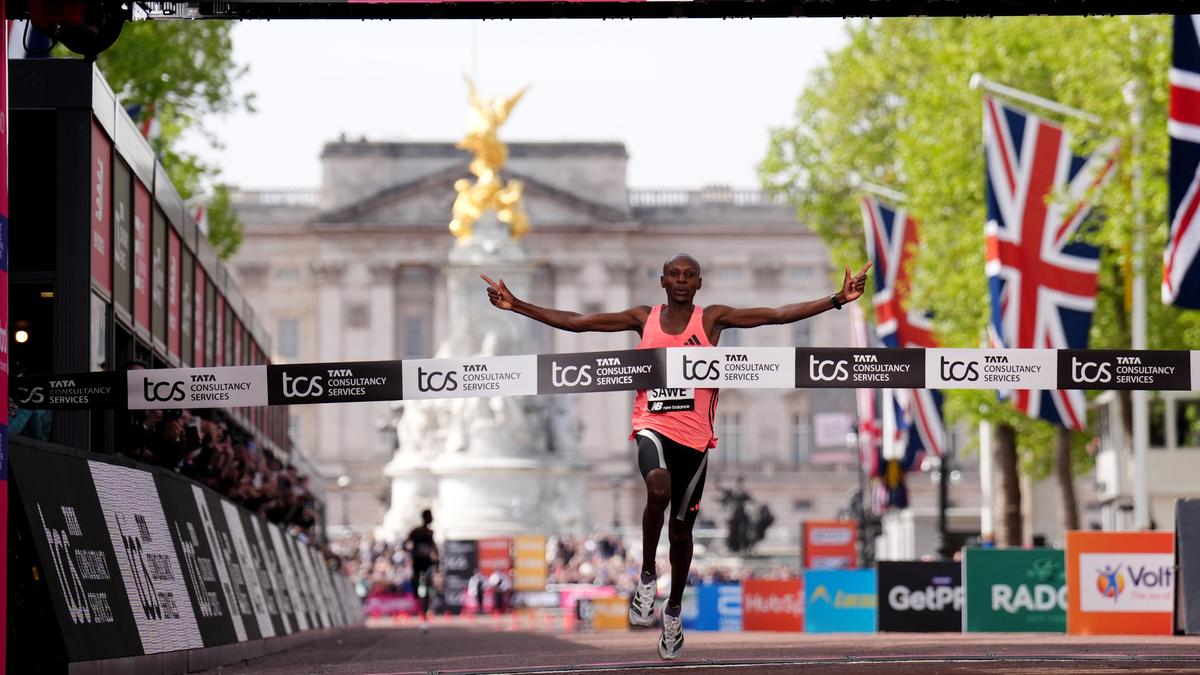
The 31-year-old Kenyan, who on Sunday became the first man to take less than two hours to run a marathon in race conditions, is assured of immortality. His feat is a first-ballot candidate for any sporting hall of fame; his breakfast has a strong case for entering the culinary wing.

Cultural significance

Sawe’s shattering of the long-unapproachable two-hour barrier in London ranks alongside Roger Bannister’s first sub-four-minute mile at Oxford in 1954 in terms of cultural significance. Both achievements have expanded the perception of what was thought humanly possible. For context, the first sub-2:30 marathon came in 1925 and the 2:15 barrier was broken 38 years after that; at the turn of the century, the world’s best time was 2:05:42, set in 1999.

Sawe’s time of 1hr 59min 30 sec was an astonishing 65 seconds inside the previous best of 2:00:35 set in Chicago in 2023 by Kelvin Kiptum, whose death in a car crash in 2024 plunged Kenya into mourning. Two years later, Sawe gave his country reason to rejoice.

Incredibly, 11 seconds after the unthinkable happened, it happened again. The marathon had its second sub-two runner. Ethiopia’s Yomif Kejelcha, 28, finished second in 1:59:41 on his marathon debut. (Kenyan great Eliud Kipchoge did run a marathon in under two hours in 2019, but his 1:59.40 did not make the record books, as it was a specially tailored event in favourable conditions, not a competitive race.)

Sawe’s statistics were dizzying. He completed the London Marathon — on a relatively flat course on a mostly sunny day (15 degrees Celsius), ideal for running — with a negative split. The second half of his race was faster than the first. With the assistance of pacemakers in the initial kilometres, he did the first half in 60:29 and then sped up, clocking a remarkable 59:01 for the second. He averaged 21.2 km per hour, or 2 minutes 49.9 seconds per kilometre.

“I have shown that nothing is not possible,” said Sawe. “I had courage to push even when the pace was so fast. I was not bothered because I was ready for it.”

Running 42.195 kilometres — a distance that has been around since ancient times — in less than 120 minutes was once treated as a natural physiological ceiling. A marathon tests a human being’s energy supply (accessing and burning ‘fuel’ without dropping pace), aerobic limit (maximal oxygen uptake), and biomechanical precision (running form and cadence).

So how did Sawe ace this test? The Kenyan, born in the Rift Valley Province to a father who worked as a maize farmer and raised by his grandmother in a mud-walled house, is extraordinarily talented and trains with punishing intensity.

“Definitely physiologically, Sabastian has to be a good one,” said Claudio Berardelli, the Italian coach who recognised Sawe’s potential and has since guided him on the path to greatness. “But all the pieces come together perfectly because of his attitude, because of his character. In 22 years I’ve been coaching in Kenya I thought I’d seen pretty much everything, but then Sabastian started to show me something which I thought was almost impossible.”

Elevated at altitude

Sawe’s high-volume training at altitude in Kapsabet, Nandi County, with a strong group of athletes who push him, has contributed significantly to his progress. In London, Berardelli said his athlete had been even fitter than in Berlin in September when the late-summer heat had spoiled his previous assault on the world record.

“In the last six weeks he was averaging 200km and above a week, while the peak was 241km,” said Berardelli. “I knew he was super-good for Berlin, but he couldn’t express himself because of the conditions. But when I started to see him running the way he ran before London, I was like, hey, something special might come out.”

While a large part of Sawe’s success is a consequence of his talent and its careful nurturing, there is no doubt that he has benefited from the developments in nutrition and — to a greater degree — the technological arms race launched by shoe companies a decade ago, when they began using carbon-fibre plates and other materials to make shoes lighter and springier.

“We are in the new era of marathon running because of the shoe and proper fuelling,” Berardelli said. According to the BBC, Sawe reportedly worked with a research team from a sports nutrition brand which specialises in hydrogels. He trained to absorb 90-120 grams of carbohydrates per hour during the race without feeling distress. This tops the glycogen levels up, allowing the body to use carbohydrates, rather than slower-burning fat reserves, as fuel.

Cutting edge: The newly developed Adidas shoes Sawe wore to navigate the streets of London were the lightest in history, the first ‘super shoe’ to weigh under 100g.
| Photo Credit:
Getty Images

The newly developed Adidas shoes Sawe wore to navigate the streets of London were the lightest in history, the first ‘super shoe’ to weigh under 100g. They clearly made a difference — second-placed Kejelcha was wearing them too.

The combination of thick foam in the sole, shaped with a ‘drop’ from heel to forefoot to keep runners ‘forward’ in their stride cycle, and stiff carbon in the midsoles, which store and return energy, reportedly acts as a lever and spring system.

The result is better running economy — in ‘super shoes’, athletes burn less energy at a given pace than in regular running shoes. There has been criticism of ‘super shoes’, the argument being that using them is akin to mechanical doping. World Athletics has tried to regulate the revolution, but there is no doubt that it has played a major role in the lowering of times.

Sawe’s achievement will inevitably be viewed against the backdrop of an appalling series of doping cases among Kenyan athletes in the last few years. But, in a bid to allay such suspicions about his own performances, he has voluntarily subjected himself to extra drug testing. Adidas provided $50,000 to the Athletics Integrity Unit to frequently test Sawe over a 12-month period.

That began with a reported 25 out-of-competition tests in the lead-up to Berlin in September, continuing at a similar rate as he prepared for London.

Next up: Mission 1:59?

The obvious question is whether Sawe can run even faster. Berardelli believes that his athlete could breach 1:59 on a quicker course such as Berlin or Chicago. “Sabastian hasn’t reached his maximum potential. It was only his fourth marathon, if we think of long-term adaptations, which is a process requiring time, I believe Sabastian has not reached this yet,” said Berardelli.

“When I started dealing with Sabastian, I immediately realised this is not just one of the best Kenyan guys. At least for my experiences, he is a different human being. An outlier.”


Source link

Sports Tags:Eliud Kipchoge, fastest marathon ever, Kelvin Kiptum, Kenyan runners, London Marathon record, marathon nutrition, marathon training, marathon world record, running performance, Sabastian Sawe, sub 2 hour marathon, super shoes technology, Yomif Kejelcha

Post navigation

Previous Post: Abu Dhabi’s OPEC exit begins its ascent of ‘peak oil’
Next Post: India to tap augmented solar capacity, coal to weather El Nino, summer-related power demand

Related Posts

  • Access Denied Sports
  • Access Denied Sports
  • KL Rahul Floors Cricket World, Experts Bow Down To India Star’s Gabba Show
    KL Rahul Floors Cricket World, Experts Bow Down To India Star’s Gabba Show Sports
  • Travis Head’s ‘Obscene’ Finger Celebration Explained After Social Media Furore During MCG Test
    Travis Head’s ‘Obscene’ Finger Celebration Explained After Social Media Furore During MCG Test Sports
  • Spinners lift Pakistan to 6-wicket win over Sri Lanka to clinch T20 tri-series title
    Spinners lift Pakistan to 6-wicket win over Sri Lanka to clinch T20 tri-series title Sports
  • Access Denied Sports

More Related Articles

India Star, Who Has 170 Test Wickets, Opens Up About IPL 2025 Snub : “Shocking…” India Star, Who Has 170 Test Wickets, Opens Up About IPL 2025 Snub : “Shocking…” Sports
Vinod Kambli ‘Stable’ After Major Health Scare, Receives Rs 5 Lakh Aid From… Vinod Kambli ‘Stable’ After Major Health Scare, Receives Rs 5 Lakh Aid From… Sports
Access Denied Sports
Wesley Koolhof Interview | Doubles tennis is a great different discipline Wesley Koolhof Interview | Doubles tennis is a great different discipline Sports
Access Denied Sports
SiteLock

Archives

  • May 2026
  • April 2026
  • March 2026
  • February 2026
  • January 2026
  • December 2025
  • November 2025
  • October 2025
  • September 2025
  • August 2025
  • July 2025
  • June 2025
  • May 2025
  • April 2025
  • March 2025
  • February 2025
  • January 2025
  • December 2024
  • November 2024
  • October 2024
  • September 2024
  • August 2024
  • July 2024
  • June 2024
  • May 2024
  • April 2024
  • March 2024
  • February 2024
  • January 2024
  • December 2023
  • November 2023
  • October 2023
  • September 2023
  • August 2023
  • July 2023
  • June 2023
  • May 2023
  • April 2023
  • March 2023
  • February 2023
  • January 2023
  • December 2022
  • November 2022
  • October 2022
  • September 2022
  • August 2022
  • July 2022
  • June 2022
  • May 2022

Categories

  • Business
  • Nation
  • Science
  • Sports
  • World

Recent Posts

  • ‘Bussy’ N. Anand: Vijay’s close confidante likely to be part of new Tamil Nadu Cabinet
  • Delhi judges grapple with rising threats and little protection
  • What is India’s first orbital data centre satellite?
  • EAM Jaishankar hands over India-assisted agro-processing facility in South Trinidad
  • Forest Department fills tanks, ponds with water in Vallanaadu Blackbuck Sanctuary

Recent Comments

  1. JosephSpupE on UP Teacher Who Asked Students To Slap Muslim Classmate
  2. SteveTeF on UP Teacher Who Asked Students To Slap Muslim Classmate
  3. Andrewfoods on UP Teacher Who Asked Students To Slap Muslim Classmate
  4. DonaldGlymn on UP Teacher Who Asked Students To Slap Muslim Classmate
  5. ShaneElden on UP Teacher Who Asked Students To Slap Muslim Classmate
  • Watch: Trump 2.0: What should India watch out for?
    Watch: Trump 2.0: What should India watch out for? World
  • Access Denied
    Access Denied Nation
  • Sophie Devine to step down as New Zealand’s women’s T20 captain after World Cup
    Sophie Devine to step down as New Zealand’s women’s T20 captain after World Cup Sports
  • Wife Kills Businessman After He Refused 8 Crore, Drives 800 Km To Dump Body
    Wife Kills Businessman After He Refused 8 Crore, Drives 800 Km To Dump Body Nation
  • Women Voters Outnumber Men By 3 Per Cent In Phase 6 Of Lok Sabha Polls
    Women Voters Outnumber Men By 3 Per Cent In Phase 6 Of Lok Sabha Polls Nation
  • Israel says 170 Gaza gunmen killed in hospital raid
    Israel says 170 Gaza gunmen killed in hospital raid World
  • Bengaluru Blast Suspect Identified “In A Way”, Efforts On To Catch Him: Karnataka Minister
    Bengaluru Blast Suspect Identified “In A Way”, Efforts On To Catch Him: Karnataka Minister Nation
  • 60-Year-Old Man Rapes Five Years Old Girl In UP, Then Kills Himself: Cops
    60-Year-Old Man Rapes Five Years Old Girl In UP, Then Kills Himself: Cops Nation

Editor-in-Chief:
Mohammad Ariff,
MSW, MAJMC, BSW, DTL, CTS, CNM, CCR, CAL, RSL, ASOC.
editor@artifex.news

Associate Editors:
1. Zenellis R. Tuba,
zenelis@artifex.news
2. Haris Daniyel
daniyel@artifex.news

Photograher:
Rohan Das
rohan@artifex.news

Artifex.News offers Online Paid Internships to college students from India and Abroad. Interns will get a PRESS CARD and other online offers.
Send your CV (Subjectline: Paid Internship) to internship@artifex.news

Links:
Associate Journalism
About Us
Privacy Policy

News Links:
Breaking News
World
Nation
Sports
Business
Entertainment
Lifestyle

Registered Office:
72/A, Elliot Road, Kolkata - 700016
Tel: 033-22277777, 033-22172217
Email: office@artifex.news

Editorial Office / News Desk:
No. 13, Mezzanine Floor, Esplanade Metro Rail Station,
12 J. L. Nehru Road, Kolkata - 700069.
(Entry from Gate No. 5)
Tel: 033-46011099, 033-46046046
Email: editor@artifex.news

Copyright © 2023 Artifex.News Newsportal designed by Artifex Infotech.