



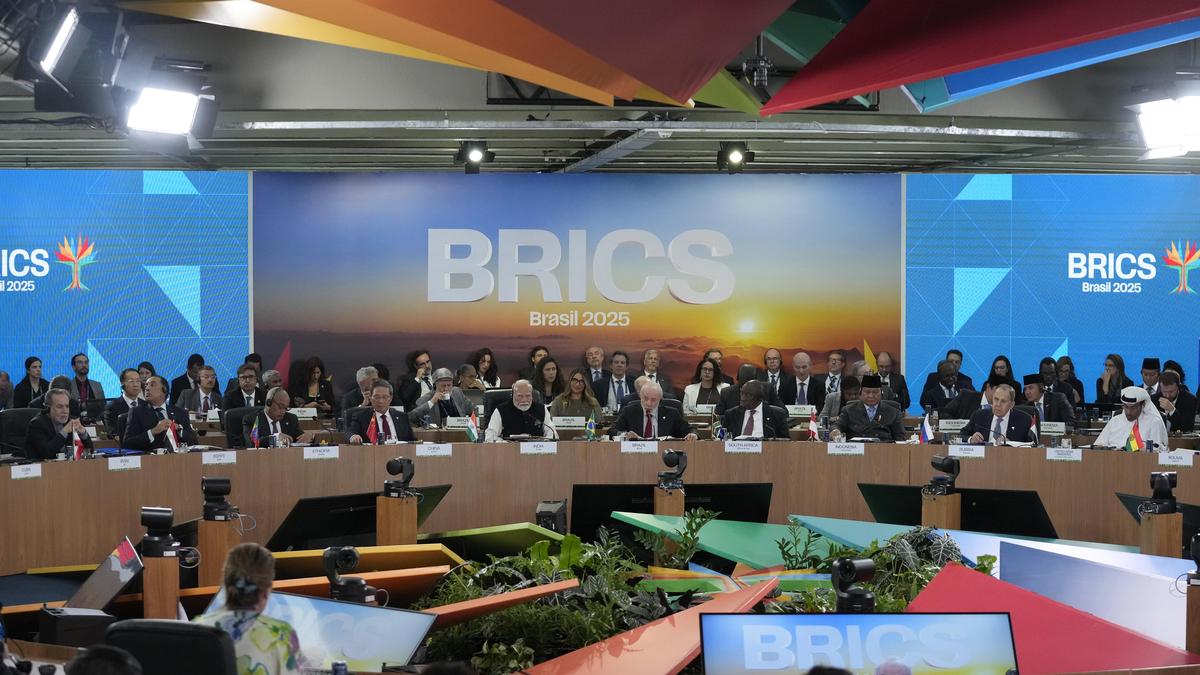
The BRICS grouping, comprising Brazil, Russia, India, China, and South Africa, is a globally significant collective defined by its substantial contributions to global GDP, scientific and technological capacity, natural resources, and total population. Since its formation, the group has evolved into a prominent international voice, representing countries that seek to challenge and provide an alternative to Western hegemony. BRICS functions as a collaborative force aimed at establishing a multipolar world system. While the group’s positions on global finance and macro-economic issues are widely recognised, the depth of cooperation among member states regarding science, technology, and innovation (STI) remains less publicised.
At a time in which global scientific collaboration is increasingly dictated by geopolitical tensions, techno-nationalism, and strategic competition, often manifesting as sanctions and export controls, BRICS assumes a critical role in the global STI landscape. Through this platform, member nations coordinate their strategies, amplify their collective voice in global economic governance, and influence development finance through institutions like the New Development Bank.
These members are also vital contributors to global trade, energy production, and the supply of essential natural resources. The 2022 launch of BRICS+ signaled a move towards a more inclusive forum, fostering development and political cooperation across the Global South to reduce technological dependencies. This collaboration is now a concrete effort to build shared capacities through various framework programmes. The group’s current membership has expanded to include Saudi Arabia, Egypt, the UAE, Ethiopia, Indonesia, and Iran.
Cooperation in STI
Cooperation in STI has been a part of the BRICS agenda since its early years. It was formally recognised in 2011 and later consolidated in meetings between senior officials and the BRICS Ministers of Science, Technology, and Innovation. A pivotal 2015 memorandum of understanding established STI as a core strategic pillar, providing the necessary institutional framework and operational signals for collaborative research and capacity-building. This framework has since expanded the scope of cooperation, allowing members to leverage their complementary strengths to address shared development challenges and advance frontier sciences.
The first BRICS Action Plan for Innovation Cooperation (2017-2020) tasked the Science, Technology, Innovation, and Entrepreneurship Partnership (STIEP) Working Group with implementing various programmes. These initiatives focused on entrepreneurship networks, the role of youth and women in STI, and collaborations regarding technology transfer and business incubators. Over time, BRICS has moved from early joint research calls focused on fundamental science toward prioritising innovation and technology transfer.
These priorities are formally identified in annual ministerial declarations. The BRICS Ministers of Science, Technology, and Innovation meet once a year to approve and sign strategic documents. Within each member country, one or two lead agencies coordinate these activities, issue calls for proposals, and prepare project lists for approval during the respective country’s presidency. For example, during India’s chairmanship, the Council of Scientific and Industrial Research (CSIR) and the Department of Biotechnology (DBT) serve as the lead agencies.
A clear emphasis on innovation-driven and technology-enabled ecosystems is evident in recent summit themes and initiatives such as iBRICs and the BRICS Technology Transfer Centre (TTC). The TTC has made notable progress in creating policy frameworks and institutional links for cross-border technology commercialisation. However, despite this progress, large-scale commercialisation of these technologies remains limited.
The focus of BRICS joint research calls has transitioned from basic science and enabling technologies to include more socially relevant areas such as energy, water, health, and the environment. The COVID-19 pandemic accelerated this shift, placing a premium on public health, vaccine research, biosecurity, and digital health. Recent calls have integrated high-performance computing (HPC), advanced materials, information and communication technology (ICT), and space-related applications. Scientific collaboration has strengthened over time, with a growing focus on artificial intelligence and data-intensive science.
While working groups reflect these shared development priorities, their progress varies across different fields. Significant progress is visible in ICT and HPC, highlighted by the establishment of the BRICS Institute of Future Networks, as well as in space cooperation following a 2021 intergovernmental agreement. Conversely, areas that require heavy infrastructure or are more exploratory, such as mega-science projects and ocean or polar research, have developed slower.
The expansion of BRICS has positioned it as a more inclusive platform for knowledge exchange and collaborative research. The 2025 Declaration on AI, elevated artificial intelligence from a sub-theme, to a central pillar of multilateral governance. This declaration outlines a vision for AI governance that is equitable, inclusive, and development-oriented, moving the partnership towards a strategic collaboration with direct economic and societal relevance. While the 2021-24 Action Plan focused on networking and thematic frameworks, subsequent plans aim to scale projects for greater impact, focusing on biotechnology, climate tech, industrial innovation, and AI.
Under India’s 2026 Presidency, with the theme ‘Building for Resilience, Innovation, Cooperation and Sustainability’, the group is positioned to deepen its scientific partnerships. The goal is to leverage expanded membership to strengthen capacities and address challenges like digital divides, public health crises, and climate resilience. However, participation from new members remains uneven; among the most recent additions, only Egypt and Iran joined the call for proposals issued last December. Additionally, the China-BRICS Research Centre on New Quality Productive Forces was recently inaugurated in Beijing. This center serves as an international platform for academic exchange and technological research.
Consequences and concerns
When compared to nations like South Korea, the National Innovation Systems (NIS) of BRICS countries exhibit various strengths and weaknesses. Specifically, gross domestic expenditure on research and development (GERD) is relatively lower across the group, with the exception of China. Research suggests that the gap between BRICS nations and South Korea is wide, and member countries excluding China have significant catching up to do according to various innovation indicators. With the expansion into BRICS+, the innovation systems of new members also require assessment and strengthening. This strengthening could be a priority for BRICS over the next decade, with the potential to eventually replicate these improvements across the broader Global South.
As noted by Stanford University visiting scholar Irina Dezhina, the heterogeneity of new members in terms of both economic development and scientific capacity makes it difficult to reconcile differing interests. Consequently, BRICS+ may need to focus on catalysing new “paired links” between specific members. Comparisons to the European Union (EU) suggest that BRICS could learn from the EU’s wide variety of STI programs, as BRICS currently offers more limited options. Further, although competition for funding is intense, the total funding available remains modest.
Experts suggest that these programmes must reach a new qualitative level to effectively respond to major global challenges. Currently, however, research into STI cooperation among BRICS nations is limited, and the existing mechanism lacks a framework for regular study to provide data-driven inputs to member countries.
A way forward
While BRICS countries have achieved significant collaboration, there are questions regarding whether the current framework is sufficient for future needs. A primary concern is the lack of a permanent mechanism to manage STI cooperation. The current system, where the lead role rotates annually with the presidency, is not ideally suited for long-term requirements. BRICS could potentially model a central mechanism after the EU’s Horizon Program, establishing a Secretariat to manage funds, issue calls for proposals, monitor progress, and review outcomes.
Developing a few long-term Mega-science Projects could also foster deeper cooperation. The framework for STI cooperation should eventually expand beyond just funding science and technology projects; it should promote research into the governance of STI and the impact of emerging technologies on BRICS+ nations. This would facilitate greater coherence in international treaty negotiations and help build capacity for STI governance.
In conclusion, while STI cooperation within BRICS has progressed significantly since 2015 despite various constraints, there is substantial room for improvement. Making the framework more effective, agile, and credible will enhance the group’s legitimacy in the global arena. As the chair of BRICS+ in 2026, India has the opportunity to lead this transition.
Krishna Ravi Srinivas is Adjunct Professor of Law, Director CoE in AI & Law, NALSAR University of Law, Hyderabad. Sneha Sinha is Consultant, Research and Information System for Developing Countries (RIS), New Delhi