






Imagine you are given three gumballs of different flavours. You are told that one of them is heavier than the others, and one is lighter. But which is which? Your task is made difficult by the fact that these gumballs weigh nearly nothing. And sometimes they swap flavours. Oh, and when you try to pick them up, most of the time they simply pass through your hand.
Such is the task facing physicists attempting to get a handle on the ghostly subatomic particle known as the neutrino. These teeny-tiny particles, which theory currently says come in three types, or “flavours,” flood the universe but rarely interact with the ordinary matter we are all familiar with. This makes them bafflingly hard to study, despite their amazing abundance.
But cracking the questions of how much neutrinos weigh, and which are the heaviest, is of vital importance to particle physicists. The Standard Model that they have painstakingly developed to describe all of nature’s particles and forces explicitly says that neutrinos have no mass at all. Yet observations have established that neutrinos do, in fact, have a very small mass. This is an annoying and critical exception to the standard rules of physics, with implications for other theories. For anyone who wants to understand the universe, fixing this problem is imperative.
The good news is that physicists are making excellent progress and have a good chance of figuring out the order of neutrino masses in just a few years, certainly by 2030, they say. “I think we will have a strong evidence, one way or the other,” says André de Gouvêa, a theoretical particle physicist at Northwestern University.
Data collected in experiments done around the world over the past 35 years have led to better and better estimates for the average mass of the neutrino (diagram shows error bars for each measurement). The latest results (inset) show a narrower range of uncertainty and put the value very close to zero, at least 500,000 times lighter than an electron.
| Photo Credit:
Knowable Magazine
Unseen and everywhere
While they may be shy, neutrinos are everywhere: They are the second most abundant thing in the universe after photons, particles of light.
“It’s kind of strange that we know so little about the second most abundant one, right?” says Carlos Argüelles, a neutrino physicist at Harvard University.
Neutrinos are created by nuclear reactions within the sun and stars, by cosmic rays traveling through the atmosphere, and by other cosmic and earthly reactions. They can also be generated by nuclear power plants and in particle accelerators. It is thought that tens of billions of neutrinos pass through every square centimeter of Earth every second, without anyone noticing a thing.
Neutrinos have been a puzzle for nearly 100 years. Physicists first dreamed them up in the 1930s, to help explain certain baffling properties of radioactive decay. The first experiment to detect neutrinos directly was published in 1956. At that point, scientists assumed they had no mass.
From the late 1960s to the 1990s, though, detectors spotted far fewer neutrinos coming from the Sun than expected, prompting some to worry that our star might be “going out.” Instead, it turned out that the sneaky neutrinos were switching (or “oscillating”) between three types (or “flavors”) as they flew, so that many evaded detection. This observation meant that, according to Einstein’s theory of relativity, neutrinos must, in fact, have some mass.
“Neutrinos like to misbehave. That’s why we might find them interesting,” says Argüelles. “They like to do things they are not supposed to be doing.”
Weirdly (as is often the case in the quantum world), neutrinos are thought to be made up of three underlying mass states that mix together with different probabilities to produce the electron, muon and tau neutrinos that experiments have detected. One of these mass states is heaviest and one is lightest.
There are two possibilities for the order of these masses. In what is called “normal” mass ordering, the electron neutrino would be mostly made of the lightest mass state, with the tau flavor drawing more from the heavier state and the muon in the middle. But it might be the other way around. In the “inverted” ordering, the electron neutrino would instead be mostly made of the heaviest mass. Which order is right?
This question about mass ordering turns out to be easier to answer than the more precise question of exactly how much neutrinos weigh, as the answer can be found by checking on the details of neutrino flavor oscillations. Even so, this “easy” question is taking a set of multimillion dollar experiments and plenty of years to answer.
Put in their place
Most neutrino detectors work by spotting flashes of light made as neutrinos occasionally interact with the particles in some giant volume of liquid, such as water, as they pass through. Different flavours make different patterns: One creates a straight track through water, for example, while the interactions of another create a little fireworks display of tracks.
Because these interactions are rare and hard to detect perfectly, researchers need to gather a lot of data over a long time before they are confident enough to make statistically sound conclusions about what they have seen and what it implies.
Some of these detectors are designed to spy in part on neutrinos made by the interactions of cosmic rays in our atmosphere. These detectors gain valuable insights by looking at the difference between neutrinos that came straight into the detector from the nearest part of the sky, versus those that came from, say, interactions on the far side of the Earth and have passed through the entire mass of the planet.

Both the air and the ground act as lenses, affecting how neutrino flavours oscillate before reaching the detector. By comparing the paths, physicists can learn a lot about neutrino oscillations, which, again, are expected to behave differently for the different mass orderings.
Such setups include IceCube, the world’s largest neutrino detector, which uses light detectors sunk on strings down long boreholes in the Antarctic ice, as well as Japan’s Super-Kamiokande detector (and Hyper-Kamiokande, now under construction and due to begin collecting data in 2028), which uses man-made vessels of water, and the newly operational ORCA detector, which catches neutrinos flying through the Mediterranean Sea. Each of these has its own pros and cons, abilities and uncertainties, but they all do roughly the same thing.
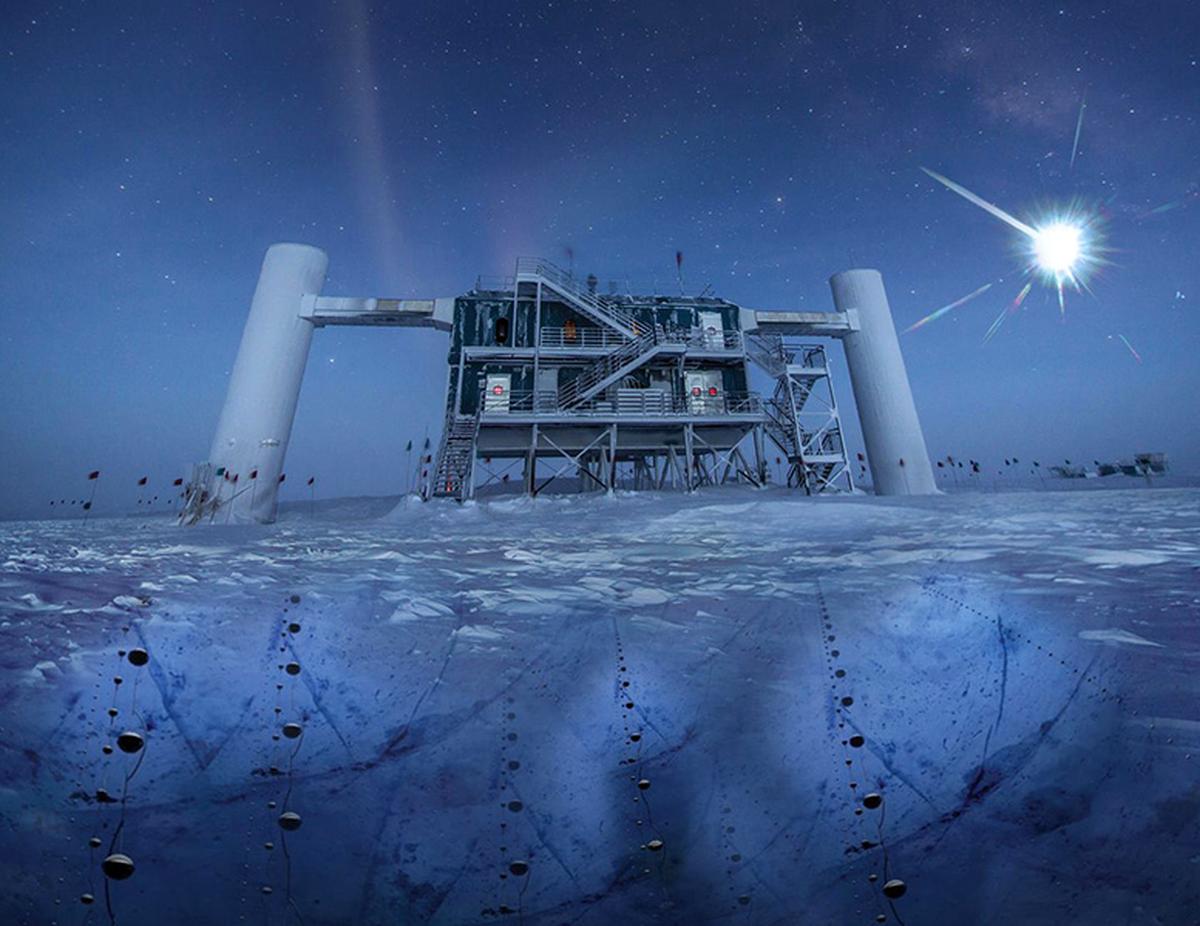
The IceCube experiment in the Antarctic, shown here in an illustration, uses long strings of light detectors buried under the ice to detect tiny flashes from occasional interactions with passing neutrinos.
| Photo Credit:
ICECUBE/NSF
Argüelles thinks that this specific set of experiments together will have collected enough data by 2030 to get a good handle on the mass ordering question.
Even better, he says, would be to compare the results from these atmospheric neutrino experiments with the results from the new Jiangmen Underground Neutrino Observatory (JUNO), a project recently built in China that started up in late August 2025.
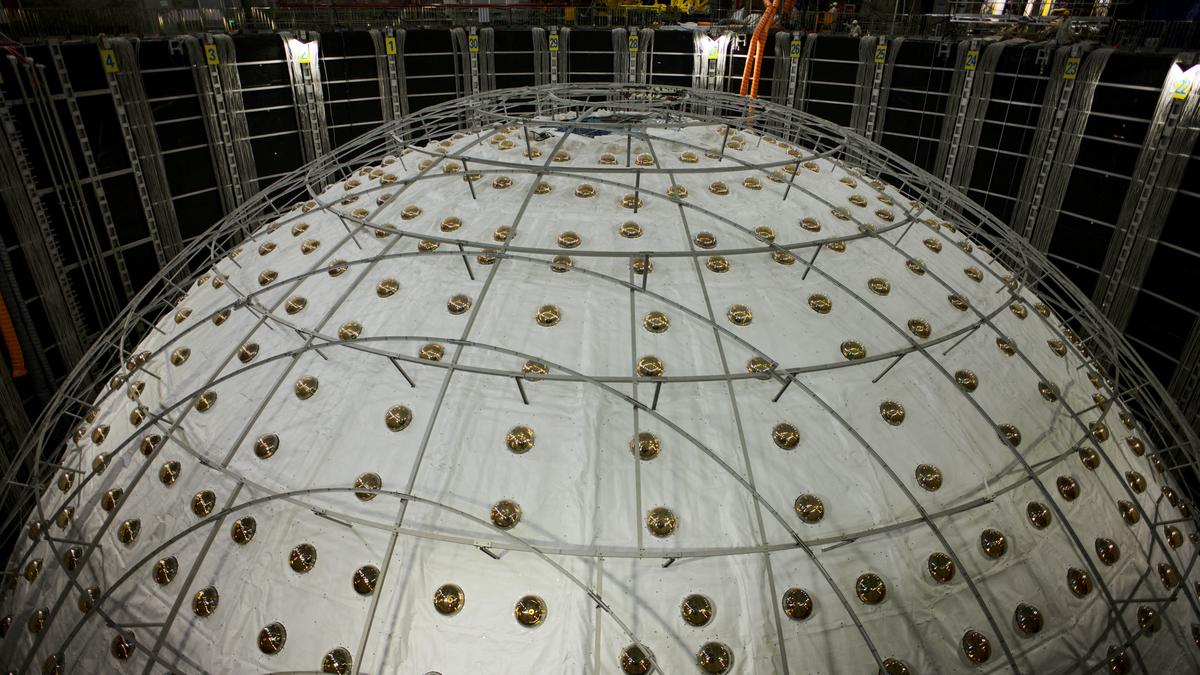
JUNO, composed of a 35-meter-wide plastic sphere deep underground, filled with 20,000 metric tons of fluid and plastered with light detectors, is special in the sense that it aims to spy on neutrinos made by nearby nuclear energy facilities. Since this neutrino source is different (nuclear energy facilities, not cosmic rays), and the neutrinos’ path is different too (just over 50 km from the source to the detector), this setup creates a complementary dataset to atmospheric experiments. Comparing the two, says Argüelles, could crack the problem of mass ordering really quickly, perhaps in just a year or two.

These are good strategies, agrees de Gouvêa, though he adds that you can run into trouble when cross-comparing results from multiple experiments, which, if you’re unlucky, can multiply errors. He thinks that the best, most reliable result will come from the Deep Underground Neutrino Experiment (DUNE) — a US project that he is involved with.
DUNE will generate an amazingly intense source of neutrinos using a particle accelerator at Fermilab in Illinois and shoot them through the ground toward a massive detector in Sanford, South Dakota, 1,300 km away. Because these neutrinos are being made intentionally for this experiment, there are a lot of them, and researchers know more about them than they do in systems that rely on natural or incidental neutrinos. This gives them a powerful advantage. But DUNE won’t turn on until around 2031.
“In particle physics units, that’s coming up very soon,” says de Gouvêa.
Which way up?
So far, early results from JUNO combined with the atmospheric experiment data seem to be hinting at a result. “The data is whispering in the normal-order direction,” says Argüelles. For some physicists, including Argüelles, this is slightly depressing news.
Theory says that a “normal” ordering means a lower overall weight for neutrinos, which will make pinning down the absolute value of that weight much harder (just because the smaller a number is, the harder it is to measure).
It also makes other theories harder to check. One theory, for example, posits that neutrinos are their own antiparticles. Under normal mass ordering and with a lower neutrino weight, the interactions we would need to witness to confirm this theory are expected to happen far less frequently — no one would be able to confirm or refute this theory using any now known experiments, says Argüelles, leaving an answer at least decades away (or impossible to determine at all).
But the jury is still out, and Argüelles is still hoping for “inverted ordering” to win out. “It would be more fun,” he says.
Weight watchers
The quest to pin down the absolute masses of neutrinos, meanwhile, is exceedingly hard. “You need detectors that have exquisitely good resolution,” says Argüelles. This is so difficult that there’s only one experiment currently capable of attempting it: the Karlsruhe Tritium Neutrino experiment (KATRIN) in Karlsruhe, Germany.
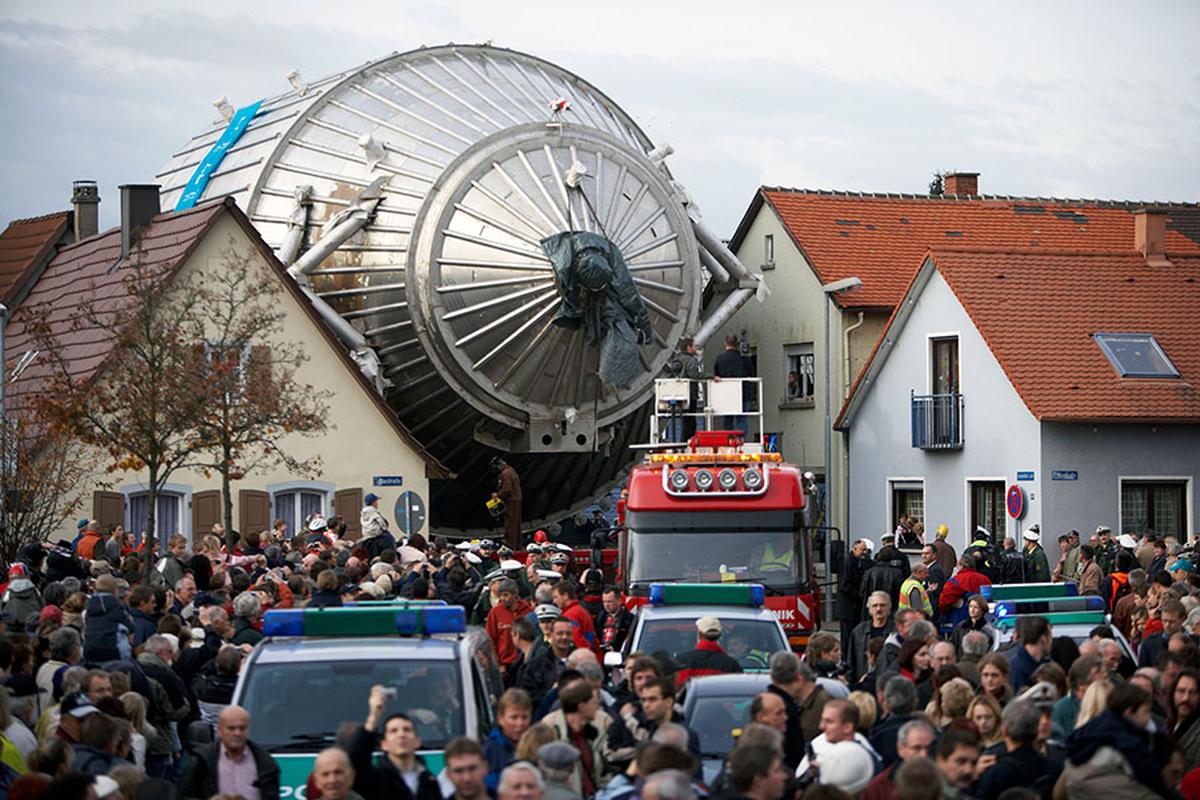
The Karlsruhe Tritium Neutrino experiment (KATRIN) — one part of it so big that it barely squeezed down streets on its way from manufacture to its home in Karlsruhe in 2006 — is the only setup today capable of determining the neutrino’s mass.
| Photo Credit:
KARLSRUHE RESEARCH CENTER
KATRIN works by taking tritium — a heavy, radioactive form of hydrogen — and letting it decay, emitting an electron and an antineutrino. The experimenters’ goal is to measure the energy of the highest-energy electrons produced, so they can infer the teeny-tiny fraction of energy that has flitted off with the unseen antineutrino. From this, they can calculate mass, since, as Einstein said, mass is equivalent to energy. Theory says that a neutrino weighs the same as an antineutrino.
The approach creates a massive number of electrons and uses a large and expensive vacuum-filled tube, 23 meters long and 10 meters wide, to filter out all but the most energetic ones. The apparatus is a beast. “It’s very big, and it’s very complicated. And so, there’s only one of its kind, and it took forever to build,” says Argüelles.
From the data KATRIN gathered from 2019 to 2022, researchers provided a first stab at an answer: The average neutrino must weigh less than 0.8eV (electron volts are used as a measure of mass). A few years and a whole lot more data later, in 2025 they nearly halved that limit to less than 0.45eV. This is extraordinarily light — at least 500,000 times lighter than an electron — and it’s a huge technical achievement. But cosmological theory suggests that the real mass is much, much lower still —perhaps smaller than 0.1eV.
“It’s very exciting to have this measurement,” says Magnus Schlösser, an astroparticle physicist involved with KATRIN at the Karlsruhe Institute of Technology. “Of course, we’d be more excited if we actually solved the neutrino masses.”

Project proposals
If neutrinos are lighter than around 0.3eV, this is beyond the ability of KATRIN to measure. So physicists are planning to up their game with other experimental setups. “The community is very innovative,” says Schlösser.
One of these is PROJECT 8: It also starts by splitting heavy hydrogen, but it measures the microwave radiation emitted from electrons as they spiral around in a magnetic field, which should offer even greater precision in assessing neutrino mass. But the project is still in the development stages, and no one knows exactly when it will get built.
Other proposed future experiments, including a next-generation effort dubbed KATRIN++, use tricks such as improving the source and measuring more electrons to crack this problem. But it will take decades yet, says Schlösser, who is hoping for an answer within 25 years, before he retires.
By chipping away at the questions of mass and mass ordering, what physicists are really trying to do is figure out why neutrinos have mass and how they get it.
“We want to know the number and the reason for the number,” says Argüelles. Are neutrinos, weirdly, their own antimatter? Do they possess some kind of previously unknown type of charge? Are we missing a batch of particles from the Standard Model altogether, including a fourth possible flavor of neutrino?
The questions are endless and the possible explanations wide and wacky. And while there aren’t exactly any known practical applications for this knowledge, it gets to the root of our understanding of everything.
“I don’t know if you care about the history of the universe,” says de Gouvêa. “But if you do, then you have to know what the neutrino masses are.”
Nicola Jones is an editor and writer who lives in Pemberton, British Columbia.
This article is republished from Knowable Magazine.