
Skip to content
  • Facebook
  • X
  • Linkedin
  • WhatsApp
  • YouTube
  • Associate Journalism
  • About Us
  • Privacy Policy
  • 033-46046046
  • editor@artifex.news
Artifex.News

Artifex.News

Stay Connected. Stay Informed.

  • Breaking News
  • World
  • Nation
  • Sports
  • Business
  • Science
  • Entertainment
  • Lifestyle
  • Toggle search form
  • Tamil Nadu Couple Drown After Car Falls Into Pit Filled With Water: Cops
    Tamil Nadu Couple Drown After Car Falls Into Pit Filled With Water: Cops Nation
  • Centre Notifies PIB As Official Fact Checker For Online Content
    Centre Notifies PIB As Official Fact Checker For Online Content Nation
  • Indian Space Start-Up Uses Spy Satellite Tech To Track Mosquitos
    Indian Space Start-Up Uses Spy Satellite Tech To Track Mosquitos Nation
  • TDP-Jana Sena alliance is a vaccine to eliminate pest called YSRCP, says Pawan Kalyan 
    TDP-Jana Sena alliance is a vaccine to eliminate pest called YSRCP, says Pawan Kalyan  Nation
  • Manu Bhaker Said “Shouldn’t Have Gone To Olympics, Won Medals”: Heartbroken Father
    Manu Bhaker Said “Shouldn’t Have Gone To Olympics, Won Medals”: Heartbroken Father Sports
  • Access Denied Sports
  • Access Denied
    Access Denied Nation
  • Justice Mittal requests Delhi HC to implead AITA Trust and DLTA – The Hindu
    Justice Mittal requests Delhi HC to implead AITA Trust and DLTA – The Hindu Sports
How does the Indian harmonium produce its lively music?

How does the Indian harmonium produce its lively music?

Posted on July 31, 2025 By admin


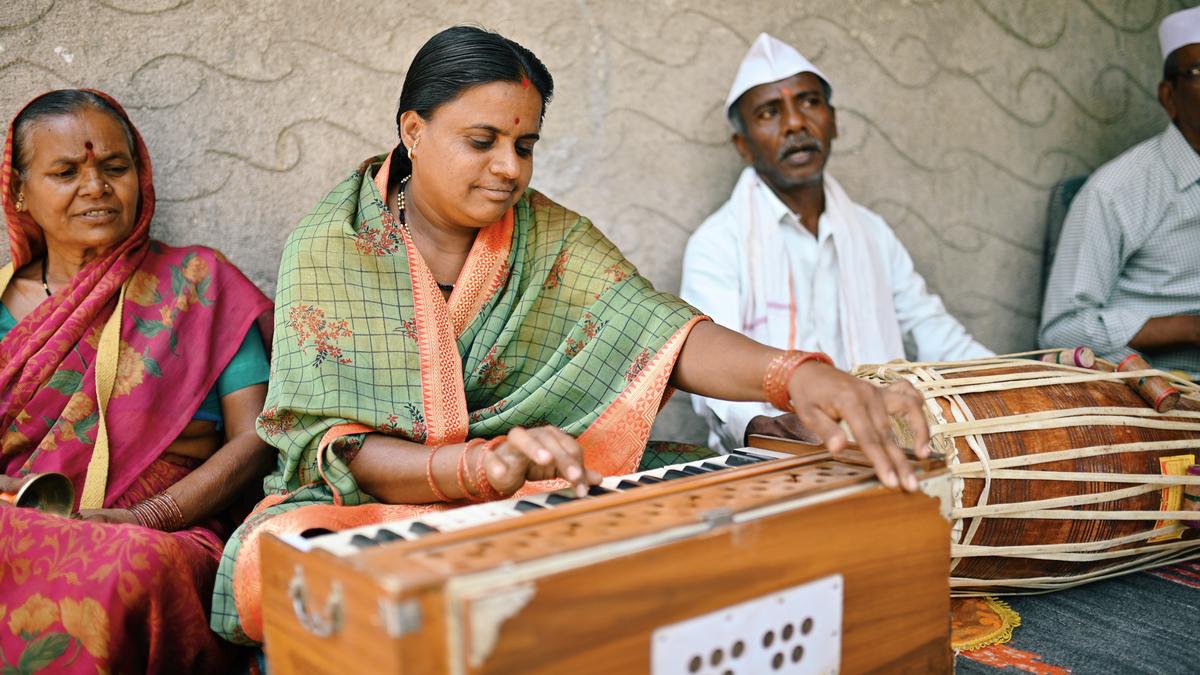
The Indian portable harmonium is a close cousin of the larger foot-pumped organs once found in European churches and homes. It’s a wooden box roughly the size of a small suitcase. You sit on the floor behind it and pump a pair of bellows with one hand and play piano-like keys with the other. All these instruments work on the same simple idea: air is pushed past metal strips called reeds; when they vibrate, musical notes are created. The sound of the harmonium has been a staple of both Indian folk music and mainstream cinema.

How does a harmonium use air?

A harmonium doesn’t have strings, membranes or electronic circuits. Instead, its ‘fuel’ is air in motion.

When the bellows attached to the instrument are pulled open, they suck some of the air in the room into their folded chambers, funnelled through inlet valves. When you push the bellows closed, the air is squeezed forward into an airtight wooden compartment that lies directly under the harmonium keys.

Because the compartment’s walls don’t move, the air pressure within rises above normal atmospheric pressure by a small amount, usually a few kilopascals. The compartment also holds a slender internal spring or a weighted flap that helps maintain this pressure, even if you don’t pump the bellows at a regular rate.

In fact, as long as you pump the bellows every few seconds, the reeds will feel enough pressure to make sounds.

How does a harmonium make sound?

The keyboard on top of the harmonium resembles a piano in miniature. But unlike in a piano, each key is only a lever. If you press a key, its far end tilts upward inside the box, lifting a pallet lined with felt.

The pallet covers a hole that leads from the pressurised wooden compartment to a single metal reed. When the key is at rest, the pallet closes the hole and no air flows. When you press the key, the pallet opens, allowing high-pressure air to rush through the hole and towards the reed.

Most Indian harmoniums expose 1.5 to 3 reeds to each hole. A stop rod next to the keyboard allows you to choose which set of reeds, called a bank, is active at any time. If you slide out one stop rod, an extra airway opens so the same key can expose a second bank that is tuned to one octave higher or lower, creating a more organ-like tone.

How does each reed operate?

Every reed is essentially a tongue of brass or phosphor-bronze nailed on top of a rectangular slot in a metal frame. When air pressure rises on the front side, the tongue bends slightly into the slot, allowing a puff of air to slip past to the rear. The same puff now exerts pressure on the back side of the tongue, pushing it forward again.

This rapid seesawing motion sets up a vibration with a frequency of hundreds of hertz for higher notes and around 100 Hz for the lower ones.

The vibrating reed shreds the air stream into pulses, which bounce around inside the box before spreading into the room as sound waves. Because the reed is fixed at one end and free at the other, its pitch depends mainly on its length, thickness, and mass. The shorter or thinner the reed, the higher its natural frequency will be.

Unlike flutes or trumpets, the harmonium’s reeds sit inside a wooden cavity rather than an open pipe. As a result, larger cavities produce lower notes and vice versa. The wooden compartment, the leather that makes the bellows, and even the player’s lap all absorb or reflect certain frequencies, giving each instrument a unique timbre.

Because warmer air is less dense, reeds in such an atmosphere will also have a slightly higher pitch. Professional players thus often carry small screwdrivers to tweak the reeds’ sounds before a performance.

Why does the sound seem ‘alive’?

The harder you pump the bellows, the louder the sounds will be. This is simply because stronger pumping raises the pressure in the compartment and moves the reeds harder. Fluent players often use quick pulses on the bellows to produce sharp accents and ease off to create graceful decrescendos. Many designs also include a coupling lever that, when engaged, connects a key to the key one octave higher, so pressing a single note automatically depresses its octave partner without forcing the player’s fingers to stretch. Second, because the reed’s vibrations feed on the pumping, the instrument can be made to respond to the smallest motions. Players can brighten a note by pumping in a short burst or stall it to thin the note.

More fundamentally, the sounds of an Indian harmonium seem ‘alive’ because the instrument doesn’t run on the clinical power of electrical energy but on a human body in motion. This may also explain why it became a staple of Indian classical, devotional, and folk music, including its willingness to accompany singers outdoors, through power cuts, and even play through the humid monsoons.

Published – July 31, 2025 08:30 am IST



Source link

Science

Post navigation

Previous Post: Samsung Q2 profit drops 55% on weak AI chip sales, China curbs
Next Post: Access Denied

Related Posts

  • SpaceX’s Falcon-9 deploys India’s GSAT-N2 satellite into orbit
    SpaceX’s Falcon-9 deploys India’s GSAT-N2 satellite into orbit Science
  • If antibiotics are becoming less effective, why not combine them?
    If antibiotics are becoming less effective, why not combine them? Science
  • Ancient DNA suggests women were at the heart of social networks in Celtic society in Britain
    Ancient DNA suggests women were at the heart of social networks in Celtic society in Britain Science
  • What will Gaganyaan change for India? | Explained
    What will Gaganyaan change for India? | Explained Science
  • ISRO launches mission in Ladakh to test mental, physical strength of astronauts
    ISRO launches mission in Ladakh to test mental, physical strength of astronauts Science
  • Researchers use sound waves to detect elusive helium gas leaks
    Researchers use sound waves to detect elusive helium gas leaks Science

More Related Articles

SpaceX’s Falcon-9 deploys India’s GSAT-N2 satellite into orbit SpaceX’s Falcon-9 deploys India’s GSAT-N2 satellite into orbit Science
NASA touts space research in anti-cancer fight NASA touts space research in anti-cancer fight Science
A decade among the stars: India’s first space observatory AstroSat completes 10 years A decade among the stars: India’s first space observatory AstroSat completes 10 years Science
Why cooling earth by reflecting sunlight back isn’t a bright idea Why cooling earth by reflecting sunlight back isn’t a bright idea Science
What is geospatial intelligence? A geographer explains the powerful melding of maps and data What is geospatial intelligence? A geographer explains the powerful melding of maps and data Science
NASA affirms plan with SpaceX to return astronauts after Trump demand NASA affirms plan with SpaceX to return astronauts after Trump demand Science
SiteLock

Archives

  • October 2026
  • September 2026
  • August 2026
  • July 2026
  • June 2026
  • May 2026
  • April 2026
  • March 2026
  • February 2026
  • January 2026
  • December 2025
  • November 2025
  • October 2025
  • September 2025
  • August 2025
  • July 2025
  • June 2025
  • May 2025
  • April 2025
  • March 2025
  • February 2025
  • January 2025
  • December 2024
  • November 2024
  • October 2024
  • September 2024
  • August 2024
  • July 2024
  • June 2024
  • May 2024
  • April 2024
  • March 2024
  • February 2024
  • January 2024
  • December 2023
  • November 2023
  • October 2023
  • September 2023
  • August 2023
  • July 2023
  • June 2023
  • May 2023
  • April 2023
  • March 2023
  • February 2023
  • January 2023
  • December 2022
  • November 2022
  • October 2022
  • September 2022
  • August 2022
  • July 2022
  • June 2022
  • May 2022

Categories

  • Business
  • Nation
  • Science
  • Sports
  • World

Recent Posts

  • Wild animal menace: solar-powered hanging fences to be set up around vulnerable areas in Chakkittappara panchayat in Keralam’s Kozhikode
  • Oregon school attack: Teen shooter was former student, police say
  • SC to hear Centre’s plea against Jharkhand DGP appointments
  • 2K Run, awareness activities mark Wildlife Week celebrations
  • Track doubling of Aduthurai – Sundaraperumal Kovil BG stretch to take off soon at a cost of ₹289.17 crore

Recent Comments

  1. RobertGat on UP Teacher Who Asked Students To Slap Muslim Classmate
  2. RobertGat on UP Teacher Who Asked Students To Slap Muslim Classmate
  3. RobertGat on UP Teacher Who Asked Students To Slap Muslim Classmate
  4. RobertGat on UP Teacher Who Asked Students To Slap Muslim Classmate
  5. Davidbrurf on UP Teacher Who Asked Students To Slap Muslim Classmate
  • Access Denied Sports
  • 12 Killed In Rain-related Incidents In Uttar Pradesh In Last 24 Hours
    12 Killed In Rain-related Incidents In Uttar Pradesh In Last 24 Hours Nation
  • Anti-Terror Watchdog Praises India’s Efforts In Combating Money Laundering
    Anti-Terror Watchdog Praises India’s Efforts In Combating Money Laundering Nation
  • Import duty waiver on 40 petrochemical products extended till July 15
    Import duty waiver on 40 petrochemical products extended till July 15 Business
  • Access Denied
    Access Denied Nation
  • Neeraj Chopra Finishes Second In Doha Diamond League
    Neeraj Chopra Finishes Second In Doha Diamond League Sports
  • Business leaders urge PM Shehbaz to initiate trade talks with India which will benefit Pakistan’s economy
    Business leaders urge PM Shehbaz to initiate trade talks with India which will benefit Pakistan’s economy World
  • ISL 2025-26 | East Bengal’s return to the top ignites red-and-gold carnival
    ISL 2025-26 | East Bengal’s return to the top ignites red-and-gold carnival Sports

Editor-in-Chief:
Mohammad Ariff,
MSW, MAJMC, BSW, DTL, CTS, CNM, CCR, CAL, RSL, ASOC.
editor@artifex.news

Associate Editors:
1. Zenellis R. Tuba,
zenelis@artifex.news
2. Haris Daniyel
daniyel@artifex.news

Photograher:
Rohan Das
rohan@artifex.news

Associate Journalists
1. Subrata Paul - AN/2020/01
2. Quamruz Zaman - AN/2021/22
3. Ahmed Sha - AN/2021/035
4. Ajay Kumar Shaw - AN/2021/39
5. Tahqiqul Hoda - AN/2021/21

Artifex.News offers Online Paid Internships to college students from India and Abroad. Interns will get a PRESS CARD and other online offers.
Send your CV (Subjectline: Paid Internship) to internship@artifex.news

Links:
Associate Journalism
About Us
Privacy Policy

News Links:
Breaking News
World
Nation
Sports
Business
Entertainment
Lifestyle

Registered Office:
72/A, Elliot Road, Kolkata - 700016
Tel: 033-22277777, 033-22172217
Email: office@artifex.news

Editorial Office / News Desk:
No. 13, Mezzanine Floor, Esplanade Metro Rail Station,
12 J. L. Nehru Road, Kolkata - 700069.
(Entry from Gate No. 5)
Tel: 033-46011099, 033-46046046
Email: editor@artifex.news

Copyright © 2023 Artifex.News Newsportal designed by Artifex Infotech.