Skip to content
  • Facebook
  • X
  • Linkedin
  • WhatsApp
  • YouTube
  • Associate Journalism
  • About Us
  • Privacy Policy
  • 033-46046046
  • editor@artifex.news
Artifex.News

Artifex.News

Stay Connected. Stay Informed.

  • Breaking News
  • World
  • Nation
  • Sports
  • Business
  • Science
  • Entertainment
  • Lifestyle
  • Toggle search form
  • Brown, botany, and Brownian motion
    Brown, botany, and Brownian motion Science
  • The Science Quiz | Numbers have celebrities, too
    The Science Quiz | Numbers have celebrities, too Science
  • Access Denied World
  • Sourav Ganguly Names ‘Next Best Red-Ball Batter After Virat Kohli’. Yashasvi Jaiswal Snubbed
    Sourav Ganguly Names ‘Next Best Red-Ball Batter After Virat Kohli’. Yashasvi Jaiswal Snubbed Sports
  • Consent forms, notices, prison terms: Maharashtra anti-conversion law | Explained
    Consent forms, notices, prison terms: Maharashtra anti-conversion law | Explained Nation
  • IRDAI imposes ₹1 cr penalty on Canara HSBC Life for mis-selling policy to 88-year-old
    IRDAI imposes ₹1 cr penalty on Canara HSBC Life for mis-selling policy to 88-year-old Business
  • Access Denied World
  • Access Denied Business
A planet on the edge: are Saturn’s rings older than they look?

A planet on the edge: are Saturn’s rings older than they look?

Posted on February 19, 2025 By admin


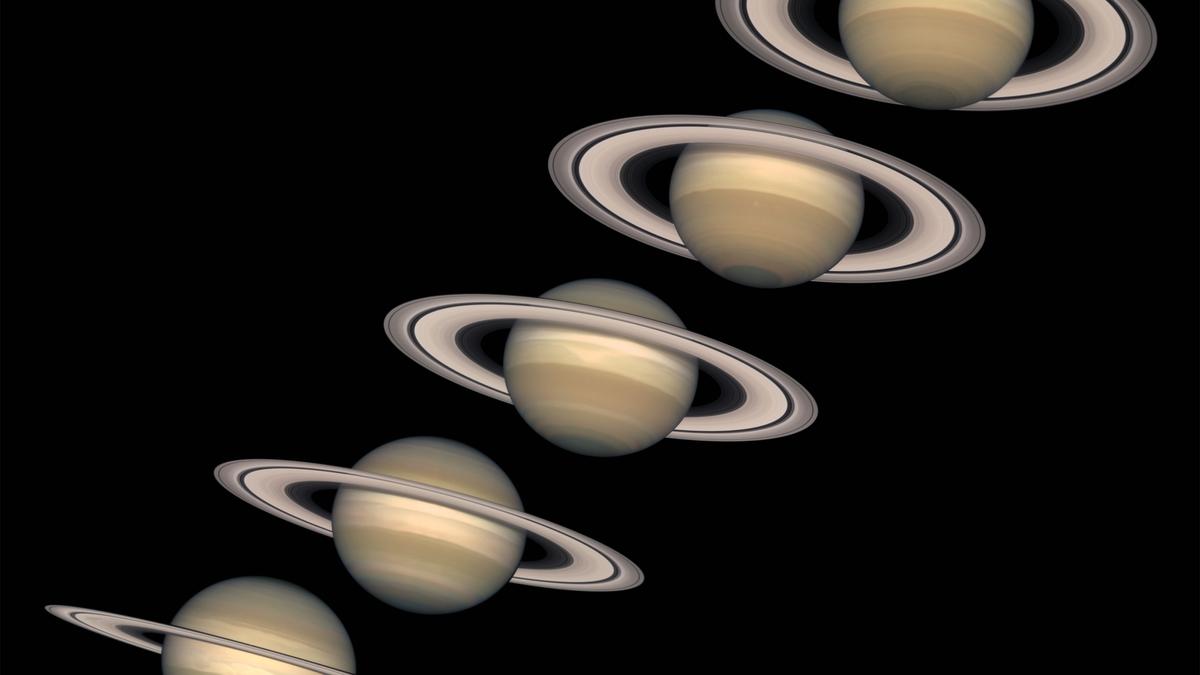
A debate about the age of Saturn’s resplendent rings has been raging for a few decades now, with no end in sight. A new study by researchers at the Institute of Science Tokyo and the Paris Institute of Planetary Physics has fresh spin to offer now that could recast the conversation.

Saturn’s rings are an arresting sight even through modest telescopes. The planet is made mostly of hydrogen and helium whereas the rings are billions of pieces of mostly bright-white water ice and rock. Some of these pieces are as small as a grain of salt; others are as big as a house.

Four spacecraft have visited Saturn thus far, all launched by NASA: Pioneer 11 and the twin Voyagers 1 and 2 flew by it while Cassini orbited Saturn from 2004 to 2017.

Unusually clean

Cassini in particular found the rings to be squeaky clean, with very little dirt. This is unusual because everything in the Solar System, including the earth, is constantly bombarded by dark pieces of dust, each finer than a grain of sand. These particles are fragments of larger chunks of rock in space.

Most of this debris burns up in the earth’s atmosphere when they get too close and never reach the surface.

Around Saturn, astronomers expected this dark dust to be omnipresent in the rings, but this isn’t the case.

Based on this, scientists hypothesised that Saturn’s rings are relatively new, only around 100 million years old — too young to have accumulated the dust.

This was a simple explanation, which is good, but there is a catch: scientists don’t know how the rings could have formed so recently.

Rings out of time

In these last 100 million years, the Solar System has been pretty calm.

“In the very early stages of the formation of our solar system, around four billion years ago, the system was chaotic and unstable,” Ryuki Hyodo, from the Institute of Science Tokyo, Chief Science Officer at Tokyo-based company SpaceData Inc., and a coauthor of the new study, said. “Therefore there is a greater chance of a big, dynamical event happening then that could form Saturn’s rings.”

“Crater size distribution is used to constrain the age of solid bodies in the solar system,” Sean Hsu, a research scientist at the University of Colorado Boulder who wasn’t involved in the new study, added. “For Saturn’s rings, age determination is even more difficult — there are no craters, and the collisional nature of ring particles erases most of its history. Depending on which measurements you choose, it is not too surprising that people end up with very different age estimates.”

“In my view, the ‘blind men and an elephant’ is not a bad metaphor here.”

Keep ‘em out

In the new analysis, Hyodo’s computer models showed that when dust particles collided with ice in Saturn’s rings, they evaporated and dispersed into hundreds of even smaller flecks, which Cassini had also observed.

The models showed that these particles then smash into Saturn itself, beat the planet’s gravitational pull or are dragged into the planet’s raging atmosphere. In other words, the pearly shine of Saturn’s rings is not thanks to them being young but because they have a way to eject such foreign bodies that enter their delicate world. In sum, there’s no reason for older rings to be darker (or vice versa).

In fact, the rings could be as old as the Solar System, according to Hyodo.

“The basic assumption in the debate about the age of the Saturnian rings centres around the water ice composition of the ring particles,” Wing-Huen Ip, who studies the origins of the Solar System and the formation of planets at the National Central University, Taiwan, and who was not a part of the new study, said. “We actually can’t be 100% sure that this is true.”

“Such an estimate is indeed questionable, because we do not know what the ring composition was when it formed,” Hsu said.

The new findings were published in the journal Nature Geoscience in December 2024.

Europa, Enceladus, and beyond

Determining when Saturn got its signature rings isn’t just a matter of curiosity. “The interest in probing the age of Saturn’s rings is beyond the rings themselves — it is about the implications, and there are many,” Hsu said. “Enceladus, the geologically active moon of Saturn, is a top-priority target to study habitability and astrobiology due to active plume activity from its subsurface ocean. The evolution of Saturn’s rings has fundamental impacts on the evolution of Enceladus, and other icy moons of Saturn, as they’re dynamically coupled.”

In the mid-2000s, Cassini found plumes abundant in water molecules leaking from Enceladus’s southern hemisphere. It also recorded evidence of cryovolcanoes, icy promontories spewing hydrogen, salt crystals, water vapour and ice, and volatile compounds like ammonia. The vapour condenses into solid flakes, not unlike snow on the earth, and drifts into one of Saturn’s rings.

In 2014, NASA scientists reported finding evidence of a 10-km-thick ocean of liquid water under Enceladus’s south pole region in Cassini data. Ip believes investigating how icy grains from the plumes of Enceladus affect the ring’s composition could play a major role in determining the ring’s age.

In related news, NASA launched the Clipper mission to study Jupiter’s moon Europa, which is similarly dynamically linked to Jupiter and contains a subsurface ocean as well, in October 2024.

The new study could also help explain why the Solar System’s four gas giants have such diverse ring systems. Either they were different by birth or diverged as they grew. The dynamics unveiled in the study could infuse fresh insight into this debate.

“We may propose to send a spacecraft to Saturn’s rings to study them in more detail,” Hyodo said.

Unnati Ashar is a freelance science journalist.

Published – February 19, 2025 05:30 am IST


Source link

Science

Post navigation

Previous Post: Canadian investigators find black boxes after Toronto plane crash, probe continues
Next Post: “Russia Wants To End Barbarianism, Senseless War”: Trump After US-Russia Meet

Related Posts

  • How the next major breakthrough in cancer could come from India
    How the next major breakthrough in cancer could come from India Science
  • Rapid, diagnostic test for UTIs may help stem super bug crisis
    Rapid, diagnostic test for UTIs may help stem super bug crisis Science
  • 76% of TB patients received payment for nutritional support
    76% of TB patients received payment for nutritional support Science
  • How does my smartphone know which way is up?
    How does my smartphone know which way is up? Science
  • Why do shrubs like hibiscus flower/fruit profusely only on the sunlit side?
    Why do shrubs like hibiscus flower/fruit profusely only on the sunlit side? Science
  • Countdown for India’s first solar observatory mission Aditya-L1 starts
    Countdown for India’s first solar observatory mission Aditya-L1 starts Science

More Related Articles

Fetus in fetu – The Hindu Fetus in fetu – The Hindu Science
China launches Pakistani satellite – The Hindu China launches Pakistani satellite – The Hindu Science
How does the Indian harmonium produce its lively music? How does the Indian harmonium produce its lively music? Science
Rocks with the oldest evidence of Earth’s magnetic field discovered Rocks with the oldest evidence of Earth’s magnetic field discovered Science
IIT-Kanpur did Delhi cloud-seeding trial despite Met dept warning of ‘no clouds’ IIT-Kanpur did Delhi cloud-seeding trial despite Met dept warning of ‘no clouds’ Science
NASA names chief of UFO research; panel sees no alien evidence NASA names chief of UFO research; panel sees no alien evidence Science
SiteLock

Archives

  • October 2026
  • September 2026
  • August 2026
  • July 2026
  • June 2026
  • May 2026
  • April 2026
  • March 2026
  • February 2026
  • January 2026
  • December 2025
  • November 2025
  • October 2025
  • September 2025
  • August 2025
  • July 2025
  • June 2025
  • May 2025
  • April 2025
  • March 2025
  • February 2025
  • January 2025
  • December 2024
  • November 2024
  • October 2024
  • September 2024
  • August 2024
  • July 2024
  • June 2024
  • May 2024
  • April 2024
  • March 2024
  • February 2024
  • January 2024
  • December 2023
  • November 2023
  • October 2023
  • September 2023
  • August 2023
  • July 2023
  • June 2023
  • May 2023
  • April 2023
  • March 2023
  • February 2023
  • January 2023
  • December 2022
  • November 2022
  • October 2022
  • September 2022
  • August 2022
  • July 2022
  • June 2022
  • May 2022

Categories

  • Business
  • Nation
  • Science
  • Sports
  • World

Recent Posts

  • AIADMK, BJP leaders slam TVK-led Tamil Nadu government over electricity purchase at high rate
  • Women stage silent demonstration at Kathipara against police action on anti-CEC protesters in Delhi
  • DGCA bans specific power banks on flights
  • Saudi Supreme Court sets aside Sri Lankan migrant worker’s death penalty
  • Nedumbassery accident: CPI(M) stages protest march to police station over ‘indifference’ in handling of case

Recent Comments

  1. RobertTes on UP Teacher Who Asked Students To Slap Muslim Classmate
  2. Manuelret on UP Teacher Who Asked Students To Slap Muslim Classmate
  3. RobertTes on UP Teacher Who Asked Students To Slap Muslim Classmate
  4. RobertTes on UP Teacher Who Asked Students To Slap Muslim Classmate
  5. BrentWes on UP Teacher Who Asked Students To Slap Muslim Classmate
  • Access Denied Sports
  • Access Denied Sports
  • Access Denied World
  • IPL-17 | Mayank likely to miss rest of season: head coach Langer
    IPL-17 | Mayank likely to miss rest of season: head coach Langer Sports
  • ICICI Bank reports 18.5% growth in Q4 net profit at ₹11,672 crore
    ICICI Bank reports 18.5% growth in Q4 net profit at ₹11,672 crore Business
  • Gautam Gambhir Finally Breaks Silence On India Coach Job, Says “Don’t See…”
    Gautam Gambhir Finally Breaks Silence On India Coach Job, Says “Don’t See…” Sports
  • War worsens Lebanon’s economic crisis with job losses, slow business, soaring prices
    War worsens Lebanon’s economic crisis with job losses, slow business, soaring prices World
  • Access Denied
    Access Denied Nation

Editor-in-Chief:
Mohammad Ariff,
MSW, MAJMC, BSW, DTL, CTS, CNM, CCR, CAL, RSL, ASOC.
editor@artifex.news

Associate Editors:
1. Zenellis R. Tuba,
zenelis@artifex.news
2. Haris Daniyel
daniyel@artifex.news

Photograher:
Rohan Das
rohan@artifex.news

Associate Journalists
1. Subrata Paul - AN/2020/01
2. Quamruz Zaman - AN/2021/22
3. Ahmed Sha - AN/2021/035
4. Ajay Kumar Shaw - AN/2021/39
5. Tahqiqul Hoda - AN/2021/21

Artifex.News offers Online Paid Internships to college students from India and Abroad. Interns will get a PRESS CARD and other online offers.
Send your CV (Subjectline: Paid Internship) to internship@artifex.news

Links:
Associate Journalism
About Us
Privacy Policy

News Links:
Breaking News
World
Nation
Sports
Business
Entertainment
Lifestyle

Registered Office:
72/A, Elliot Road, Kolkata - 700016
Tel: 033-22277777, 033-22172217
Email: office@artifex.news

Editorial Office / News Desk:
No. 13, Mezzanine Floor, Esplanade Metro Rail Station,
12 J. L. Nehru Road, Kolkata - 700069.
(Entry from Gate No. 5)
Tel: 033-46011099, 033-46046046
Email: editor@artifex.news

Copyright © 2023 Artifex.News Newsportal designed by Artifex Infotech.