



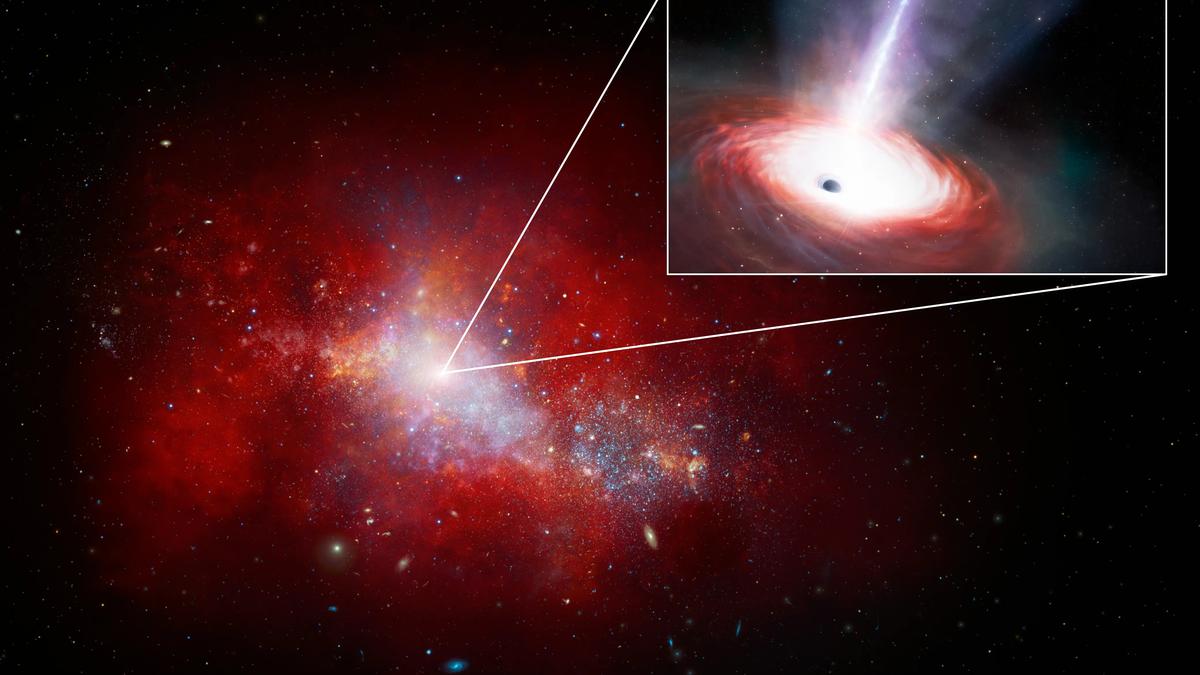
An international team of researchers using NASA’s James Webb Space Telescope (JWST) and the Chandra X-ray observatory has discovered a bizarre black hole that may provide insights into the genesis and growth of supermassive black holes.
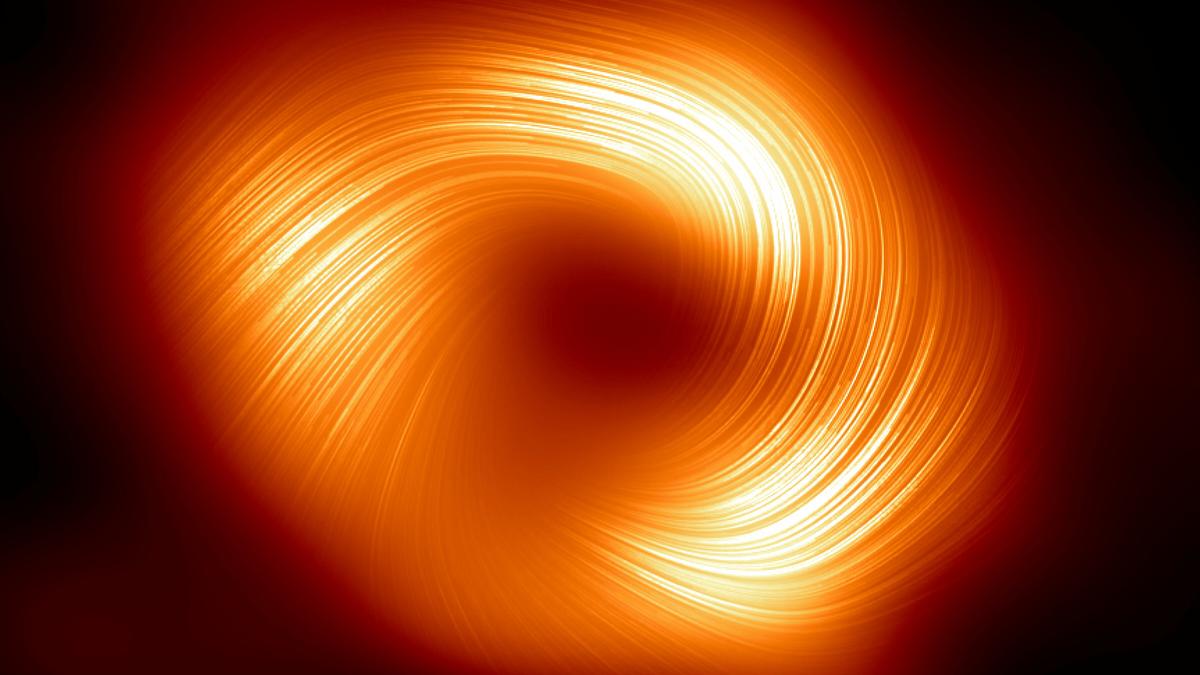
Supermassive black holes are among the most common types of black holes in the universe. Most galaxies contain a supermassive black hole at their centres. These black holes have masses ranging from millions to billions of times that of the sun. The supermassive black hole Sagittarius A* located at the center of the Milky Way galaxy has a mass of approximately 4.3 million solar masses.
However, scientists are not yet fully certain how these giants grow to become so big.
Beyond the upper limit
The newfound black hole, designated LID-568, is a low-mass supermassive black hole that existed just 1.5 billion years after the Big Bang. If the universe were a human, it could be said to be around eight years old at this time.
A detailed analysis of its effects on its neighbourhood indicated that the black hole was feeding on a surrounding cloud of matter at an exceptional rate — almost 40-times greater than what astrophysicists thought was the upper limit.
The study was led by International Gemini Observatory/NSF NOIRLab astronomer Hyewon Suh and the results were published in the journal Nature Astronomy in November 2024.
“We first identified this unusual object through Chandra X-ray observations, as it was exceptionally bright in X-rays but completely invisible in the deepest optical and near-infrared observations, even with the Hubble Space Telescope,” Suh, the lead researcher, said.
“Because it was only detected in X-rays, we couldn’t determine its nature. With JWST’s unparalleled sensitivity in the infrared, we were finally able to uncover this exotic object, highlighting the complementary power of these observatories,” she added.
A class apart
The rate at which a black hole feeds on matter is governed by what astronomers call the Eddington limit. This limit — named after the English astronomer Arthur Stanley Eddington because he worked it out first — is also related to how brightly a black hole can shine.
Nothing can escape a black hole of course. But when a black hole pulls surrounding matter towards itself, the infalling material becomes compressed, heats up, and emits radiation, especially X-rays.
The concept behind the Eddington limit is straightforward: as matter collects around the black hole and gets packed into the disc, it heats up and emits radiation that generates an outward pressure capable of counteracting the gravitational pull of the black hole. When this radiation pressure balances the force of gravity, the black hole will stop accruing the matter. Ergo, there is a limit on how brightly the black hole can shine.
If this limit is crossed, the scenario is called a super-Eddington accretion. This is the category in which LID-568 lies.

Suh said that they measured the total light coming from the black hole and its mass using observations from Chandra and JWST’s Near-Infrared Spectrograph instrument, which revealed the exceptional accretion behavior of LID-568.
Experts have hypothesised that super-Eddington black holes can exist. They have even found a few. But LID-568 has defied their expectation in two ways. First, it’s much, much farther away. The most distant of these other black holes is ‘only’ around 2.3 billion light years from earth. Second, while the known rule-breakers exceeded the Eddington limit by a factor of two or three, LID-568 has done so by a factor of roughly 40, according to Suh.
Super-Eddington episodes in black holes are expected to be short-lived, so it is also remarkable that researchers captured LID-568 in action.
Making sense of the oddball
The existence of supermassive black holes that are millions or even billions of times more massive than our sun poses a challenge to current models of black hole formation and growth. Scientists have confirmed that such black holes reside at the centres of many galaxies that should have formed when the universe was less than a billion years old. However, they can’t explain how these objects came to be when the universe was so young, when there shouldn’t have been enough matter for them to form.
According to some traditional models, Suh said, “supermassive black holes are thought to form from the death of the first star, i.e. light seeds with 10-100 times the mass of the sun, and/or through the direct collapse of primordial gas clouds, such as heavy seeds with 1,000-100,000 times the mass of the sun.”
“However, these models lack direct observational confirmation and require sustained, continuous accretion of large amounts of matter over several hundred million years to account for the most extreme supermassive black holes observed in the early universe, which is likely difficult,” she added.
The discovery of LID-568 is crucial because it suggests that large black holes could have put on a significant fraction of their weight during short-lived episodes of rapid feeding. If true, this mechanism would do away with black holes having to feed on large quantities of matter for a very long time, and offer “a convincing explanation for how supermassive black holes could form so quickly, regardless of their initial seed mass,” whether heavy or light.

Chasing more black holes
Suh also said there are several theories to explain how black holes can exceed the Eddington limit, including geometrically thick accretion disks, powerful black hole jets, and black-hole mergers. However, she said that her team still doesn’t fully understand the exact mechanism that allowed LID-568 to feed so fast and that follow-up observations with JWST will be crucial to testing other hypotheses.
The researchers also found that the galaxy where LID-568 resided wasn’t producing many new stars — the result of the black supermassive hole driving powerful streams of material outward from the centre, called outflows. These outflows could be preventing matter from accumulating in enough quantities to form stars.
To confirm this idea as well as to inform it with more data, Suh said she and her team are planning to examine similar galaxies and examine their outflows, especially those driven by very large black fast-snacking holes.
The research team is also planning to find out how long a black hole can accrue matter at a super-Eddington rate as well as what percentage of all black holes do so.
Shreejaya Karantha is a freelance science writer and a content writer and research specialist at The Secrets of The Universe.
Published – January 23, 2025 05:30 am IST