




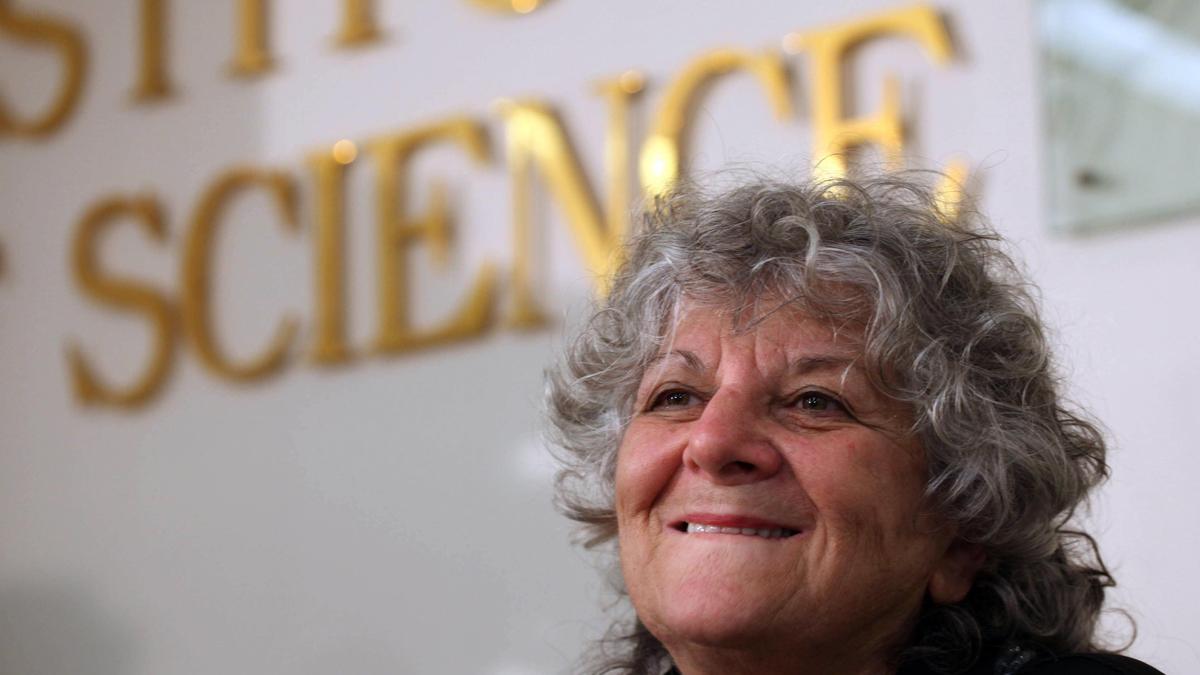
In science, some discoveries change the way we understand life. Others change the lives of the people who make them. For Tanaya Bose, her years in the laboratory of late Nobel laureate Ada Yonath were marked by both. Yonath passed away on August 31, 2026 at 87.
(Sign up for THEdge, The Hindu’s weekly education newsletter.)
Yonath, the Israeli structural biologist who shared the 2009 Nobel Prize in Chemistry for studies of the structure and function of the ribosome, is known for helping unravel one of biology’s most fundamental molecular machines. But for Dr. Bose, now a scientist at the CSIR-Indian Institute of Chemical Biology in Kolkata, the lasting influence of Yonath lies as much in her approach to mentorship as in her scientific achievements.
Over seven years, from November 2016 to September 2023, Dr. Bose witnessed a scientist who was willing to take risks on young researchers, give them difficult problems to solve, and, perhaps most unusually, step aside to let them receive recognition for their work.
“She was not afraid of giving away the spotlight,” Dr. Bose recalled. “In fact, she seemed to believe that the spotlight was meant to be passed on.”
It is a lesson Dr. Bose hopes to carry into her own laboratory. Every living cell depends on proteins. They perform a remarkable range of functions, from catalysing biochemical reactions and transmitting signals to providing structural support. Yet proteins cannot be made without ribosomes, the molecular machines that translate genetic instructions carried by messenger RNA into chains of amino acids.
Understanding the ribosome’s structure is therefore central to understanding how life operates at the molecular level. When Yonath began investigating the ribosome in the 1970s, determining its three-dimensional structure presented a formidable scientific challenge. Ribosomes are enormous molecular assemblies, comprising ribosomal RNA and proteins arranged in intricate configurations. Their complexity made it exceptionally difficult to obtain crystals suitable for structural analysis and to interpret the resulting X-ray diffraction data.
At the time, many scientists regarded the task as extraordinarily difficult. Yonath persisted, developing approaches to crystallising ribosomes and investigating their structure using X-ray crystallography. Her work helped make possible the determination of ribosomal structures at atomic resolution, revealing how the ribosome is organised and how it participates in protein synthesis. In 2000, Yonath and other research groups reported landmark structural advances that transformed the field.
These discoveries also had important implications for medicine. Several antibiotics work by targeting bacterial ribosomes, disrupting the production of proteins essential for bacterial survival. Structural knowledge of the ribosome has helped scientists understand how these drugs bind to their targets and how their action can be improved.
In 2009, Yonath shared the Nobel Prize in Chemistry with Venkatraman Ramakrishnan and Thomas A. Steitz for studies of the structure and function of the ribosome. Her scientific career is a testament to the value of pursuing difficult questions long after their answers appear out of reach. Yet the story of her work also has another dimension: the people she encouraged to ask questions of their own.
When Dr. Bose arrived in Israel in September 2016, she had recently completed her Ph.D. in chemistry. Her husband was a postdoctoral researcher at the Weizmann Institute of Science, and she had followed him there without a clear idea of what she would do next. After several weeks of looking for postdoctoral opportunities, she decided to write to Yonath.
The prospect was intimidating, she said. Dr. Bose was an organic chemist, while Yonath was one of the world’s leading structural biologists. The Nobel laureate’s stature made a reply seem unlikely. Instead, Yonath responded almost immediately and invited her for a meeting.
Dr. Bose remembers barely sleeping the night before the interview. She was anxious about the questions she might be asked and whether she would be able to answer them. But when she entered Yonath’s office in the Kimmelman Building, her first surprise had little to do with science.
“It was a simple room tucked away in one corner of the sixth floor of the Kimmelman Building. I had imagined a grand office befitting a Nobel Prize winner, perhaps surrounded by students and visitors. Instead, there was simply Ada,” she said.
Coming from an organic chemistry background, Dr. Bose was entering an unfamiliar area of structural biology. But Yonath did not treat that difference as a limitation. Instead, Dr. Bose was able to bring a new way of thinking to the problem. Within a couple of months, the work produced a result. Yonath travelled frequently, sometimes moving between continents within days. Yet when she heard about the breakthrough, she appeared at the office the following day, Bose recalled.
“There is a familiar pattern in academia where a young scientist makes an important discovery in a laboratory, but the principal investigator becomes the face of that discovery. Ada did the opposite,” Dr. Bose said. She pushed the young scientist forward. It was the beginning of a scientific relationship in which the young researcher was given not only a demanding problem, but also the freedom to approach it in her own way.
For Dr. Bose, one of the clearest demonstrations of Yonath’s character came at a ribosome meeting in Bordeaux, France. Yonath was scheduled to deliver the keynote lecture. A few days before the conference, she told Dr. Bose that she thought the younger scientist should give the lecture instead.
The organisers refused. The audience had come to hear a Nobel laureate. Yonath could have accepted their decision. Instead, she devised another plan. The lecture was scheduled for 25 minutes. Yonath instructed Dr. Bose to remain ready near the podium. She would begin the keynote, speak for ten minutes and then invite Dr. Bose onto the stage to deliver the remaining 15 minutes.
She was unsure whether Yonath was serious. “But to my surprise, she was”, Dr. Bose said. At the conference, Yonath began the lecture as planned. Ten minutes later, Bose joined her on stage and delivered the rest.
For the audience, it was a keynote address by a Nobel laureate. For Dr. Bose, it was an experience that would shape her understanding of what scientific leadership could mean.
In academia, the principal investigator often becomes the most visible face of research conducted by a laboratory, even when a young scientist has made a substantial contribution. Yonath, Dr. Bose says, repeatedly did the opposite. She put her researchers forward for lectures, scientific meetings, and opportunities to present their own work.
Yonath could easily have occupied the stage herself. Instead, she made space for someone who was still establishing her scientific identity. The gesture was not simply an act of kindness. It was a lesson in independence, confidence and the importance of allowing young scientists to become visible in their own right, Dr. Bose said. “To me, she was the mentor who opened doors I did not even know existed,” she said.
Opening doors beyond the laboratory
Yonath’s support did not end with scientific presentations or research opportunities.
Towards the end of her postdoctoral years, as Dr. Bose began looking for an independent faculty position in India, she encountered another difficult transition: moving from working within an established laboratory to building a research programme of her own.
She had assumed that a Nobel laureate would have little time to concern herself with the career uncertainties of a young researcher. Yonath, once again, proved her wrong. She reached out to members of the Indian scientific community on Dr. Bose’s behalf, contacting senior professors who had been her longstanding friends as well as younger principal investigators who had only recently established their laboratories. She did more than recommend Dr. Bose. She sought advice, connected her with scientists who could guide her, and helped her navigate the unfamiliar process of applying for faculty positions. For Dr. Bose, the significance of this support lay in the effort behind it. Yonath was lending not only her time but also her reputation and personal relationships to help a younger colleague find her footing.
“A mentor’s greatest achievement is not always the discovery made in their laboratory. Sometimes it is the scientist who leaves the laboratory more confident, more independent and more visible than when they arrived. That is what Ada did for me,” Dr. Bose said.
Today, as a scientist leading her own research group, Dr. Bose often reflects on the example Yonath set. She cannot repay what her mentor did for her, she says, but she can extend the same generosity to the young scientists who will one day enter her laboratory. That, perhaps, is how mentorship becomes a lasting scientific legacy: not merely through the transfer of knowledge from one generation to another, but through the willingness of each generation to make the path easier for the next.
Dr. Bose’s memories of Yonath bring into focus a dimension of scientific achievement that is less easily measured than publications, discoveries or awards. Yonath’s determination helped open a window into the molecular machinery responsible for protein synthesis. Her work contributed to a deeper understanding of how antibiotics interact with bacterial ribosomes, advancing a field with important implications for medicine.
But her influence on Dr. Bose demonstrates another way a scientist can shape the future: by recognising potential in someone whose background differs from her own, giving that person the freedom to think independently, and ensuring that the credit for scientific work reaches the people who have done it.
For Dr. Bose, the memories remain vivid: the anxious young chemist waiting outside a Nobel laureate’s office; the difficult research problem that became an opportunity to think differently; the unexpected invitation to share a keynote stage in Bordeaux; and the personal effort Yonath made to help her find an independent position in India.
To the world, Yonath is a Nobel laureate whose research transformed structural biology. To Dr. Bose, she is also the mentor who opened doors she had not known existed.
The measure of that mentorship may ultimately be found in what Dr. Bose does next. As she builds her own research group, she hopes to create the same space for young scientists to explore unfamiliar questions, develop confidence, and receive recognition for their work. It is a way of honouring Yonath that requires no grand gesture: only the decision, made repeatedly, to help another scientist move forward. And so the spotlight passes on.
(Nibedita Sen is an independent journalist specialising in defence, with over 15 years of experience covering diverse topics like rural India, healthcare, education, and women’s issues.)