




Skip to content
  • Facebook
  • X
  • Linkedin
  • WhatsApp
  • YouTube
  • Associate Journalism
  • About Us
  • Privacy Policy
  • 033-46046046
  • editor@artifex.news
Artifex.News

Artifex.News

Stay Connected. Stay Informed.

  • Breaking News
  • World
  • Nation
  • Sports
  • Business
  • Science
  • Entertainment
  • Lifestyle
  • Toggle search form
  • TCS World 10K — only the summer heat can slow down the runners
    TCS World 10K — only the summer heat can slow down the runners Sports
  • Access Denied
    Access Denied Nation
  • “Awarding On Basis Of Rankings…”: Afghanistan Pacer On India Winning Asian Games Gold After Washout
    “Awarding On Basis Of Rankings…”: Afghanistan Pacer On India Winning Asian Games Gold After Washout Sports
  • Access Denied Sports
  • GST Authority Imposes Rs 36,844 Fine On LIC
    GST Authority Imposes Rs 36,844 Fine On LIC Nation
  • Asia Cup: Did Sri Lanka Reveal Key Weakness In Virat Kohli’s Game? Stats Show A Worrying Pattern
    Asia Cup: Did Sri Lanka Reveal Key Weakness In Virat Kohli’s Game? Stats Show A Worrying Pattern Sports
  • India’s Q1FY26 CAD narrows to .4 billion 
    India’s Q1FY26 CAD narrows to $2.4 billion  Business
  • What is quantum computing? – The Hindu
    What is quantum computing? – The Hindu Science
Scientists report world’s first working nuclear clocks

Scientists report world’s first working nuclear clocks

Posted on October 2, 2026 By admin


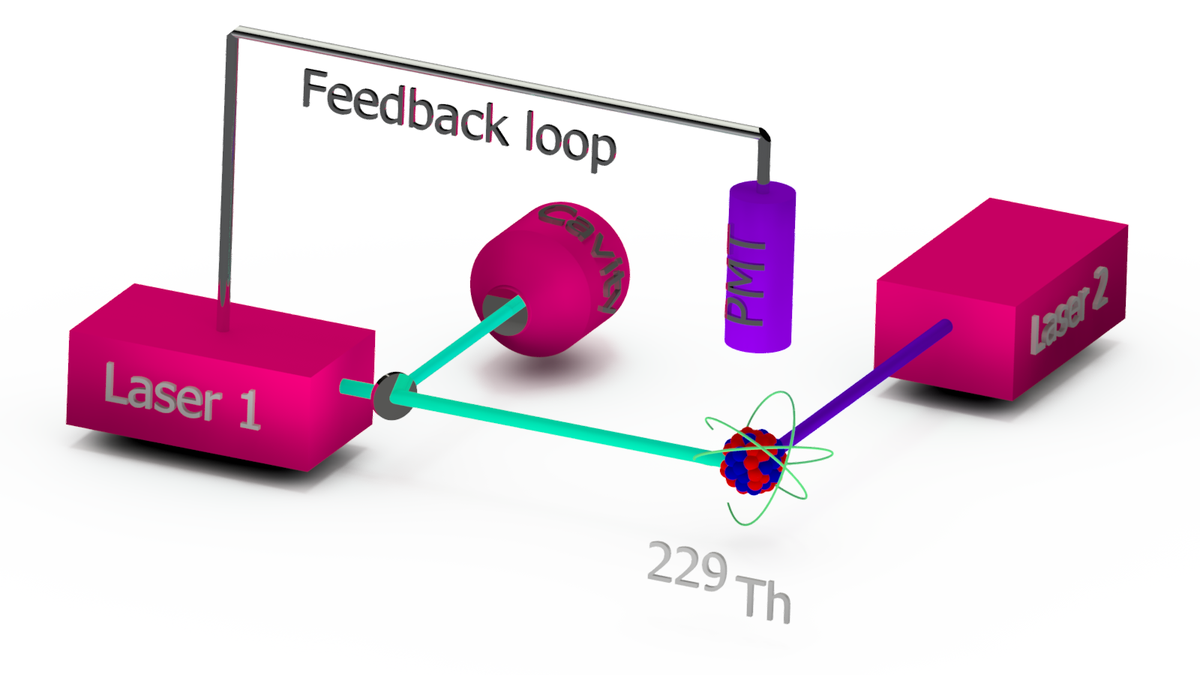
A schematic diagram of a thorium-229 nuclear clock. The nucleus is irradiated with laser light (laser 1). A second laser checks if the nucleus was successfully excited. A photomultiplier tube (PMT) checks laser 2’s output. Based on its signal, laser 1 is stabilised to the nuclear transition via a feedback loop.
| Photo Credit: LarsvdW (CC BY-SA)

Atomic clocks are the world’s gold standard for timekeeping, at the heart of everything from GPS navigation to synchronised networks. A ytterbium atomic clock is so precise it misses one second every 23 billion years.

Yet scientists are interested in more precise clocks to detect infinitesimal changes in fundamental forces and further advance navigation.

In two papers in Nature, scientists from Europe and China have now reported the world’s first working nuclear clocks.

While, in an atomic clock, an atom’s electrons are easily disturbed by electric or magnetic fields and temperature changes in a room, the nucleus is shielded by the electron cloud.

Exciting a nucleus usually requires energetic X-rays or gamma rays, which are difficult to harness. However, the thorium-229 isotope’s nucleus has a transition energy low enough to be triggered by an ultraviolet laser.

A laser’s electric field oscillates rapidly: positive, zero, negative, zero, positive, and so on. An atomic or nuclear clock counts these cycles like an old clock counts the swings of a pendulum.

The laser’s frequency can drift slightly, however. In a nuclear clock, scientists expose thorium-229 nuclei to the laser and check how readily they become excited. If it happens less often than expected, the laser’s frequency has drifted away and a computer corrects it.

In one study, teams from Beijing and Shanghai embedded thorium-229 in calcium fluoride crystals and fired an ultraviolet laser at them. A feedback loop constantly checked the laser against the thorium nuclei and corrected it. Because the clock operated within a simple crystal, it could pave the way for compact, portable clocks.

The second effort, by teams from Austria and Germany, built a thorium-229 clock and used it to look for dark matter.

The thorium-229 nucleus has such low transition energy because the strong nuclear force and the electromagnetic force nearly cancel each other out. Thus, the nuclear clock is highly sensitive to any slight changes in these fundamental forces.

Some theories suggest ultralight dark matter may cause these constants to fluctuate as it passes through earth. The team ran the nuclear clock alongside a ytterbium atomic clock. Because the two clocks react differently to fluctuating physics constants, any change in their relative tick rates could reveal the presence of dark matter. The teams didn’t find a signal, however.

These prototypes are not yet as precise as the best atomic clocks but their architecture is proven. With upgrades to laser power and crystal quality, scientists expect nuclear clocks to eventually surpass their atomic predecessors.

mukunth.v@thehindu.co.in

Published – October 08, 2026 07:00 am IST


Source link

Science

Post navigation

Previous Post: Spanish lawmakers reject government housing measure amid protests
Next Post: Irani Cup | Dogra and Nasir dig in to help J&K take the lead

Related Posts

  • India successfully test-fires long range hypersonic missile
    India successfully test-fires long range hypersonic missile Science
  • What human brain tissue transplanted into mice showed us
    What human brain tissue transplanted into mice showed us Science
  • Chandrayaan 4 and 5 design complete; 70 satellites likely to be launched in 5 years: ISRO chief
    Chandrayaan 4 and 5 design complete; 70 satellites likely to be launched in 5 years: ISRO chief Science
  • Why do so many flowers have five petals?
    Why do so many flowers have five petals? Science
  • Storm fears overshadow India coast decades after tsunami
    Storm fears overshadow India coast decades after tsunami Science
  • First LVM3 launch vehicle equipped with semi-cryogenic stage slated to fly in 2027
    First LVM3 launch vehicle equipped with semi-cryogenic stage slated to fly in 2027 Science

More Related Articles

Science Snapshots: June 14, 2026 Science Snapshots: June 14, 2026 Science
Hidden pandemic of AMR poses challenge for modern medicine Hidden pandemic of AMR poses challenge for modern medicine Science
Hahnöfersand bone: of contention – The Hindu Hahnöfersand bone: of contention – The Hindu Science
Why is it colder at higher altitudes? Why is it colder at higher altitudes? Science
The promises and problems of using bacteria to get rid of plastic The promises and problems of using bacteria to get rid of plastic Science
Afghanistan: ‘all four quakes were in the same fault system’ Afghanistan: ‘all four quakes were in the same fault system’ Science
SiteLock

Archives

  • October 2026
  • September 2026
  • August 2026
  • July 2026
  • June 2026
  • May 2026
  • April 2026
  • March 2026
  • February 2026
  • January 2026
  • December 2025
  • November 2025
  • October 2025
  • September 2025
  • August 2025
  • July 2025
  • June 2025
  • May 2025
  • April 2025
  • March 2025
  • February 2025
  • January 2025
  • December 2024
  • November 2024
  • October 2024
  • September 2024
  • August 2024
  • July 2024
  • June 2024
  • May 2024
  • April 2024
  • March 2024
  • February 2024
  • January 2024
  • December 2023
  • November 2023
  • October 2023
  • September 2023
  • August 2023
  • July 2023
  • June 2023
  • May 2023
  • April 2023
  • March 2023
  • February 2023
  • January 2023
  • December 2022
  • November 2022
  • October 2022
  • September 2022
  • August 2022
  • July 2022
  • June 2022
  • May 2022

Categories

  • Business
  • Nation
  • Science
  • Sports
  • World

Recent Posts

  • Coal stocks at thermal plants hold above 18 MT as supply deficit narrows
  • Coal stocks at thermal plants hold above 18 MT as supply deficit narrows
  • Caste discrimination during SC man’s burial: Protest in Erode seeks action against officials
  • World’s top climate body deadlocked over inclusivity concerns
  • Nobel Prize in economics 2026: Robert E. Hall, Michael Woodford win the award

Recent Comments

  1. Michaeldoown on UP Teacher Who Asked Students To Slap Muslim Classmate
  2. Roberthek on UP Teacher Who Asked Students To Slap Muslim Classmate
  3. Wesleysiz on UP Teacher Who Asked Students To Slap Muslim Classmate
  4. HectorTOk on UP Teacher Who Asked Students To Slap Muslim Classmate
  5. StevenVoips on UP Teacher Who Asked Students To Slap Muslim Classmate
  • Scottish, Northern Irish, Welsh leaders assert right to ‘self-determination’
    Scottish, Northern Irish, Welsh leaders assert right to ‘self-determination’ World
  • Warne’s death felt like losing someone from my family: Kuldeep Yadav
    Warne’s death felt like losing someone from my family: Kuldeep Yadav Sports
  • Access Denied Sports
  • Access Denied Business
  • Fake Gutkha, Other Materials Worth Rs 25 Crore Seized At Rajasthan Factory
    Fake Gutkha, Other Materials Worth Rs 25 Crore Seized At Rajasthan Factory Nation
  • India’s First Private Satellite Constellation Showcases Talent Of Youngsters: PM Modi
    India’s First Private Satellite Constellation Showcases Talent Of Youngsters: PM Modi Nation
  • D’artagnan lives up to the favourite billing in the Zavaray S. Poonawalla Colts Championship Stakes
    D’artagnan lives up to the favourite billing in the Zavaray S. Poonawalla Colts Championship Stakes Sports
  • FIFA World Cup 2026: Australia spoils Turkiye return in Group D match
    FIFA World Cup 2026: Australia spoils Turkiye return in Group D match Sports

Editor-in-Chief:
Mohammad Ariff,
MSW, MAJMC, BSW, DTL, CTS, CNM, CCR, CAL, RSL, ASOC.
editor@artifex.news

Associate Editors:
1. Zenellis R. Tuba,
zenelis@artifex.news
2. Haris Daniyel
daniyel@artifex.news

Photograher:
Rohan Das
rohan@artifex.news

Artifex.News offers Online Paid Internships to college students from India and Abroad. Interns will get a PRESS CARD and other online offers.
Send your CV (Subjectline: Paid Internship) to internship@artifex.news

Links:
Associate Journalism
About Us
Privacy Policy

News Links:
Breaking News
World
Nation
Sports
Business
Entertainment
Lifestyle

Registered Office:
72/A, Elliot Road, Kolkata - 700016
Tel: 033-22277777, 033-22172217
Email: office@artifex.news

Editorial Office / News Desk:
No. 13, Mezzanine Floor, Esplanade Metro Rail Station,
12 J. L. Nehru Road, Kolkata - 700069.
(Entry from Gate No. 5)
Tel: 033-46011099, 033-46046046
Email: editor@artifex.news

Copyright © 2023 Artifex.News Newsportal designed by Artifex Infotech.