



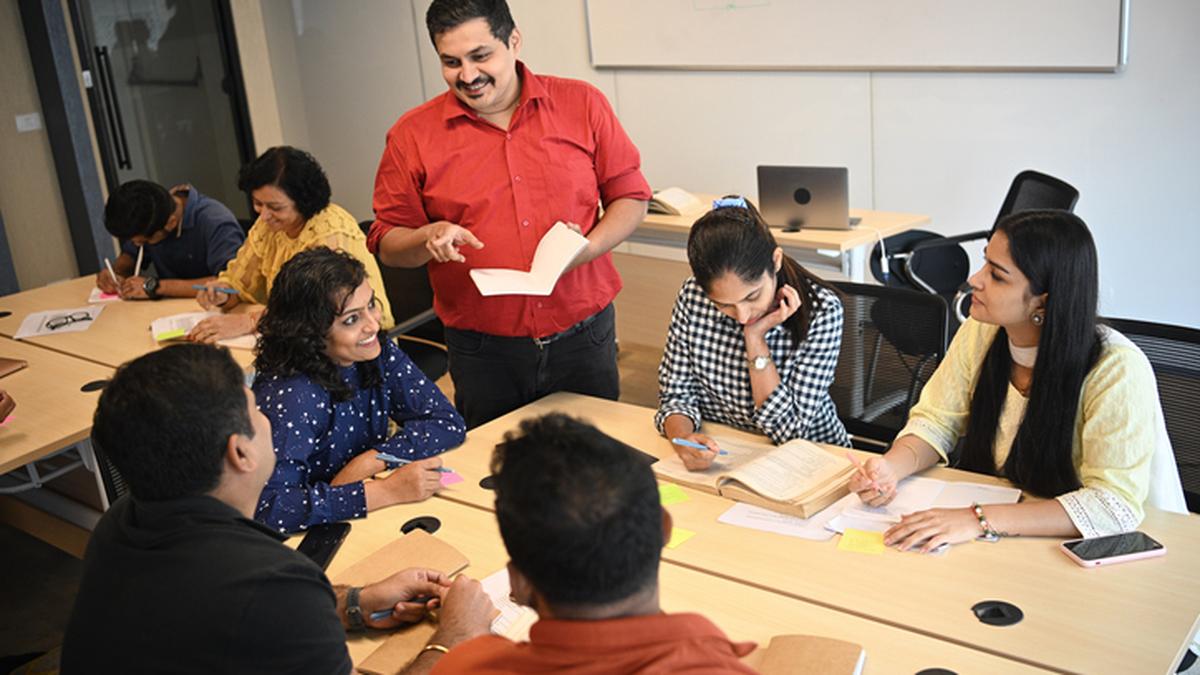
Fixing higher education requires completely redesigning how we recruit, train, and support faculty, while overhauling the legacy administrative and disciplinary protocols that govern our campuses.
Ask the toppers of any graduating class what they want to do next- university teaching rarely tops the list. The reason is simple: teaching is not perceived as a competitive, well-paid, or clearly defined career choice. This explains why classrooms across the country are increasingly staffed by overworked, ad hoc lecturers and guest faculty rather than our best youngsters.
(Sign up for THEdge, The Hindu’s weekly education newsletter.)
As higher education addresses this structural deficit, it faces a simultaneous, radical disruption: the explosion of Generative AI.
What needs to be fixed?
The consequences of this systemic problem reached a tipping point when the Supreme Court directed all Higher Educational Institutions (HEIs) to fill vacant teaching posts within four months, as chronic faculty shortages and an over-dependence on under-prepared guest teachers directly contribute to severe student burnout.
Generative AI has dramatically altered the exam environment. Unlike old ways of malpractice — which required pre-planned hidden notes — Gen AI tools present an instantaneous temptation. In a moment of exam stress, a student can call up ChatGPT in a few seconds. Traditional SOPs, built around punitive threats, suspension notices, and public confrontational reporting, fail to address this new reality.
Fixing Indian higher education is no longer about merely filling vacancies or appealing to the nobility of the teaching profession. It requires completely redesigning how we recruit, train, and support faculty, while overhauling the legacy administrative and disciplinary protocols that govern our campuses today.
Before an institution trains a good teacher, it must first recruit one. Today, the entry gateway itself is severely compromised. The UGC-NET (University Grants Commission–National Eligibility Test), which certifies eligibility for assistant professorships and Ph.D. admissions across India, has faced repeated operational and integrity crises.
Beyond paper leaks and cancelled exam cycles, however, lies a deeper design flaw: the current UGC-NET tests subject-matter recall, not teaching competence or preparedness to manage students in a classroom.
Moreover, the current system funnels every successful candidate into a single entry point—Assistant Professor. Before the 2006 UGC pay revision, university teacher entry was at the Lecturer level. Restructuring eliminated that lower rung to standardise pay bands, effectively eliminating an accessible, entry-level stepping stone.
How to fix the system?
Reviving an “Assistant Lecturer” or “Lecturer” grade—open to fresh postgraduates pursuing NET or early-stage doctoral work—would provide attractive pay, job security, and a clear transition into full professorships upon clearing required benchmarks. This would eliminate the prolonged, uncertain entry path that currently frightens away bright graduates.
To bridge the pedagogical gap, India needs a dedicated, one-year Postgraduate Diploma in Higher Education Pedagogy customised specifically for the AI era. Unlike school-focused B. Ed. programs, this credential would provide a fast, structured entry track for fresh postgraduates alongside doctoral or NET preparations. It also imparts pedagogical grounding to the NET-qualified candidates before their first classroom assignment. More importantly, it offers formal upskilling in AI-integrated pedagogy to the serving faculty.
Borrowing from global benchmarks like the U.K.’s Advance Higher Education Fellowship, India should build a portable, multi-tiered recognition ladder, thereby treating teaching excellence as a continuous, lifetime journey rather than a one-time checkbox early in a career.
Teaching Gen Z in the new AI era
What should this new training cover? UNESCO’s AI Competency Framework for Teachers offers a clear blueprint across five key dimensions: human-centric mindsets, AI ethics, foundational knowledge, AI pedagogy, and professional development.
The rationale is clear: Generative AI can now deliver factual and procedural content effortlessly. Consequently, a professor’s value addition has shifted from just the transfer of knowledge through lectures to curating AI-generated information, facilitating critical dialogue, and designing assessments that AI chatbots cannot easily answer.
For the roughly 17 lakh teachers already serving in higher education, UGC’s Human Resource Development Centres (formerly Academic Staff Colleges) must be rebuilt around these competencies. Upgrading skills from basic AI awareness and literacy to AI-driven pedagogical design must be a promotion-linked pathway under the Career Advancement Scheme (CAS), which currently rewards research publication counts while ignoring classroom teaching and innovation.
To address the galloping supply-demand gap for teachers in IT, instead of competing with the lucrative private sector or scarce Computer Science PhDs, institutions should cross-train existing engineering faculty. Expanding the All India Council for Technical Education’s (AICTE) ATAL Academy into a formal, funded “Core-to-Computing Bridge Programme” would enable civil, mechanical, and electrical engineering professors to apply machine learning within their native disciplines.
At the same time, initiatives like AICTE’s Industry Fellowship Programme — which places faculty inside leading companies — must be matched by clear pathways for industry experts to join campuses as Professors of Practice without procedural hurdles.
When technology collides with legacy rules
The immediate need for updated faculty training and institutional reform in examinations is not just an academic exercise; it is a matter of student well-being and life safety, without sacrificing academic discipline and integrity.
The traditional examination Standard Operating Procedures (SOPs) were built for a pre-digital age, making them not suitable for today’s AI age. An invigilator catching a student with an AI tool is simply doing their job. Diluting examination integrity is not an option. However, the system fails miserably in what happens the moment after the infraction is discovered.
When a student in a high-stakes ecosystem is caught cheating with AI, they do not perceive it as a minor setback; instead, they experience it as a public disgrace, a sudden trauma, and damage to their future. Expecting a teacher — trained as an academician — to handle an acute emotional crisis without support is not realistic.
To prevent recurrence of future tragedies, higher education institutions must urgently overhaul their examination and malpractice SOPs. Spotting malpractice should never lead to loud, public confrontation in the exam hall.
Exams and devices should be collected quietly and discreetly, allowing the student to exit without being publicly paraded before peers. Under current rules, once a student gives a written confession statement, they are allowed to walk back alone to a hostel room. This creates a critical, high-risk window of isolation.
Revised SOPs must mandate an immediate, supportive transfer to a student counselor or peer mentor. The fear of immediate expulsion or academic ruin drives extreme desperation.
Clear campus guidelines must distinguish between minor AI policy breaches and major fraud, prioritising course retakes, restorative assignments, and learning opportunities over permanent academic destruction. Student counseling teams must operate independently from disciplinary boards. Students facing disciplinary action never speak openly to administrators who hold power over their academic standing.
Training academic leaders
Systemic academic reforms need competent leadership. Heads of Departments, Deans, and Vice-Chancellors need formal training in conflict resolution and crisis management. Expanding leadership initiatives like the Leadership for Academicians Programme (LEAP) is essential if campus administrators are to handle the combined pressures of digital transformation and student mental health.
Enforcing academic rigour and student welfare are not conflicting goals—they are the twin pillars of institutional responsibility. Catching cheating is an invigilator’s professional duty, but preserving human life is an institution’s moral obligation.
By combining a modernised recruitment pipeline, AI-aligned pedagogical training, and compassionate, modernised campus protocols, India can build a higher education system that attracts young talent and adapts to technological disruption.
Nurturing the next generation without breaking them is critical. Academic discipline and student welfare must go hand in hand to impart quality education to the AI-driven Gen Z students.
(Professor O.R.S. Rao is the Chancellor of the ICFAI University, Sikkim. Views are personal)