






Skip to content
  • Facebook
  • X
  • Linkedin
  • WhatsApp
  • YouTube
  • Associate Journalism
  • About Us
  • Privacy Policy
  • 033-46046046
  • editor@artifex.news
Artifex.News

Artifex.News

Stay Connected. Stay Informed.

  • Breaking News
  • World
  • Nation
  • Sports
  • Business
  • Science
  • Entertainment
  • Lifestyle
  • Toggle search form
  • T20 World Cup Debacle Impact? Babar Azam, Mohammed Rizwan May Not Be Picked For Pakistan’s Series vs Bangladesh
    T20 World Cup Debacle Impact? Babar Azam, Mohammed Rizwan May Not Be Picked For Pakistan’s Series vs Bangladesh Sports
  • DHL Express to hike charges by 8.9% in India from Jan
    DHL Express to hike charges by 8.9% in India from Jan Business
  • Trump submits civil nuclear agreement with Saudi Arabia to Congress for review
    Trump submits civil nuclear agreement with Saudi Arabia to Congress for review World
  • Taylor Swift’s Father Accused Of Assaulting Photographer In Australia
    Taylor Swift’s Father Accused Of Assaulting Photographer In Australia World
  • Access Denied
    Access Denied Nation
  • Rupee recovers 55 paise from all-time low level to close at 90.38 against U.S. dollar
    Rupee recovers 55 paise from all-time low level to close at 90.38 against U.S. dollar Business
  • India, U.S. exploring combined engagement with third countries to source minerals: Piyush Goyal
    India, U.S. exploring combined engagement with third countries to source minerals: Piyush Goyal Business
  • Trump Reacts To Mystery Drones Over New Jersey
    Trump Reacts To Mystery Drones Over New Jersey World
Urban spider found building soundproof webs to keep noise out

Urban spider found building soundproof webs to keep noise out

Posted on October 5, 2026 By admin


The next time you sweep away a cobweb without a second thought, consider this: the silken structure is an engineering marvel. According to new research published last week in Current Biology, a North American spider species can change how its webs transmit vibrations.

The authors have reported that spiders in urban environments can build webs that filter out loud ambient vibrations. Conversely, spiders from quieter rural spaces build webs that amplify biologically relevant vibrations they need to pick up in their noisy environment.

Webs in folklore and science

Spiders and their remarkable weaving abilities have been celebrated in folklore for thousands of years. West African folklore tales of Ananse, the trickster spider that could turn human, celebrate him as a wise creator. In Greek mythology, Arachne was a skilful woman who defeated Athena in a contest by weaving a flawless tapestry. She was turned into a spider in her afterlife, and goes on to create beautiful webs, or so the tale tells us.

Webs are tools of creation in mythology as well as material science. Spider silk is known to be an amazing natural material with unique properties. It has inspired researchers to develop materials derived from spider silk with applications in tissue engineering and regenerative medicine. They are also studying the unique combination of strength and flexibility in spider silk for use in textile production.

A few decades ago, researchers began to study how vibrations in webs transmit critical information for spiders.

For the first time, however, researchers from the University of Nebraska-Lincoln, Brandi Pessman and Eileen Hebets, have shown that spiders can alter how they receive vibratory information in loud environments.

Also Read: Letting the wind flow freely is the secret to cooling our cities

Vibratory information from the web is crucial for spiders because they don’t have ears. Pessman, the lead author of the study, said, “Webs are more than just nets that catch bugs. They’re actually extensions of the spider’s sensory system.”

Spider ‘hearing’ in a noisy world

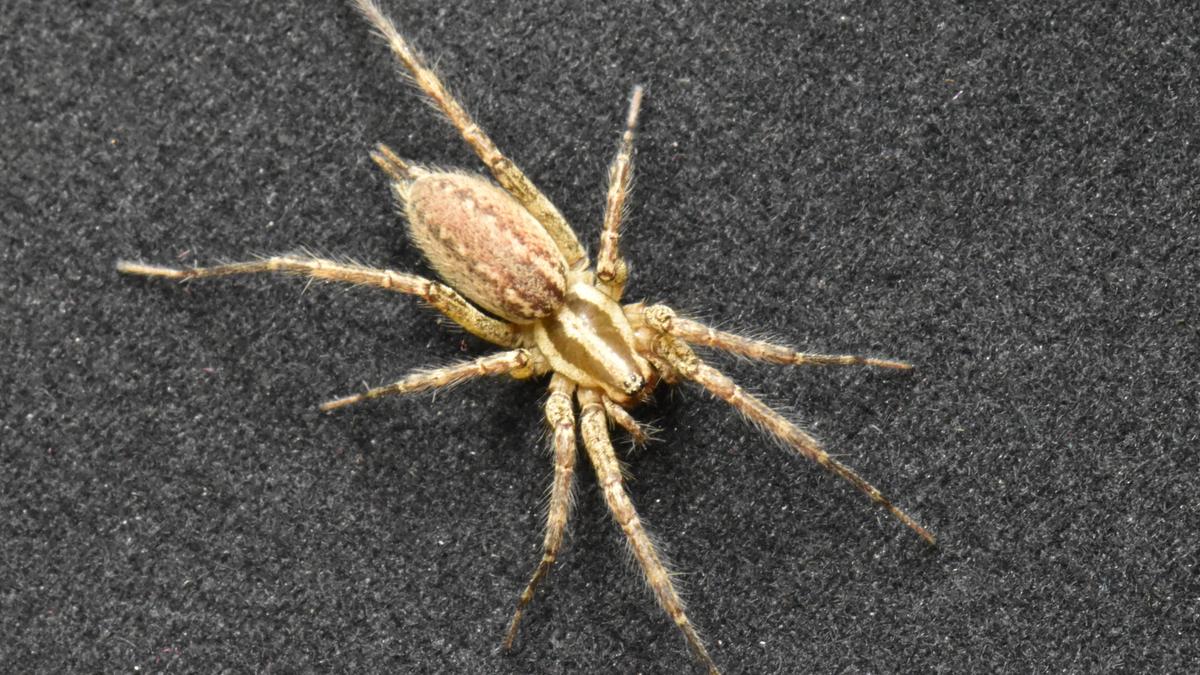
The researchers studied one species of funnel-weaving spiders, Agelenopsis pennsylvanica, a species spread all over North America. They weave a funnel-shaped web into which they retreat to protect themselves from predators. Unlike their cousins that build orb-shaped webs, these spiders don’t build sticky webs. Instead, this species uses just real-time vibrations in the web to sense when there’s prey in it, then jumps out and injects them with venom.

Pessman noticed how sensitive these spiders were to vibrations. “Even my footsteps disturb the spiders, so they’d run into the retreat and hide,” she said. She then started exploring how the spiders used the vibrations to detect prey. Pessman would tape a toothpick onto a vibrating toothbrush, then place the toothpick onto the funnel web. “The spider would reliably come out and attack the toothpick because they think it’s prey,” she recalled.

The researchers collected spiders both from a noisy city and its peaceful country surroundings and brought them back to the lab. They built small arenas for the spiders with a speaker at the bottom that played loud or quiet white noise to both urban and rural spiders.

Over the next four days, the spiders built their webs in these conditions. After this, the researchers tested 60 webs by sending controlled vibrations through them at either short or long range (3.5 cm and 7 cm, respectively, from the opening of the retreat), and recorded energy transmission. What they found was very illuminating.

“It’s like the spiders are using their webs as their own personal volume dial,” Pessman said.

When confronted with loud noise, city spiders built webs that dampened energy from a broad range of frequencies (300-1,000 Hz) at the short range. On the other hand, rural spiders built webs that retained energy in a narrow range (350-600 Hz) from the long range.

What this means for urban wildlife

The difference between city and rural spiders only emerged when the spiders were blasted with loud white noise, suggesting that spiders built their webs differently to manage ambient noise. However, it is very difficult to prove whether they do so consciously.

That said, the new study naturally raised questions about what its findings mean for the animal communities living in rapidly urbanising spaces around the world. “We need a lot more studies across animals before we can really begin to generalise,” Pessman said. “Cities are a very difficult place for animals to live and there are not many animals that have accomplished such a feat of being able to do so well in cities.”

Shannon Olsson, a researcher in urban ecology, chemical ecology, and sustainability, said, “This [study] suggests that chronic exposure to urban environments impacts the way spiders build their webs and respond to environmental cues.”

Olsson, who wasn’t involved in the study, also pointed out that whether these changes are indeed an adaptation to urban noise and whether these changes actually affect prey capture remain to be tested. As she summed it up: “Regardless, that urbanisation impacts how spiders construct their home and source of food is an important result.”

Similar needs for spiders, humans

India’s urban centres are notorious for their noise pollution. While the government has defined upper limits to curb noise pollution, cities regularly make the news for exceeding them. “Noise pollution is a huge issue in Indian cities,” Olsson said. “Generally, people compensate with soundproof walls and sound barriers. However, increasingly, researchers are showing the impacts of noise on our wildlife and calling for action.”

How much of a concern is noise pollution compared to, say, carbon pollution?

“Globally, we have what is known as ‘carbon tunnel vision’,” Olsson, who is also the founder and global director of the ‘echo network’, an international programme connecting 2,500 members across 46 countries that works on global sustainability challenges. “Yet other stressors such as air, light, and noise pollution arguably have greater immediate impacts on the plants and animals we rely on for survival.”

In India and worldwide, there is a growing need to study and communicate the diverse consequences of human beings on wildlife. In the mythology of the Cherokee, an indigenous North American people, the spider web is a metaphor for the connections among all living beings, highlighting all of nature as a deeply interconnected community.

As Olsson added, “These funnel web spiders are important pest controllers for a habitat, but they need lots of food to eat, and clean and safe places to build their homes. Their needs are not too different from us, in the end.”

Vrinda Ravi Kumar is an evolutionary biologist based in the Czech Republic.

Published – April 29, 2025 05:30 am IST


Source link

Science

Post navigation

Previous Post: Successful urban birds sport different colours from unsuccessful ones
Next Post: VACB begins probe into alleged irregularities in Mundamveli P&T apartment project in Kochi

Related Posts

  • Scientists propose warming up Mars using heat-trapping ‘glitter’
    Scientists propose warming up Mars using heat-trapping ‘glitter’ Science
  • Why is India on the U.S. blacklist on fentanyl? | Explained
    Why is India on the U.S. blacklist on fentanyl? | Explained Science
  • India’s open ecosystems face an unusual threat: trees
    India’s open ecosystems face an unusual threat: trees Science
  • The Science Quiz | The Skylab ‘incident’
    The Science Quiz | The Skylab ‘incident’ Science
  • President Murmu congratulates ISRO for successful deployment of Pragyan Rover
    President Murmu congratulates ISRO for successful deployment of Pragyan Rover Science
  • Science for All newsletter: Ancient grasslands, once destroyed for development, can take 100 years to grow back
    Science for All newsletter: Ancient grasslands, once destroyed for development, can take 100 years to grow back Science

More Related Articles

The Science Quiz | SI-derived units The Science Quiz | SI-derived units Science
Science quiz: 110 years of general relativity Science quiz: 110 years of general relativity Science
Exploring the ‘wonderful world’ of symplectic geometry to solve problems in mechanics Exploring the ‘wonderful world’ of symplectic geometry to solve problems in mechanics Science
How proteins are being tweaked to be quantum sensors inside the body How proteins are being tweaked to be quantum sensors inside the body Science
What two districts can teach India about dealing with rural waste What two districts can teach India about dealing with rural waste Science
Call to quantify bat poop nutrition for crops Call to quantify bat poop nutrition for crops Science
SiteLock

Archives

  • October 2026
  • September 2026
  • August 2026
  • July 2026
  • June 2026
  • May 2026
  • April 2026
  • March 2026
  • February 2026
  • January 2026
  • December 2025
  • November 2025
  • October 2025
  • September 2025
  • August 2025
  • July 2025
  • June 2025
  • May 2025
  • April 2025
  • March 2025
  • February 2025
  • January 2025
  • December 2024
  • November 2024
  • October 2024
  • September 2024
  • August 2024
  • July 2024
  • June 2024
  • May 2024
  • April 2024
  • March 2024
  • February 2024
  • January 2024
  • December 2023
  • November 2023
  • October 2023
  • September 2023
  • August 2023
  • July 2023
  • June 2023
  • May 2023
  • April 2023
  • March 2023
  • February 2023
  • January 2023
  • December 2022
  • November 2022
  • October 2022
  • September 2022
  • August 2022
  • July 2022
  • June 2022
  • May 2022

Categories

  • Business
  • Nation
  • Science
  • Sports
  • World

Recent Posts

  • Kasturi Cotton gains traction as India puts traceability on the textile map
  • 26 government schools in Andhra’s Nellore district to be developed with ₹250 crore CSR funds
  • Ex-spy chief is arrested in Germany on suspicion of trading state secrets, treason
  • Three-day raw material expo takes off in Coimbatore
  • Youth Test | Baloda puts India in control despite Green’s seven-for

Recent Comments

  1. Larrymix on UP Teacher Who Asked Students To Slap Muslim Classmate
  2. Larrymix on UP Teacher Who Asked Students To Slap Muslim Classmate
  3. Larrymix on UP Teacher Who Asked Students To Slap Muslim Classmate
  4. MelvinLit on UP Teacher Who Asked Students To Slap Muslim Classmate
  5. Larrymix on UP Teacher Who Asked Students To Slap Muslim Classmate
  • Access Denied
    Access Denied Nation
  • Access Denied
    Access Denied Nation
  • Williamson named in New Zealand squad for Ireland, England Tests
    Williamson named in New Zealand squad for Ireland, England Tests Sports
  • What Is Debasement Trade? The Key Trigger Behind Gold, Silver Rally Business
  • PM Modi Returns To India After 3-Day US Visit
    PM Modi Returns To India After 3-Day US Visit World
  • Access Denied Sports
  • Rupee rises 3 paise to 82.99 against U.S. dollar in early trade
    Rupee rises 3 paise to 82.99 against U.S. dollar in early trade Business
  • Veiled Dig At Gautam Gambhir? On Yashasvi Jaiswal Run-Out, Australia Star’s ‘Coach Killer’ Remark
    Veiled Dig At Gautam Gambhir? On Yashasvi Jaiswal Run-Out, Australia Star’s ‘Coach Killer’ Remark Sports

Editor-in-Chief:
Mohammad Ariff,
MSW, MAJMC, BSW, DTL, CTS, CNM, CCR, CAL, RSL, ASOC.
editor@artifex.news

Associate Editors:
1. Zenellis R. Tuba,
zenelis@artifex.news
2. Haris Daniyel
daniyel@artifex.news

Photograher:
Rohan Das
rohan@artifex.news

Artifex.News offers Online Paid Internships to college students from India and Abroad. Interns will get a PRESS CARD and other online offers.
Send your CV (Subjectline: Paid Internship) to internship@artifex.news

Links:
Associate Journalism
About Us
Privacy Policy

News Links:
Breaking News
World
Nation
Sports
Business
Entertainment
Lifestyle

Registered Office:
72/A, Elliot Road, Kolkata - 700016
Tel: 033-22277777, 033-22172217
Email: office@artifex.news

Editorial Office / News Desk:
No. 13, Mezzanine Floor, Esplanade Metro Rail Station,
12 J. L. Nehru Road, Kolkata - 700069.
(Entry from Gate No. 5)
Tel: 033-46011099, 033-46046046
Email: editor@artifex.news

Copyright © 2023 Artifex.News Newsportal designed by Artifex Infotech.