



Skip to content
  • Facebook
  • X
  • Linkedin
  • WhatsApp
  • YouTube
  • Associate Journalism
  • About Us
  • Privacy Policy
  • 033-46046046
  • editor@artifex.news
Artifex.News

Artifex.News

Stay Connected. Stay Informed.

  • Breaking News
  • World
  • Nation
  • Sports
  • Business
  • Science
  • Entertainment
  • Lifestyle
  • Toggle search form
  • Jharkhand’s Cycle Coal Workers And Weight of Survival
    Jharkhand’s Cycle Coal Workers And Weight of Survival Nation
  • Romania says Russian drone entry poses new security ‘challenge’
    Romania says Russian drone entry poses new security ‘challenge’ World
  • Access Denied
    Access Denied Nation
  • Access Denied Sports
  • Exploding pagers injure hundreds in Lebanon: Health Minister
    Exploding pagers injure hundreds in Lebanon: Health Minister World
  • ICC Punishes India Star Arundhati Reddy For Fiery Send-Off To Pakistan’s Nida Dar In Women’s T20 World Cup
    ICC Punishes India Star Arundhati Reddy For Fiery Send-Off To Pakistan’s Nida Dar In Women’s T20 World Cup Sports
  • Morning Digest | ‘Operation Ajay’ set to evacuate Indian nationals from Israel; 4 dead, more than 70 injured as train derails in Bihar
    Morning Digest | ‘Operation Ajay’ set to evacuate Indian nationals from Israel; 4 dead, more than 70 injured as train derails in Bihar World
  • U.K.’s Starmer hosts German chancellor Scholz in his country estate as he touts ‘reset’ with EU
    U.K.’s Starmer hosts German chancellor Scholz in his country estate as he touts ‘reset’ with EU World
The gap in manufacturing sector GVA

The gap in manufacturing sector GVA

Posted on September 3, 2026 By admin


Early this year, the National Statistical Office (NSO) released the new series of the National Accounts Statistics (NAS). It shows that the manufacturing sector’s gross value added (GVA) is ₹38.6 lakh crore (₹38.6 trillion), constituting 14.7 per cent of GDP (gross domestic product) for the year 2023-24 at current prices. How reliable is the official estimate? This article investigates.

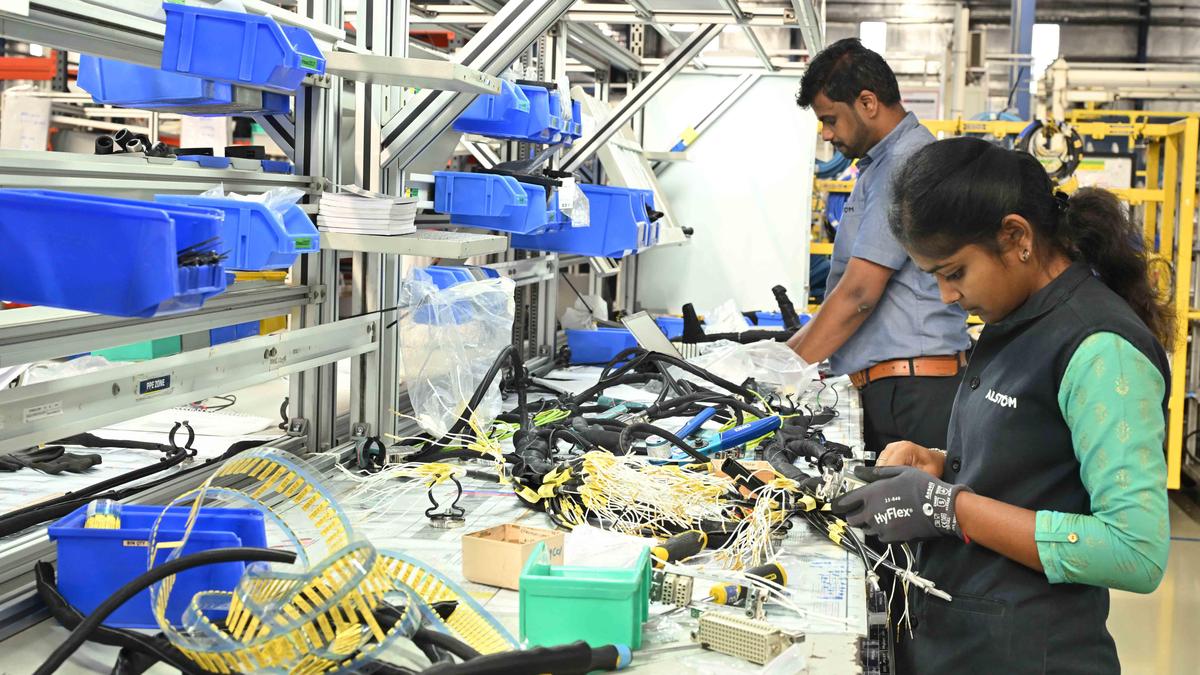
The manufacturing sector has two parts: One comprises all registered factories employing 10+/20+ workers with/without power, including registered companies (defined as the organised/formal sector). The other comprises unincorporated/ informal/ household units consisting of small factories/workshops falling outside the corporate/factory sector. The Annual Survey of Industries (ASI) reports the production accounts of the factory sector, while the Annual Survey of Unincorporated Sector Enterprises (ASUSE) covers the informal sector. The combined output (GVA) of the factory and unincorporated sectors almost completely represents total manufacturing output.

The discrepancy in estimates

For 2023-24, the sum of the GVA of units covered by the ASI and ASUSE is ₹27.4 lakh crore (the Alternative Estimate or, AE). The official figure, as per the NAS, is ₹38.6 lakh crore. It is higher than the AE by a whopping 40.9 per cent. Let’s call this the GAP. What could account for it?

While minor variations between the two estimates is understandable due to methodological or definitional issues, such a substantial GAP between the two estimates using official data sources surely raises many questions.

What are the data sources used for estimating the official GVA? For the unincorporated sector, it is ASUSE – the same as what we have used to estimate the AE. Hence, it cannot account for the GAP noted above. Moreover, the unincorporated sector’s share in total manufacturing GVA is a mere 13.9 per cent.

Hence, the reason for the GAP must lie in the estimation of organised manufacturing output. The NAS uses company balance-sheet data sourced from the Ministry of Corporate Affairs’ database (MCA-21), compiled using the annual statutory filings by registered companies. This practice of using the MCA data began with the previous NAS revision (base year 2011-12), partially replacing the ASI. The procedure has continued in the latest revision, with minor modifications.

A standard way to validate the GVA is to use employment data to estimate the sector’s potential output by applying appropriate “technical ratios” drawn from the ASI and ASUSE datasets. The official Periodic Labour Force Survey (PLFS) for 2023-24, estimated that the manufacturing sector employed 697.5 lakh workers.

However, as per the ASI and ASUSE datasets, only 532.9 lakh workers were employed to produce the official GVA. Thus, quite possibly, the contribution of the remaining 164.6 lakh “residual workers” — 697.5 minus 532.9 — may account for the GAP in the GVA reported above.

The definitions of employment in the three surveys are not the same, and their data collection methods differ. However, for a validation exercise, the PLFS estimates provide a useful reference point. Official agencies also use similar methods.

Some of this GAP is contributed by the residual 2,72,534 MCA companies, not covered in the 78,618 “private companies” captured in the ASI data. A majority of the residual companies are likely to be to non-factory private companies. The left over residual workers are likely to belong to the unincorporated sector not covered in ASUSE survey because of their small size.

Then, applying the “technical ratios” of the appropriate segments of manufacturing as derived from unit-wise ASI and ASUSE data, the potential GVA of the residual workers is estimated to be ₹3.6 lakh crore.

Then adding the potential GVA to the AE of ₹27.4 lakh crore reported earlier, the likely/potential overall manufacturing GVA could be ₹31.0 lakh crore.

This figure, however, still falls short of the official GVA estimate (of ₹38.6 lakh crore) by 24.5 per cent. In other words, the potential GVA of all workers employed in the manufacturing sector in companies and unincorporated sector enterprises would at best account for 80.3 per cent of the official estimate. It still leaves ₹7.6 lakh crore (or 19.7%) worth of NAS manufacturing GVA “unaccounted” for or “unexplained” (Figure 1). This is the real puzzle of the new GDP figures for the manufacturing sector.

How can this GAP be reconciled with the best alternative estimate obtained using widely used data sources? The NSO documents say that, being an establishment-based survey, the ASI reportedly fails to capture value addition taking place within an enterprise, but outside of the factory premises (such as head office, marketing and distribution, or R&D activities). Is this really true? Probably not. Available evidence does not seem to support the official view (Dholakia, Nagaraj and Pandya, Economic and Political Weekly, 2018).

Alternatively, if the ASI-based GVA estimate did not underestimate production, how could such a large GAP arise. Is it because of the NSO methodology of scaling up of sample estimates of active companies for the universe of companies whose size and composition are hazy and unverified?

The statistical issue

As per the latest NAS, for 2023-24, manufacturing GVA is ₹38.6 lakh crore at current prices. An alternative estimate, using time-tested official ASI and ASUSE data sets, finds the official figure to be higher than the alternative estimate by 40.9 per cent.

Even after accounting for the contribution of residual companies and workers, the unexplained GAP remains at 24.5 per cent. Whether the official estimate represents a “fuller description of ground reality” through the use of corporate data, or amounts to an overestimation of output, remains a matter of contention. The statistical issue can only be resolved if the MCA data and NSO’s methodologies are made public for independent verification.

(Jatinder S. Bedi is a Professor of Economics at the Institute for Development and Communication, Chandigarh. R. Nagaraj was formerly with the Indira Gandhi Institute of Development Research (IGIDR), Mumbai)

Published – September 04, 2026 07:30 am IST



Source link

Business Tags:gross domestic product, Gross Value-Added, manufacturing sector, Official estimate

Post navigation

Previous Post: Gloria Steinem obituary: The feminist organiser and her everyday rebellions
Next Post: No two-wheelers on one stretch of Airport Road elevated corridor from September 4

Related Posts

  • Access Denied Business
  • Sensex, Nifty hit new all-time peaks in early trade
    Sensex, Nifty hit new all-time peaks in early trade Business
  • Rupee weakens 12 paise to settle at 86.52 against U.S. dollar
    Rupee weakens 12 paise to settle at 86.52 against U.S. dollar Business
  • Access Denied Business
  • Access Denied Business
  • Rupee declines 16 paise to settle at 96.32 against U.S. dollar
    Rupee declines 16 paise to settle at 96.32 against U.S. dollar Business

More Related Articles

SEBI orders defreezing of bank, demat accounts, MF folios of Rana Kapoor SEBI orders defreezing of bank, demat accounts, MF folios of Rana Kapoor Business
Budget 2024: Stock markets react negatively to tax provisions on investors Budget 2024: Stock markets react negatively to tax provisions on investors Business
Access Denied Business
Rupee falls 12 paise to 96.42 against U.S. dollar in early trade Rupee falls 12 paise to 96.42 against U.S. dollar in early trade Business
Access Denied Business
SiteLock

Archives

  • September 2026
  • August 2026
  • July 2026
  • June 2026
  • May 2026
  • April 2026
  • March 2026
  • February 2026
  • January 2026
  • December 2025
  • November 2025
  • October 2025
  • September 2025
  • August 2025
  • July 2025
  • June 2025
  • May 2025
  • April 2025
  • March 2025
  • February 2025
  • January 2025
  • December 2024
  • November 2024
  • October 2024
  • September 2024
  • August 2024
  • July 2024
  • June 2024
  • May 2024
  • April 2024
  • March 2024
  • February 2024
  • January 2024
  • December 2023
  • November 2023
  • October 2023
  • September 2023
  • August 2023
  • July 2023
  • June 2023
  • May 2023
  • April 2023
  • March 2023
  • February 2023
  • January 2023
  • December 2022
  • November 2022
  • October 2022
  • September 2022
  • August 2022
  • July 2022
  • June 2022
  • May 2022

Categories

  • Business
  • Nation
  • Science
  • Sports
  • World

Recent Posts

  • Man sentenced to 5 years of imprisonment in POCSO case
  • Ansell to manufacture gloves at Perundurai plant for key global markets
  • Despite zoonotic diseases threat, Keralam’s proposed veterinary public health wing yet to take shape
  • New, sophisticated drugs did not move the needs on hearts attacks, strokes: what this teaches us
  • Fact, fiction and flying objects: This new docufiction journeys across prehistory, colonial records and UFO encounters in Pavagada

Recent Comments

  1. AlvinNet on UP Teacher Who Asked Students To Slap Muslim Classmate
  2. AlvinNet on UP Teacher Who Asked Students To Slap Muslim Classmate
  3. Jamesslits on UP Teacher Who Asked Students To Slap Muslim Classmate
  4. MichaelClear on UP Teacher Who Asked Students To Slap Muslim Classmate
  5. Jamesslits on UP Teacher Who Asked Students To Slap Muslim Classmate
  • AI Audio Falsely Shared As Amitabh Bachchan’s Opinion On Politics
    AI Audio Falsely Shared As Amitabh Bachchan’s Opinion On Politics Nation
  • Access Denied Sports
  • AIADMK rebel MLAs to back TVK in Tamil Nadu floor test
    AIADMK rebel MLAs to back TVK in Tamil Nadu floor test Nation
  • Mining amendment is unfair to States
    Mining amendment is unfair to States Business
  • West Bengal Governor Assures Trinamool To Take Up MGNREGA Dues Issue With Centre
    West Bengal Governor Assures Trinamool To Take Up MGNREGA Dues Issue With Centre Nation
  • Access Denied
    Access Denied Nation
  • Everything To Know About Taliban’s New “Vice And Virtue” Law In Afghanistan
    Everything To Know About Taliban’s New “Vice And Virtue” Law In Afghanistan Nation
  • Stock markets decline for second day on losses in private banks, weak global trends
    Stock markets decline for second day on losses in private banks, weak global trends Business

Editor-in-Chief:
Mohammad Ariff,
MSW, MAJMC, BSW, DTL, CTS, CNM, CCR, CAL, RSL, ASOC.
editor@artifex.news

Associate Editors:
1. Zenellis R. Tuba,
zenelis@artifex.news
2. Haris Daniyel
daniyel@artifex.news

Photograher:
Rohan Das
rohan@artifex.news

Artifex.News offers Online Paid Internships to college students from India and Abroad. Interns will get a PRESS CARD and other online offers.
Send your CV (Subjectline: Paid Internship) to internship@artifex.news

Links:
Associate Journalism
About Us
Privacy Policy

News Links:
Breaking News
World
Nation
Sports
Business
Entertainment
Lifestyle

Registered Office:
72/A, Elliot Road, Kolkata - 700016
Tel: 033-22277777, 033-22172217
Email: office@artifex.news

Editorial Office / News Desk:
No. 13, Mezzanine Floor, Esplanade Metro Rail Station,
12 J. L. Nehru Road, Kolkata - 700069.
(Entry from Gate No. 5)
Tel: 033-46011099, 033-46046046
Email: editor@artifex.news

Copyright © 2023 Artifex.News Newsportal designed by Artifex Infotech.