


Skip to content
  • Facebook
  • X
  • Linkedin
  • WhatsApp
  • YouTube
  • Associate Journalism
  • About Us
  • Privacy Policy
  • 033-46046046
  • editor@artifex.news
Artifex.News

Artifex.News

Stay Connected. Stay Informed.

  • Breaking News
  • World
  • Nation
  • Sports
  • Business
  • Science
  • Entertainment
  • Lifestyle
  • Toggle search form
  • Access Denied
    Access Denied Nation
  • What are the changes being proposed to Transgender Persons (Protection of Rights) Act, 2019 | Explained
    What are the changes being proposed to Transgender Persons (Protection of Rights) Act, 2019 | Explained Nation
  • Scientists find way to deliver insulin to diabetes patient exactly when it is needed
    Scientists find way to deliver insulin to diabetes patient exactly when it is needed Science
  • Access Denied World
  • Access Denied
    Access Denied Nation
  • India’s Champions Trophy 2025 Squad: No Jasprit Bumrah Due To Injury, No Place For Nitish Reddy In Side By Harsha Bhogle
    India’s Champions Trophy 2025 Squad: No Jasprit Bumrah Due To Injury, No Place For Nitish Reddy In Side By Harsha Bhogle Sports
  • North Korea resumes missile tests, raising tensions with its rivals after their military drills’ end
    North Korea resumes missile tests, raising tensions with its rivals after their military drills’ end World
  • Access Denied World
How a star with an extreme magnetic field could prove space is not empty

How a star with an extreme magnetic field could prove space is not empty

Posted on August 30, 2026 By admin


Quantum physics has made numerous strange predictions, and scientists have checked and confirmed many of them. But one of the strangest ones persists unresolved. In the 1930s, the German physicists Werner Heisenberg and Hans Heinrich Euler proposed that empty space is not really empty. Instead, they predicted that in the presence of a magnetic field, the vacuum of space would behave like a crystal, changing the properties of light passing through it.

The trouble with testing this prediction — called vacuum birefringence — is that the magnetic field has to be extraordinarily strong.

In a study published in Nature on August 5, astronomers from Australia, Canada, Japan, South Africa, Taiwan, and the U.S. reported it had observed such birefringence using two satellites and a telescope in Australia, almost confirming the prediction at long last.

The work could prove ‘nothingness’ is actually a complex and active medium and also potentially help scientists refine their maps of the universe.

Staggering numbers

In classical physics, a vacuum is absolute nothingness. But in quantum electrodynamics (QED) — which is a theory in quantum physics — a vacuum is a soup of virtual particles: pairs of electrons and anti-electrons that constantly pop in and out of existence, and so quickly that they cannot be observed.

Normally, these virtual particles have a negligible effect on light. But when a magnetic field nearby becomes strong enough, it changes how the short-lived charged particles can move, so they respond differently to light depending on the direction in which its electric field is vibrating. This part of space will then behave like a calcite crystal when light passes through it, splitting it into different paths depending on its electric field. (As an electromagnetic wave, light consists of electric and magnetic fields travelling through space.)

For vacuum birefringence to become noticeable, the magnetic field has to be around 88 trillion times stronger than the earth’s magnetic field, and more than 500 million times as strong as the ultra-powerful magnets in the world’s largest science experiment, the CERN supercollider. These are staggering numbers far beyond the abilities of current technologies, so physicists have been looking for proof of vacuum birefringence in outer space, where objects called magnetars generate the universe’s most extreme magnetic fields.

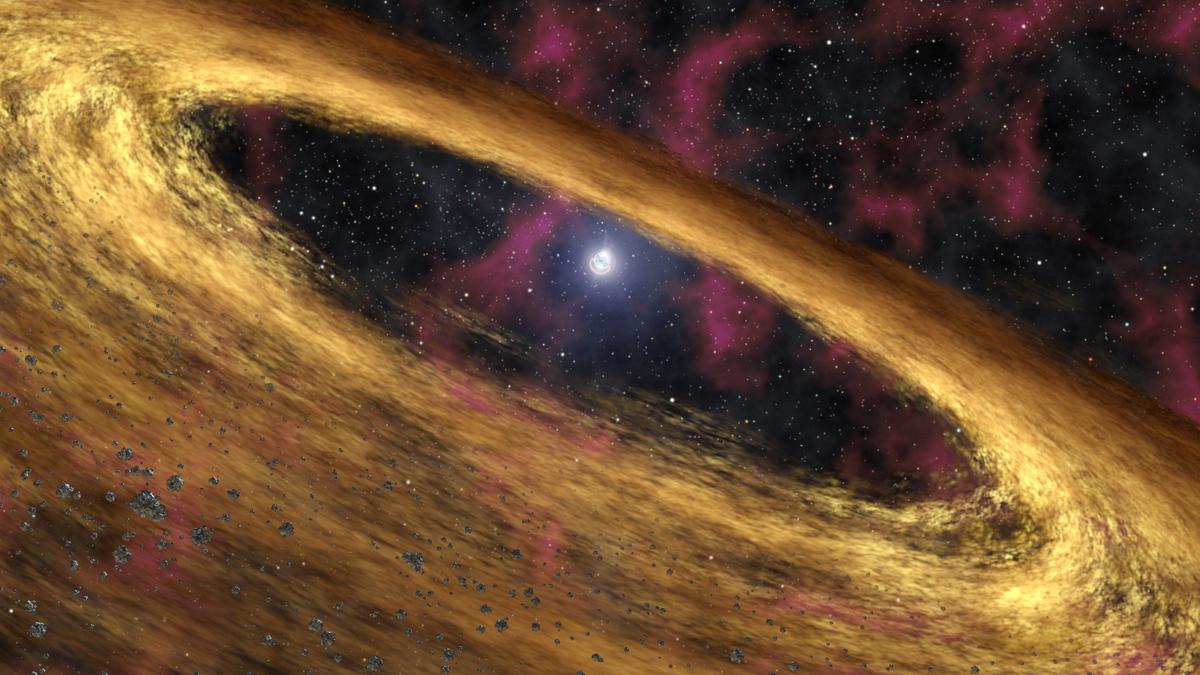
Sometimes the core of a dead star can collapse to form a neutron star. Neutron stars with powerful magnetic fields are called magnetars.

Railroading polarisation

The international team focused its attention on one magnetar named 1E 1547.0-5408, located 14,700 lightyears away. As independent experts Ekaterina Sokolova-Lapa and Joern Wilms wrote in a commentary accompanying the team’s paper, “1E 1547.0−5408 belongs to a rare subclass of magnetars that also emit pulses at radio wavelengths”.

By combining X-ray and radio frequency measurements, then, the team could piece together the geometry of the magnetar’s magnetic field.

If the vacuum of space were truly empty — as in classical physics — the X-rays from the magnetar would reach the earth with a low degree of polarisation. But the team found the opposite: the NASA Imaging X-ray Polarimetry Explorer (IXPE) satellite in particular detected very high levels of polarisation, up to 80% in some instances, which is the smoking gun of vacuum birefringence.

As X-rays leave the magnetar and move through the surrounding space, QED predicts that their electric field will have to lock itself into one of two directions — a condition that unmagnetised space does not impose — thus polarising the light. Since these directions are defined by the direction of the magnetic field, the X-rays’ polarisation is effectively railroaded along the magnetic field lines. And as the X-rays travel away from the magnetar, their polarisation will stay fixed even as the magnetic field becomes less and less able to ‘hold on’.

According to the team, the amount of polarisation dropped as the energy of the X-rays increased, which QED predicts as well. The team was also able to elucidate that the magnetar rotated along an axis that aligned almost perfectly with its magnetic poles, like a top spinning upright — a detail that informed the team’s models of how the X-rays from the magnetar would look with and without vacuum birefringence.

The models that did not account for the phenomenon fit substantially worse with the telescope data than those that included it.

Direct observation

Other than IXPE, the team had also used the Neutron Star Interior Composition Explorer instrument onboard the International Space Station and the Murriyang radio telescope in Australia.

The finding takes a big step towards bolstering space’s character as a complex medium that both gravity and magnetism can manipulate.

On a final note, the team wrote in its paper that its next goal is “to more directly probe the nature of the … polarisation”. And this, the commentary noted, requires “coordinated astronomical campaigns that observe multiple magnetars and cover a wider part of the electromagnetic spectrum”.

The current finding is indirect because the astronomers recorded polarised light and inferred from that that it had passed through extremely magnetised space.

As Sokolova-Lapa and Wilms put it, the high polarisation reported in the study only proves vacuum birefringence if the team’s model of the magnetar’s geometry is correct. If, instead, its axis of rotation and magnetic poles are further apart, the X-rays could have been polarised by plasma on the magnetar’s surface. A paper published in The Astrophysical Journal by researchers from Italy, Spain, and the U.K. has already raised doubts about the alignment.

Physicists are also interested in the vacuum resonance: a distinctive dip in the polarisation — from one of the two allowed directions to the other — at a specific energy level. The international team itself reported a dip but said it was too noisy to be dispositive.

But one way or another, the dark voids between the stars we see when we look up are far from dead, buzzing with activity.

Published – August 31, 2026 09:00 am IST


Source link

Science

Post navigation

Previous Post: Which Nifty is right for you?
Next Post: Gen Z cohort is not ‘homogenous’, concludes BJP in brainstorming session

Related Posts

  • Huge energetic flare from magnetic neutron star detected
    Huge energetic flare from magnetic neutron star detected Science
  • Sci-Five | The Hindu Science: On Bees
    Sci-Five | The Hindu Science: On Bees Science
  • Can heat-related illnesses be prevented in dogs?
    Can heat-related illnesses be prevented in dogs? Science
  • Climate footprint of space exploration is passing below the radar
    Climate footprint of space exploration is passing below the radar Science
  • ‘Datura’ lands e-commerce platforms in trouble in Karnataka: What is the plant?
    ‘Datura’ lands e-commerce platforms in trouble in Karnataka: What is the plant? Science
  • Scientists surprised by source of largest quake detected on Mars
    Scientists surprised by source of largest quake detected on Mars Science

More Related Articles

Racing to build a quantum computer in Hyderabad Racing to build a quantum computer in Hyderabad Science
UoH student’s research offers solution to acid fly problem in hostels UoH student’s research offers solution to acid fly problem in hostels Science
Saltwater flooding a serious fire threat for electric vehicles Saltwater flooding a serious fire threat for electric vehicles Science
Rattlesnake blood could reinvent the fight against deadly venoms Rattlesnake blood could reinvent the fight against deadly venoms Science
IISc announces distinguished alumni awards for 2023 IISc announces distinguished alumni awards for 2023 Science
Discover the secrets of negligible senescence in tortoises and turtles, offering insights for anti-ageing research and potential medical breakthroughs. Discover the secrets of negligible senescence in tortoises and turtles, offering insights for anti-ageing research and potential medical breakthroughs. Science
SiteLock

Archives

  • October 2026
  • September 2026
  • August 2026
  • July 2026
  • June 2026
  • May 2026
  • April 2026
  • March 2026
  • February 2026
  • January 2026
  • December 2025
  • November 2025
  • October 2025
  • September 2025
  • August 2025
  • July 2025
  • June 2025
  • May 2025
  • April 2025
  • March 2025
  • February 2025
  • January 2025
  • December 2024
  • November 2024
  • October 2024
  • September 2024
  • August 2024
  • July 2024
  • June 2024
  • May 2024
  • April 2024
  • March 2024
  • February 2024
  • January 2024
  • December 2023
  • November 2023
  • October 2023
  • September 2023
  • August 2023
  • July 2023
  • June 2023
  • May 2023
  • April 2023
  • March 2023
  • February 2023
  • January 2023
  • December 2022
  • November 2022
  • October 2022
  • September 2022
  • August 2022
  • July 2022
  • June 2022
  • May 2022

Categories

  • Business
  • Nation
  • Science
  • Sports
  • World

Recent Posts

  • India’s IT exports: Deliver the code, chase the cash
  • Is Wetland Authority accountable to government or construction companies, asks Anbumani
  • TCS looks to quantum computing to solve complex ‘what if’ problems
  • AIADMK, BJP leaders slam TVK-led Tamil Nadu government over electricity purchase at high rate
  • Two arrested for attacking security guard with knife in Besant Nagar

Recent Comments

  1. RobertTes on UP Teacher Who Asked Students To Slap Muslim Classmate
  2. Manuelret on UP Teacher Who Asked Students To Slap Muslim Classmate
  3. RobertTes on UP Teacher Who Asked Students To Slap Muslim Classmate
  4. RobertTes on UP Teacher Who Asked Students To Slap Muslim Classmate
  5. BrentWes on UP Teacher Who Asked Students To Slap Muslim Classmate
  • Two Policemen Found Dead With Bullet Injuries in Jammu And Kashmir’s Udhampur
    Two Policemen Found Dead With Bullet Injuries in Jammu And Kashmir’s Udhampur Nation
  • Access Denied Sports
  • The Hindu Morning Digest: February 22, 2024
    The Hindu Morning Digest: February 22, 2024 World
  • Access Denied Sports
  • Access Denied
    Access Denied Nation
  • Access Denied World
  • Access Denied Sports
  • Access Denied Sports

Editor-in-Chief:
Mohammad Ariff,
MSW, MAJMC, BSW, DTL, CTS, CNM, CCR, CAL, RSL, ASOC.
editor@artifex.news

Associate Editors:
1. Zenellis R. Tuba,
zenelis@artifex.news
2. Haris Daniyel
daniyel@artifex.news

Photograher:
Rohan Das
rohan@artifex.news

Associate Journalists
1. Subrata Paul - AN/2020/01
2. Quamruz Zaman - AN/2021/22
3. Ahmed Sha - AN/2021/035
4. Ajay Kumar Shaw - AN/2021/39
5. Tahqiqul Hoda - AN/2021/21

Artifex.News offers Online Paid Internships to college students from India and Abroad. Interns will get a PRESS CARD and other online offers.
Send your CV (Subjectline: Paid Internship) to internship@artifex.news

Links:
Associate Journalism
About Us
Privacy Policy

News Links:
Breaking News
World
Nation
Sports
Business
Entertainment
Lifestyle

Registered Office:
72/A, Elliot Road, Kolkata - 700016
Tel: 033-22277777, 033-22172217
Email: office@artifex.news

Editorial Office / News Desk:
No. 13, Mezzanine Floor, Esplanade Metro Rail Station,
12 J. L. Nehru Road, Kolkata - 700069.
(Entry from Gate No. 5)
Tel: 033-46011099, 033-46046046
Email: editor@artifex.news

Copyright © 2023 Artifex.News Newsportal designed by Artifex Infotech.