
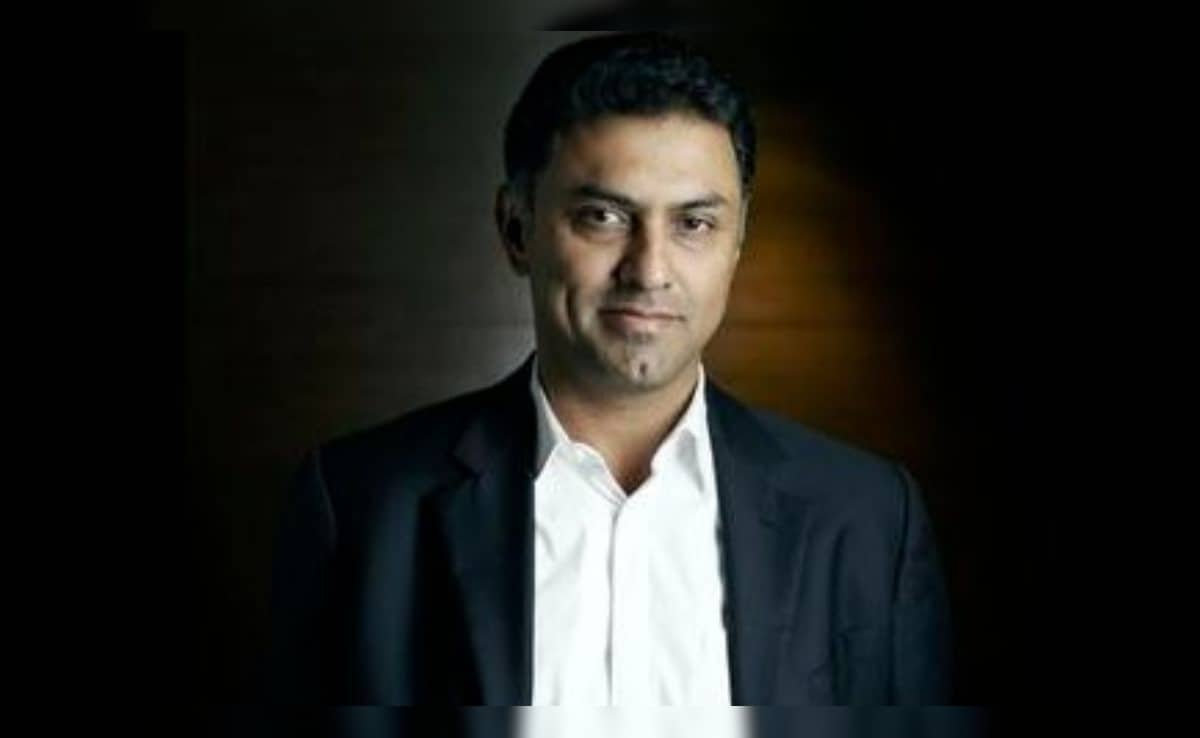

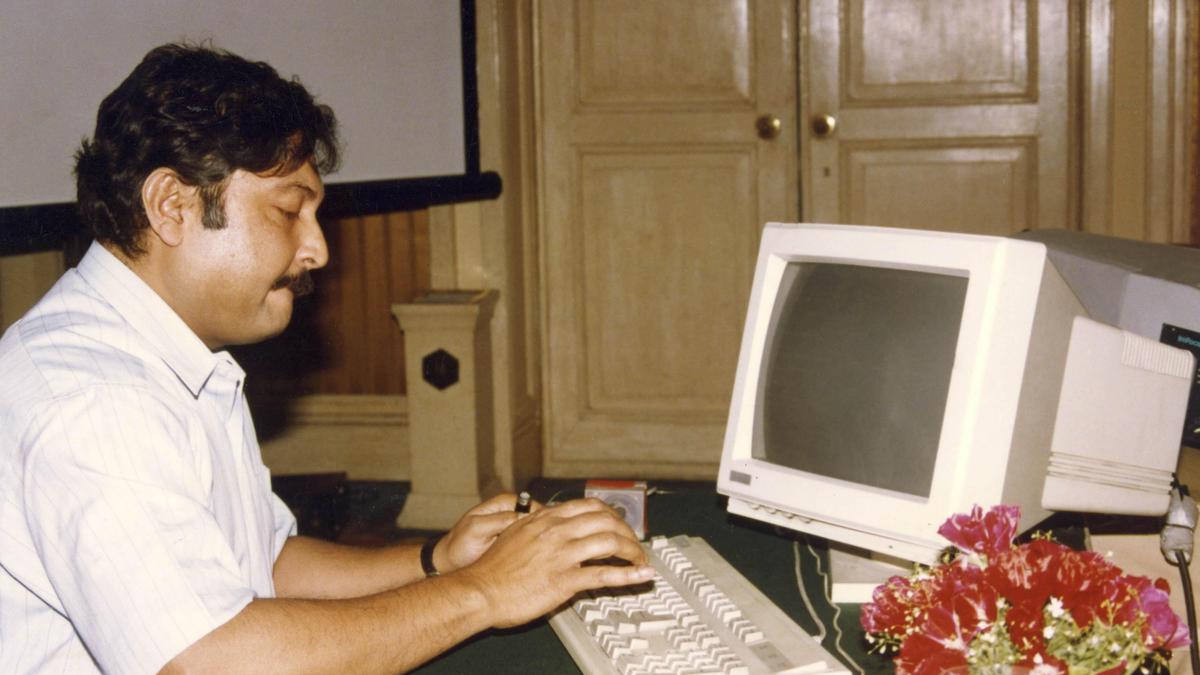
Imagine a classroom where you are given the space to explore and understand concepts on your own with the guidance of a teacher and the internet. Imagine the amount of knowledge which will open up if this non-traditional education style is adopted. That is exactly what Professor Sugata Mitra, a computer scientist and educational theorist, envisioned in his idea of how educational systems can become better equipped for the future.
At a time when conversations are moving more towards banning phones and social media, here’s a glimpse into the conversation I had with Sugata Mitra on various things from his works and life to his idea being implemented worldwide.
A Hole in the Wall
The idea began as a question of curiosity in Mitra’s mind. The question was whether all children — without knowing English or being financially stable — would be able to understand the functioning of a computer as quickly as others. This led to the ‘Hole in the Wall’ educational experiment, which was conducted in 1999 by Sugata Mitra.
The ‘Hole in the Wall’ experiment.
| Photo Credit:
Special Arrangement
Mitra embedded a free, internet-connected computer inside a brick boundary wall separating his office and a poor slum in Kalkaji, New Delhi. He wanted to know whether, without teachers or instructions, the neighbourhood children would be able to learn to browse the web and teach each other within hours.
“What the experiment showed was that groups of children using the Internet can learn almost anything by themselves, and I think young people will say, ‘What’s the big deal?’ But older people keep telling me, ‘That can’t be true because we must be required. We have to teach the children things. Otherwise, how will they learn?’” Sugata Mitra said with a laugh.
This is the core concept followed by the SOLE or Self-Organized Learning Environment method created by Mitra after the experiment. Basically, an educational approach which allows students to use internet-connected devices to explore big, open-ended questions together, SOLE helps foster self-discovery, teamwork, and independent critical thinking.
“What the experiment showed was that groups of children using the Internet can learn almost anything by themselves.”
| Photo Credit:
The Hindu file photo
“What you’ll get is it’s an upside-down teaching process. The children come back, and what I’ve measured is that if they learn that way, then they remember it for the rest of their lives because they will go home and they will tell their parents, ‘today I told the teacher what a certain concept or thing is, not the other way about it,’” adds Sugata Mitra.
When asked what motivated him to create such an experiment, the answer was quite simple. Computers were a luxury back then; only a few homes had them, and parents of those children with computers at home often mentioned how extraordinary it was that their kids were teaching them the device after a couple of days of exploration. “It can’t be that just those kids from the rich households were able to do this, right?” Mitra added.
In the digital age
A major question which popped into my mind during my conversation with Sugata Mitra was how relevant and realistic the concept is at a time when more and more countries are trying to keep students away from devices and social media. The answer was surprisingly quite simple again.
“The Hole in the Wall experiment had two very important rules which we are forgetting in today’s age. The children must be in groups, and the large device screen must be in public,” Sugata Mitra says. He adds that once these rules are followed, the problems being described today can easily be managed.

“Would you open your Facebook, your own Facebook page, in public when everybody else can see what you’re doing? You would not, so we know the answer. The answer is not to ban the thing; the answer is to make it public.”Sugata Mitra
He also suggested that mobile phone usage should be prohibited in classrooms, similar to the way students are often discouraged from reading novels while the teacher is giving a lesson. The solution he proposes is quite straightforward. If there are 20 children, the class needs around 4 computers, and they should be placed in such a way that the teacher in front of the class can see all four screens. Now these should be used to implement the SOLE method, and students should be asked to give collective answers to questions being asked. The answer, according to the professor, is to make a change in the format rather than avoiding such a resourceful source.

The SOLE method.
| Photo Credit:
Special Arrangement
“I’ve been across the length and breadth of India; there are schools where these computers are there, and they’re locked up simply because the principal says, ‘who is going to repair them? What if the children break them?;”Sugata Mitra
Changing the system
“The crux of the problem is the examination system,” said Mitra about the decades-old, outdated practice. “At that time, there was no way that you could find the answer unless you knew the answer in your head, but today we are in exactly the opposite situation where all the answers are in your pocket all the time,” he added.
Exam patterns must step away from making students learn answers by heart. For this, Professor Mitra’s solution is yet again quite simple: allowing the use of the internet in class and during exams. While the idea might seem quite appalling for many, he emphasises how this will help in creating systemic change. In such a scenario, the format of examinations and the teaching method itself will change, creating a system where rutting information will not get you marks.

Exam patterns must step away from making students learn answers by heart.
| Photo Credit:
Special Arrangement
“Give them questions where they have to think before they can answer, whether they know the question or not. So instead, what are we doing? We are going to use the army and the navy and helicopters and police and everybody so that the question paper does not leak,” he said with a smile.
“It’ll be a really big mistake we make if we stop children from accessing the internet, instead of realising that the problem is the device, not the internet itself.”Sugata Mitra
Several Scandinavian countries have made significant strides towards having similar education systems which encourage open thinking, even though they have not fully implemented SOLE.
Evolving with time
When asked about how the system he’s recommending would work in reality and how exams and admissions would work, he admitted it is a difficult idea. “However, in today’s time, the concept that things we learn remain valid over a long period of time has completely broken down. So continuously learning and updating ourselves is a necessity in almost all fields,” he said while adding how SOLE helps students understand that from a young age onwards.
“Asking the right questions is more important than memorising answers; students should understand that,” he added while saying how he did not say it — Gautam Buddha and Socrates did hundreds of years ago.
When asked what his advice to the young generation is, he laughed and said, “Who am I to give them advice? It is their world. All I can tell them is that you are in a world which we (the older generation) cannot predict anymore. You are on your own. So what advice can I give you? Well, I can give you one line if you can make sense out of it — If you can control what you want, you can do what you like. Think about it.” That was his final advice before getting back to his life in a corner of the United Kingdom, empowering and educating thousands worldwide.
Published – September 05, 2026 07:00 am IST