





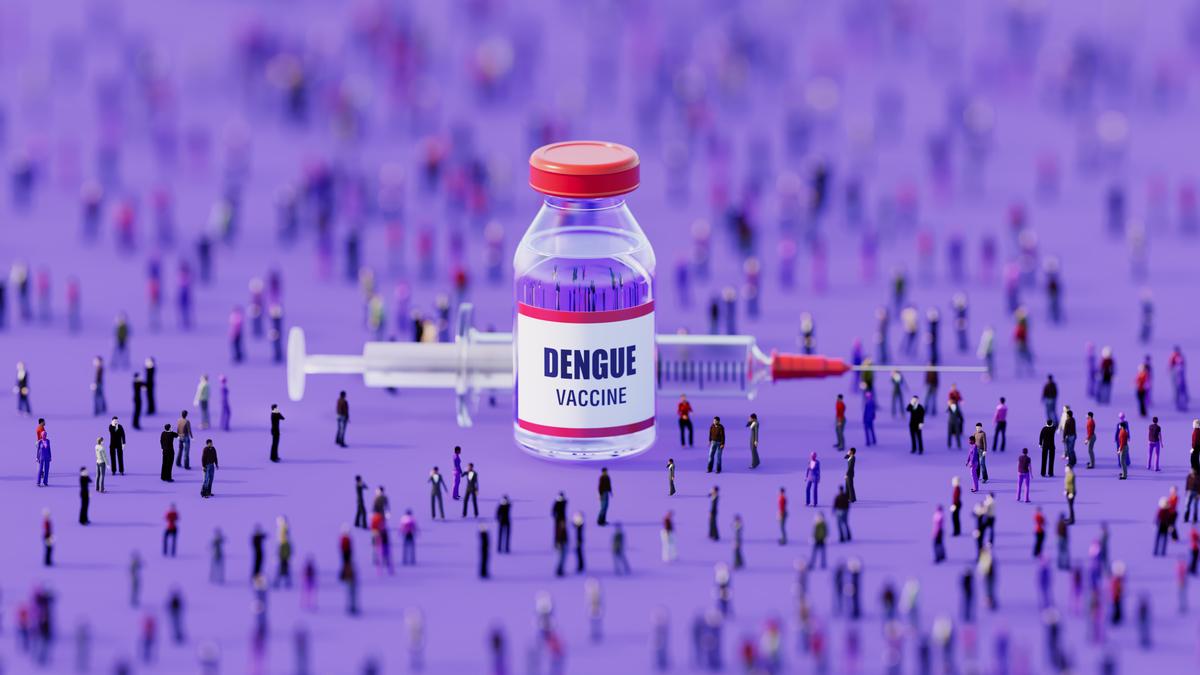
India’s drug regulator just approved the country’s first dengue vaccine, Qdenga. It is designed and claimed to protect against the four serotypes of the dengue-causing virus, called DENV-1 to DENV-4. Young children as well as adults (aged 4-60 years), irrespective of whether they have had dengue before, may be vaccinated with Qdenga.
More than 40 countries have already approved Qdenga, which is manufactured by the Japanese pharmaceutical company Takeda. That said, data from clinical trials that Takeda published in 2019, 2020, and 2024 on the vaccine’s efficacy raise a specific concern about its abilities.
Rationale of dengue vaccines
All the four DENV serotypes are prevalent in India. Each serotype is different from the other such that an immune response to one may not necessarily protect against another. A person who has experienced a natural dengue infection will carry antibodies to the specific DENV serotype in their serum, and the person will be said to be seropositive. A person who has not been exposed to a natural DENV infection will not carry dengue antibodies and is said to be seronegative.
When a seronegative person contracts a first DENV infection for the first time, they will develop antibodies to that particular DENV serotype. When this person, seropositive for that particular DENV serotype, suffers a second infection by another DENV serotype, there is a non-zero chance that they may experience severe dengue. This is because the antibodies produced against the first DENV serotype may actually enhance infection by the second DENV serotype. This is called antibody-dependent enhancement (ADE).
The holy grail of dengue vaccines is to avoid ADE. Any safe and effective vaccine for dengue must be ‘tetravalent’ — meaning it must target all four DENV serotypes simultaneously and equally. If a dengue vaccine fails to protect against even one serotype, it will keep the door open to ADE in future.

People queuing up for check-up at Government Fever Hospital in Hyderabad, 2019. Thousands of patients throng the hospital with seasonal diseases like dengue, viral fevers, and cholera rampant during the monsoon.
| Photo Credit:
RAMAKRISHNA G./The Hindu
It is quite clear that the efficacy and safety of a dengue vaccine are linked to each other as two sides of the same coin. And Qdenga’s phase-3 trial efficacy data need to be understood through this lens.
Phase-3 trial
Takeda set up a large phase-3 trial involving around 20,000 healthy children (4-16 years old) across eight Latin American and Asian countries where dengue is endemic to assess Qdenga’s safety and efficacy. The results from this trial were first published in 2019, with additional data published in 2020 and 2024. Around two-thirds of the children in the trial received Qdenga while the remaining third received a saline solution. Then the researchers compared the vaccine efficacy between the two groups. The efficacy was defined to mean the ability of Qdenga to prevent dengue infections and resultant hospitalisation.
If the vaccine worked as intended, one would expect fewer cases of dengue in the vaccinated group versus in the unvaccinated group. And this was true. In the vaccinated group, 5 children out of 1,000 contracted a DENV infection while in the unvaccinated group, 24 children per 1,000 contracted a DENV infection. This translates to an overall efficacy of about 80%.
Overall, Takeda’s investigators stratified their participants into seropositive and seronegative groups before administering the vaccine. The efficacy was about 82% and 75% in these two groups, respectively. These seem like solid numbers — but the devil is in the details.

‘Variable VE’
If you look at the results stratified by DENV serotype as well, a particular granular detail, which could actually be a potential safety signal, emerges. In children who were seronegative prior to vaccination, those susceptible to DENV-3 infection were noticeably more numerous in the vaccinated group than in the unvaccinated group. In other words, seronegative children vaccinated with Qdenga were 25% more likely to be infected by DENV-3 relative to unvaccinated children.
The number of DENV-4 cases during the trial were so low (in the seropositive group) or totally absent (in the seronegative group) that the efficacy of Qdenga for DENV-4 is essentially unknown. The efficacy was high against DENV-1 and -2, irrespective of the serostatus at baseline.
The investigators had consistently noted these observations in Takeda’s 2020 and 2024 papers as well.
They also persistently referred to this feature of their vaccine as “variable VE against the different serotypes” and described it as a “numerical imbalance” in the number of dengue infections.
The data clearly demonstrate that Qdenga does not offer protection against DENV-3 and could in fact actually be responsible for enhancing dengue in children who have not had a dengue infection yet in their lives. In such cases, Qdenga — being a live dengue vaccine — could simulate a primary dengue infection in the body, resulting in protection against DENV-1 and DENV-2 infections — but not against a DENV-3 infection.
And if such children were to contract a natural DENV-3 infection, they will have a 25% higher likelihood of falling sick, as this will be a secondary dengue infection linked to potential ADE.

Representative image of Qdenga.
| Photo Credit:
File photo
Need for screening
The consequences of contracting a secondary DENV-4 infection by such children cannot be predicted since we do not know of Qdenga’s efficacy against DENV-4. At a conservative estimate of 40 million children in India, with only under 30%of them estimated to be seropositive for dengue, the number of seronegative children facing this heightened risk could be very large.
In a paper in Nature Medicine on July 25, researchers from Imperial College London modelled the health impact of Qdenga in a population and concluded that it would be safer for seronegative recipients — especially children — to be screened for prior dengue exposure before receiving the shot.
In sum, ignoring the DENV-3 safety signal in seronegative children could be a costly and avoidable mistake, and should be avoided through screening.
S. Swaminathan is retired professor of biology from BITS Pilani-Hyderabad and a former scientist in the area of dengue vaccinology at ICGEB, New Delhi.
Published – July 27, 2026 09:00 am IST