




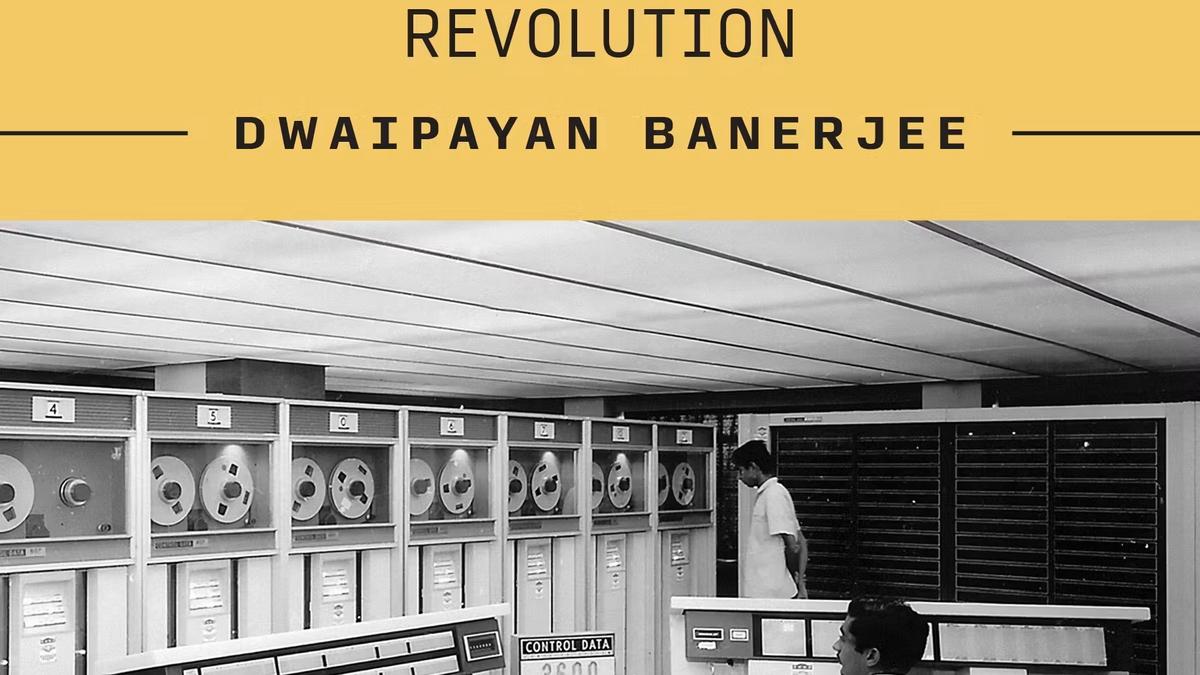
In his new book Computing in the Age of Decolonization, MIT-based historian Dwaipayan Banerjee uncovers the overlooked history of India’s computing industry from the 1950s to the 1980s, and analyses why the efforts to build self-reliance failed.
The story unfolds at the Tata Institute of Fundamental Research (TIFR), where scientists found computing to be integral to national sovereignty and built TIFRAC, an indigenous computer completed around 1960. While the postcolonial Indian state fully supported this flagship project, it did not cultivate an industry around it, leaving a weak domestic electronics base and technical talent concentrated in a handful of institutions.
IBM, meanwhile, leased refurbished and outdated machines into a captive Indian market, and by the early 1970s had produced roughly three-quarters of all the country’s computers. It was infamously pushed out in 1977 by the stringent equity dilution requirements of the Foreign Exchange Regulation Act and the resolve of the then Industry Minister George Fernandes.
But it returned a few years later and joined hands with the Tata Group to get back in business.
ECIL saga
Dr. Banerjee unravels details of the TIFR’s attempts to develop indigenous capacity in computers with assistance from UNESCO, an effort that was thwarted by the U.S. Later, the TIFR collaborated with IBM’s competitor Control Data Corporation, which did not last long due to Cold War-era export controls and U.S. concerns that high-performance computing could be diverted to the nuclear weapons program.
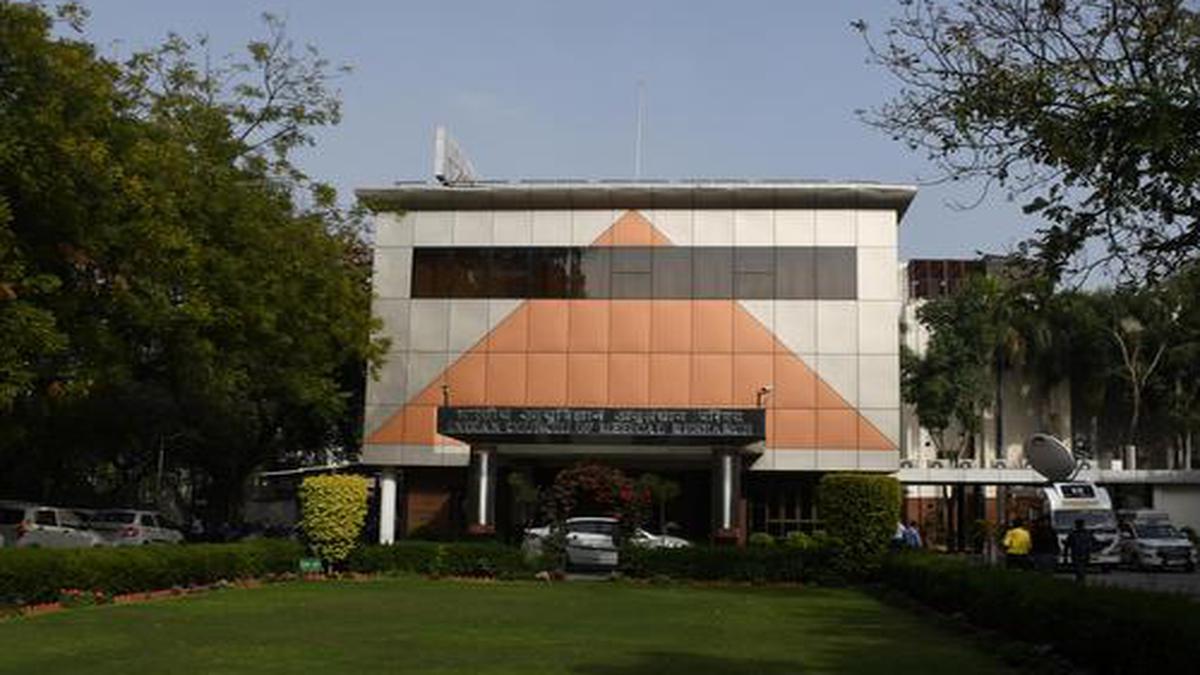
India also made attempts to promote indigenous computing capacity through the Electronics Corporation of India, Ltd. (ECIL), a public-sector undertaking, and established the Computer Maintenance Corporation, responsible for service and support, as a separate entity.
In 1968, the ECIL made a significant advance by developing the Trombay Digital Computer (TDC-12), India’s first computer based on semiconductors. In subsequent years, ECIL enhanced its capacity to develop and produce more such machines, and also built up significant capacity in software development.
However, the state was aware that the ECIL was dependent on imported components. The Indian government had the Department of Electronics take initiatives to promote the domestic manufacturing of components, including semiconductors.
But on account of various factors, including internal politics among the Departments and Ministries, the hostile Cold War milieu, a persistent imbalance in international trade, and the lack of indigenous capacity in electronics, the vision to become self- sufficient in computers did not succeed.
Wrong turn
According to Dr. Banerjee, real technological independence demands more than technical expertise: it requires confronting the enduring political and social structures rooted in colonial legacies.
India’s technocratic elite mistook technical advancement for development. The decisive wrong turn, according to the author, was to decouple software from hardware and the country’s preference for profitable technical services based on exports over costly investments in research and manufacturing.
The book is most persuasive when it insists that the hardware-software split was a choice that had compounding consequences. The framing also rightly internationalises the lesson of the dependency dynamic, which according to Dr. Banerjee is recognisable in India as the concentration of semiconductor fabrication and intellectual property in a few geographies like Taiwan and the U.S. and, more recently, in extractive renewable-energy supply chains across the Global South.
Path forward
However, the book is based on a structural deterministic framework that can flatten contingency. For example, blame for India’s inability to achieve self-reliance can’t be pinned entirely on colonial structures. The country’s choices about industrial policy, foreign exchange, and import substitution were live and reversible, and the book doesn’t fully explore a counterfactual scenario in which India does build a durable hardware base.
Second, the book devotes enormous space and details to its protagonists’ motivations and ends up showing how ineffectual they were. But there could be alternative or counter-perspectives to that. Finally, the book ends with a call to revive the “revolutionary promise of decolonisation” through fundamental social and political transformation. This is rhetorically powerful but strategically very weak as the real challenge lies in fleshing out the alternative pathways and solving the problems they pose. Put another way, while Dr. Banerjee is perhaps right about what didn’t work, the path forward is limited to the level of aspiration.
Dr. Banerjee’s perspective on the Indian software exports industry is also reductionist because he doesn’t seem to give due credit to long-term gains in the form of foreign exchange earnings, jobs created, and gains in productivity.
Over the years, the Indian software industry has acquired significant technological capacity, just not in hardware design and development. The push for software exports did result in the boom of global capacity centres (GCCs) — units owned by multinational corporations that leverage Indian talent for high-end research, product development, and global business processes. But whether India has a mature strategy to make the best use of them is a different issue.
Lessons for today
Debates about technological sovereignty and strategic autonomy are alive and kicking in India even today. For instance, the Indian government is currently pouring crores of rupees into the ‘India Semiconductor Mission’ to lure global chipmakers and reduce its dependence on imported silicon.
To this end, the book is unusually timely. Dr. Banerjee’s history is a warning that flagship projects and catchy headlines may not translate into industrial capability or actual manufacturing capacity. In other words, while subsidy schemes and state-supported initiatives are necessary, they are not sufficient: the larger innovation ecosystem that links research, fabrication, and deployment is crucial. In past attempts to develop indigenous computers and electronics sector, this link didn’t materialise.
Second, while the sovereignty rhetoric is fashionable and politically beneficial, realising it in a productive manner in practice needs a long-term vision and an industrial policy consistent with technological sovereignty. That is, it requires going beyond ‘screwdriver electronics’ — the mere assembly of imported components — to a deep-tech ecosystem where India owns the patents as well as the production equipment.
Against technosolutionism
As Dr. Banerjee writes in the book: “Any renewed struggle for technological sovereignty must begin by reclaiming the revolutionary promise of that first decolonial moment, while appreciating that genuine independence requires not just scientific expertise or state planning, but fundamental social and political transformation.”
This is a good observation that cautions against ‘technosolutionism’ — i.e. projecting technology-based solutions as panacea. In practice, however, it falls short of specifying the institutional frameworks and strategies that lead to technologies resulting in real technological sovereignty.
Dr. Banerjee’s thrust is also on state-led solutions, but India today is very different from what it was until the 1980s. State-led solutions can’t address technological sovereignty when geopolitics and competition in high technologies are intertwined with geopolitics. If anything, the book tells us that today, our ideas need not be confined to yet another ECIL.
Instead, we need to think more in terms of solutions that bring together the state, private capital, research institutions, and global Indian talent — backed by a mature vision.
Krishna Ravi Srinivas is adjunct professor of law and director, Centre of Excellence in AI and Law, NALSAR University of Law, Hyderabad.