




Skip to content
  • Facebook
  • X
  • Linkedin
  • WhatsApp
  • YouTube
  • Associate Journalism
  • About Us
  • Privacy Policy
  • 033-46046046
  • editor@artifex.news
Artifex.News

Artifex.News

Stay Connected. Stay Informed.

  • Breaking News
  • World
  • Nation
  • Sports
  • Business
  • Science
  • Entertainment
  • Lifestyle
  • Toggle search form
  • Germany cracks down on Muslim groups viewed as threats to its constitutional order
    Germany cracks down on Muslim groups viewed as threats to its constitutional order World
  • HIV strains in India resist some top broadly neutralising antibodies
    HIV strains in India resist some top broadly neutralising antibodies Science
  • Access Denied
    Access Denied Nation
  • Access Denied Business
  • T20 Wprld Cup: ‘Hopefully, our performances can help grow cricket in Netherlands,’ says Scott Edwards
    T20 Wprld Cup: ‘Hopefully, our performances can help grow cricket in Netherlands,’ says Scott Edwards Sports
  • Amid Paris Olympics Gender Row, Fresh Video Of Algerian Boxer Imane Khelif’s Beauty Makeover Is Viral
    Amid Paris Olympics Gender Row, Fresh Video Of Algerian Boxer Imane Khelif’s Beauty Makeover Is Viral Sports
  • UN Security Council condemns attack on UAE nuclear plant
    UN Security Council condemns attack on UAE nuclear plant World
  • Access Denied Sports
Why scientists watched a gene hop from a predator into its prey

Why scientists watched a gene hop from a predator into its prey

Posted on July 14, 2026 By admin


Since scientists discovered jumping genes in maize in 1950, they have known that bits of DNA can move around the genome, mostly within the cell nucleus. Scientists have also found evidence of genes having jumped across species.

Now, researchers at the Max Planck Institute for Marine Microbiology in Germany have reported a remarkable observation: they have visually tracked an RNA molecule, called an intron, as it jumped from one organism into another.

This is remarkable because the scientists literally caught the gene as it jumped across species, without the help of any courier.

Jumping genes — technically now called transposable elements — are responsible for the spread of antibiotic resistance and in the development of several cancers. Scientists are also studying circular RNA molecules, like the one derived from the jumping intron, as next generation vaccine platforms. Understanding the lives of jumping genes can thus have profound implications for evolution and ultimately to medicine and biotechnology.

A tiny predator

Microbial communities that occur naturally are very difficult to nurture in large numbers in a lab because they will be isolated from their surroundings. So the team at Jens Harder’s laboratory seeded a lab culture with a small amount of wastewater from a local sewage treatment plant.

Over time, this culture of microbes came to consist of several members of archaea and bacteria. Like bacteria, archaea are another domain of life, and are also microscopic.

Microbes of both these domains lack a true nucleus. Instead, their nucleus lies in the cytoplasm itself.

The team focused on two members of this community. One member is the methane-producing archaeon, Methanothrix soehngenii. The other is a bacterium so small that it is called an ultramicrobacterium. The team named it Velamenicoccus archaeovorus. It is a predator: it attaches to the surface of the archaeon, breaks apart its cell membrane, and kills it.

The rough draft

It is impractical to investigate each member of a highly diverse microbial community separately, so scientists study them en masse. In the study, the researchers identified the RNA molecules in the members’ ribosomes. The ribosome is each cell’s protein-making factory.

The ribosomes in all cells of all life forms have RNAs called ribosomal RNAs (rRNA). All life forms have rRNA that perform the same function. However, each species has a unique sequence of bases that can be used to identify the species. This way, the scientists determined the composition of their lab culture.

In the ultramicrobacterium, one type of rRNA called 23S is initially made as a precursor — like a rough draft, something the cell has to edit further. This editing takes the form of losing a particular sequence of bases called the intron. Essentially, the intron is cut out of the precursor.

The intron itself is a special kind of RNA molecule with two unique roles: it cuts itself out of the precursor rRNA and joins its own ends up to acquire a circular structure. And it contains information that can allow it to ‘jump’.

The team also analysed the rRNA sequences of the ultramicrobacterium from a previous study. This revealed that the introns were highly efficient at their tasks: they rarely failed.

Tracking by eye

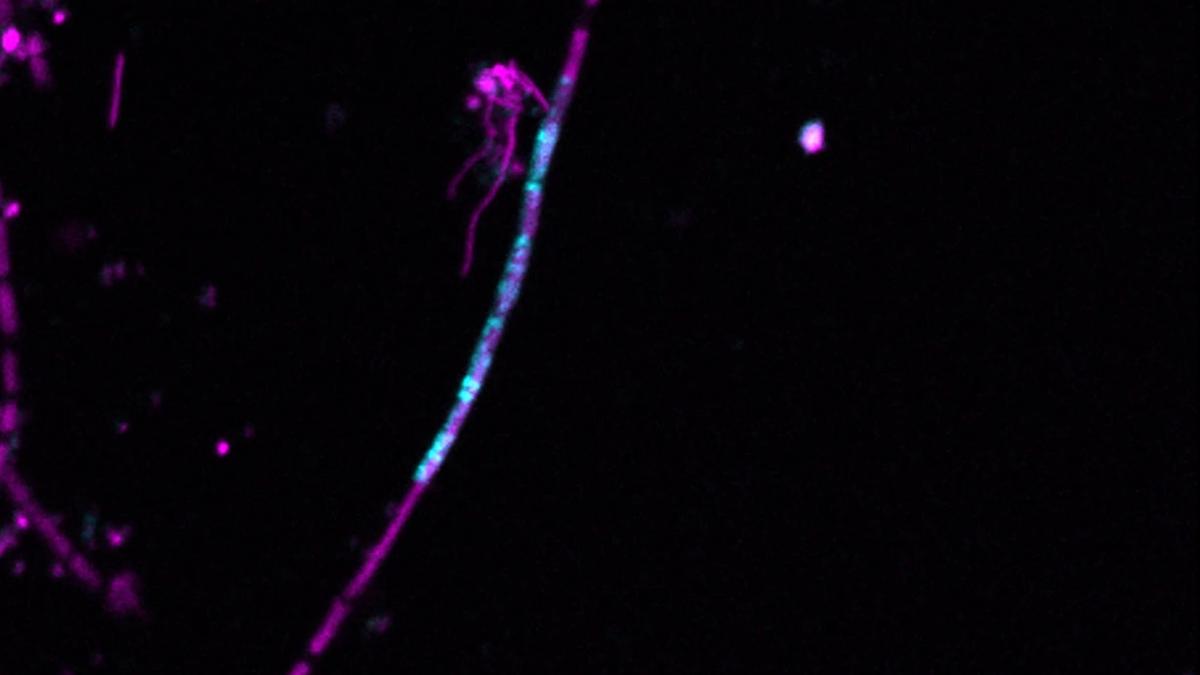
Finally, the team decided to check visually whether the intron of the 23S rRNA of the predator jumped to the prey as the two interacted.

Other scientists at the same Max Planck Institute had already found, and perfected, a way to track RNA visually. It consisted of tracking the RNA using a probe with a pair of special features. One, it was designed to home in on the intron (based on its sequence) and latch on to it. Two, the probe was attached to a fluorescent label — a chemical compound that glows when seen through a fluorescence microscope.

The team modified the probe so that its label would glow green in live cells but yellow in dead cells — either way only if the intron was present.

The team also could tell which cells the intron was by using the difference in appearance of the microbes. V. archaeovorus appears as small spots while Methanotrix soehngenii appears as filaments.

This way, the team detected the intron in Methanotrix soehngenii cells. Specifically, there was a faint yellow glow in the filamentous structures. This meant the cells in which the intron was present were dead.

Clearly, the intron RNA had exited the predator cells and entered the prey cells.

Truly remarkable

RNA molecules are famously unstable, so how did the introns survive this jump? The researchers proposed that the intron’s self-circularisation could be the reason. The circular shape of the RNA molecule allows it to resist being degraded by a cell’s enzymes. The ultramicrobacterium’s genome also encodes an enzyme that could have helped the intron insert itself into foreign DNA.

There are still some unanswered questions. For example, does evolution intend for introns to be integrated into prey DNA? In the experiment, the intron actually jumped into dead cells. Why? Or, alternatively, did the intron kill the cells?

Visual confirmation that an intron can jump across two different domains of life is truly remarkable. Still, let us remember that it happened in a laboratory culture (even if there is indirect evidence that introns do jump in the real world as well).

Living beings sometimes swap genes with viruses, which are the essential couriers of gene transfer. This is known as horizontal gene transfer. The new study, however, has reported the first direct visual evidence of horizontal gene transfer across species without a courier.

Studying this phenomenon helps scientists understand how organisms rapidly acquire new traits, such as antibiotic resistance or new metabolic abilities. It also reveals how genes move across species, potentially reshaping ecosystems and driving the rise of new disease-causing microbes.

S. Swaminathan is a retired professor of biology (BITS-Pilani, Hyderabad) and a former scientist (ICGEB, New Delhi).

Published – July 15, 2026 09:00 am IST



Source link

Science

Post navigation

Previous Post: Gujarat’s Unjha cumin and fennel receive GI tag
Next Post: Bhojshala Temple dispute: Supreme Court suggests temporary prayer space for Muslims until case decided

Related Posts

  • Gaganyaan mission: ISRO completes key engine test
    Gaganyaan mission: ISRO completes key engine test Science
  • Heart failure patients in India die 10 years earlier: study
    Heart failure patients in India die 10 years earlier: study Science
  • Does Mars have life? – The Hindu
    Does Mars have life? – The Hindu Science
  • Why Union Minister Suresh Gopi met ISRO team in Bengaluru, and who else was with him 
    Why Union Minister Suresh Gopi met ISRO team in Bengaluru, and who else was with him  Science
  • Frigid alien planet may offer a glimpse at Earth’s distant future
    Frigid alien planet may offer a glimpse at Earth’s distant future Science
  • Putin aims to have Russian space station by 2027
    Putin aims to have Russian space station by 2027 Science

More Related Articles

Science This Week | 2023 Nobel Prize winners announced, ISRO to begin unmanned flight tests for Gaganyaan and more Science This Week | 2023 Nobel Prize winners announced, ISRO to begin unmanned flight tests for Gaganyaan and more Science
ICMR study finds the drivers of COVID-19 vaccine hesitancy ICMR study finds the drivers of COVID-19 vaccine hesitancy Science
Language learning begins in the womb Language learning begins in the womb Science
ISRO to launch European Space Agency’s Proba-3 mission on December 4 ISRO to launch European Space Agency’s Proba-3 mission on December 4 Science
‘Station’ in Ladakh begins research to simulate life on Moon, Mars ‘Station’ in Ladakh begins research to simulate life on Moon, Mars Science
More than just a pigment: What is melanin? More than just a pigment: What is melanin? Science
SiteLock

Archives

  • July 2026
  • June 2026
  • May 2026
  • April 2026
  • March 2026
  • February 2026
  • January 2026
  • December 2025
  • November 2025
  • October 2025
  • September 2025
  • August 2025
  • July 2025
  • June 2025
  • May 2025
  • April 2025
  • March 2025
  • February 2025
  • January 2025
  • December 2024
  • November 2024
  • October 2024
  • September 2024
  • August 2024
  • July 2024
  • June 2024
  • May 2024
  • April 2024
  • March 2024
  • February 2024
  • January 2024
  • December 2023
  • November 2023
  • October 2023
  • September 2023
  • August 2023
  • July 2023
  • June 2023
  • May 2023
  • April 2023
  • March 2023
  • February 2023
  • January 2023
  • December 2022
  • November 2022
  • October 2022
  • September 2022
  • August 2022
  • July 2022
  • June 2022
  • May 2022

Categories

  • Business
  • Nation
  • Science
  • Sports
  • World

Recent Posts

  • Now, road safety lessons await traffic violators in Delhi
  • Excise targets drug peddlers as ‘dead drop’ trend soars in Kochi
  • EC extends SIR deadline; final electoral roll to be out on Oct. 19
  • Kerala High Court prohibits political events at Thekkinkadu Maidan in Thrissur
  • Around 100% distribution of enumeration forms in Delhi reflect door-to-door coverage, not voter receipt: official

Recent Comments

  1. WilliamNer on UP Teacher Who Asked Students To Slap Muslim Classmate
  2. DavidQuera on UP Teacher Who Asked Students To Slap Muslim Classmate
  3. Traviswat on UP Teacher Who Asked Students To Slap Muslim Classmate
  4. WilliamNer on UP Teacher Who Asked Students To Slap Muslim Classmate
  5. Frankiemug on UP Teacher Who Asked Students To Slap Muslim Classmate
  • U.S. President Donald Trump declares end to birthright citizenship
    U.S. President Donald Trump declares end to birthright citizenship World
  • The rise of temporary teachers in West Bengal
    The rise of temporary teachers in West Bengal Nation
  • US Urges Israel’s Defence Minister To Avoid Lebanon Escalation
    US Urges Israel’s Defence Minister To Avoid Lebanon Escalation World
  • Access Denied Sports
  • 11 Palestinians Killed In Israeli Air Strike On Tent In Gaza’s Rafah
    11 Palestinians Killed In Israeli Air Strike On Tent In Gaza’s Rafah World
  • CBI Arrests ‘Rocky’, Alleged Mastermind In NEET-UG Paper Leak Case
    CBI Arrests ‘Rocky’, Alleged Mastermind In NEET-UG Paper Leak Case Nation
  • Access Denied Sports
  • Charred Bodies Of 3 Assam Men, Burnt Vehicle Found In Meghalaya
    Charred Bodies Of 3 Assam Men, Burnt Vehicle Found In Meghalaya Nation

Editor-in-Chief:
Mohammad Ariff,
MSW, MAJMC, BSW, DTL, CTS, CNM, CCR, CAL, RSL, ASOC.
editor@artifex.news

Associate Editors:
1. Zenellis R. Tuba,
zenelis@artifex.news
2. Haris Daniyel
daniyel@artifex.news

Photograher:
Rohan Das
rohan@artifex.news

Artifex.News offers Online Paid Internships to college students from India and Abroad. Interns will get a PRESS CARD and other online offers.
Send your CV (Subjectline: Paid Internship) to internship@artifex.news

Links:
Associate Journalism
About Us
Privacy Policy

News Links:
Breaking News
World
Nation
Sports
Business
Entertainment
Lifestyle

Registered Office:
72/A, Elliot Road, Kolkata - 700016
Tel: 033-22277777, 033-22172217
Email: office@artifex.news

Editorial Office / News Desk:
No. 13, Mezzanine Floor, Esplanade Metro Rail Station,
12 J. L. Nehru Road, Kolkata - 700069.
(Entry from Gate No. 5)
Tel: 033-46011099, 033-46046046
Email: editor@artifex.news

Copyright © 2023 Artifex.News Newsportal designed by Artifex Infotech.