






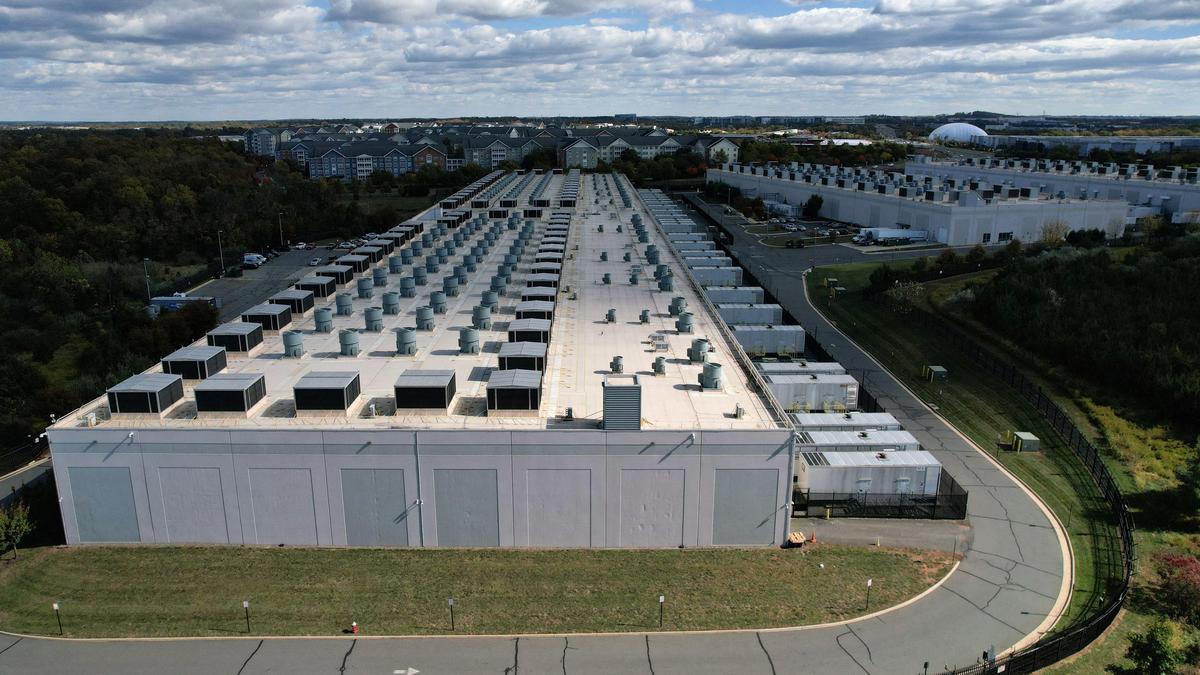
The story so far: Carbon emissions from Google, Amazon, and Microsoft have jumped drastically between 2024 and 2025 as Big Tech firms jostle to stay ahead in the AI race. These companies are expanding their data centre capacities and the world is paying a steep environmental cost.
How are carbon emissions reported?
Per the Greenhouse Gas Protocol, a company’s emissions are divided under three categories — Scope 1, Scope 2, and Scope 3 — with the first one capturing the company’s direct emissions, the second measuring its industrial use of energy, and the third covering a wide range of activities including employees’ commutes and how the customers use the company’s products and services.
Big Tech firms’ reports present how these tiered emissions and total emissions have changed in a financial year. In doing so, they tend to play up minor reductions in the first and second tier emissions, instead of highlighting the increase in total emissions.
Let’s take a look at the numbers. In its 2026 Environmental Report, Google noted that its Greenhouse Gas Protocol-aligned emissions saw an increase to 18.84 million tonnes of carbon dioxide equivalent (tCO2e) in 2025 from 15.93 million tCO2e in 2024. In other words, Google’s total emissions increased by more than 18% since last year.
What’s more, the first tier emissions increased by 20% in 2025 compared to 2024, primarily because of Google’s expanding data centre portfolio and associated increases in fuel use. While the second tier emissions (market-based) fell slightly, the third tier emissions increased. Google attributed this primarily to technical infrastructure hardware manufacturing, their logistics, and data centre construction. Google’s total emissions have skyrocketed by more than 80% since 2019.
E-commerce giant Amazon stated in its 2025 Sustainability Report that absolute emissions increased by 16% from 2024 to 2025, coming to 80.85 million tCO2e. Since 2019, Amazon’s emissions have surged by more than 50%.
Coming to Microsoft, the software company reported that total emissions increased in 2025 by 25% to 20 million tCO2e from 16 million tCO2e in 2024.
Social media giant Meta’s emissions are yet to be released this year. But the company’s data centre buildout is causing novel concerns: U.S. officials in the state of Wyoming linked a bacteria, Cupriavidus gilardii, to discharge from a Meta data centre that is under construction.

Why did carbon emissions increase?
Out of the three types of emissions, Scope 3 usually occupies the biggest share, as it takes into consideration emissions from the company’s supply chain teams, its third-party activities, its employees, and even its customers. Scope 3 emissions are relatively more challenging to control and reduce through policy changes.
However, AI was an overlapping factor when it came to the three Big Tech companies’ carbon emissions.
“We recognize that our climate impact has been growing alongside the unprecedented growth of AI, and we’re actively working to minimize this impact,” said Google, going on to claim that without its decarbonisation interventions, the company’s 2025 ambition-based carbon footprint might have been five times larger.
Amazon pointed to supply chain emissions include building and data centre construction, fuel consumption by third-party transportation providers, and the production of Amazon branded products and hardware. Amazon further reported that in view of customer demands, it added more data centre capacity globally in 2025 than any other company.
“Our supply chain emissions account for 76% of our carbon footprint, and these emissions increased 20% compared to 2024,” stated Amazon, stressing that it was working with its partners to help them reduce these levels and that the company was also transitioning to electric vehicle fleets across its markets.
Microsoft confirmed that total emissions had increased and attributed this primarily to the expansion of its data centre infrastructure. However, the company also pointed out that it had paused its use of non-additional, unbundled renewable energy certificates, which also affected the way emissions were measured.
Both Google and Microsoft defended their numbers by pointing out that without their existing measures and interventions, their carbon emissions in 2025 would have been far higher than what they actually were.

What is the impact of the report?
Annual environmental reports are packed with photos of beautiful landscapes, flowing rivers, and blue skies, but the Big Tech companies’ sustainability reports reveal that AI is making our environment noxious with a huge energy bill. Companies are acknowledging that they are struggling to adhere to their earlier environmental pledges to reduce Scope 3 emissions as they race to expand data centre capacity.
While many technologists have used the energy demands of AI and data centres to herald a transition to clean energy or hail progress in other sustainability initiatives (such as going paperless or reducing plastic use), these reports make it clear that pollution is unquestionably on the rise and that AI is a major catalyst.
Such outcomes are likely to further galvanise community movements that want to keep AI data centres out of their localities, as this becomes a significant campaign issue in the U.S. But considering the U.S. government’s record on environmental protection under President Donald Trump, it is expected that Big Tech companies will largely be allowed to self-regulate — or, continue as they see fit.
Published – July 14, 2026 10:49 am IST