


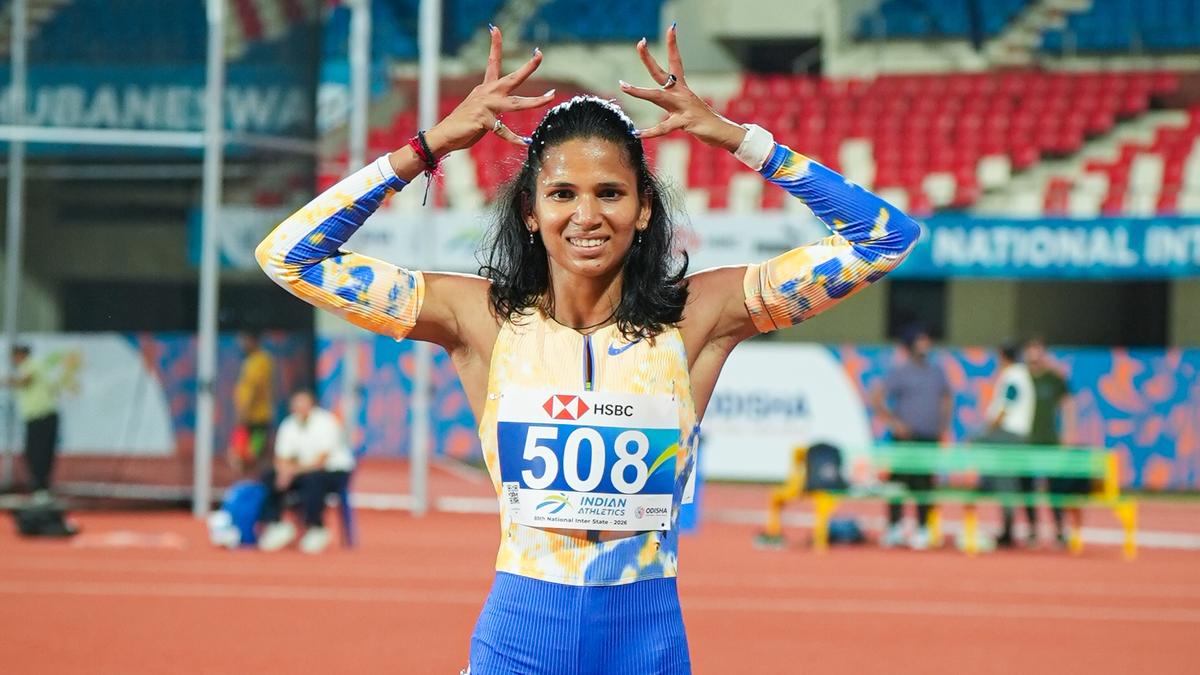
When Jyothi Yarraji saw ‘12.99 seconds’ flash across the giant screen after the women’s 100m hurdles final at the National Inter-State Championships at Kalinga Stadium, she crumpled onto the track.
For the first time in over a year, the tears weren’t born of pain. They were of relief, joy and vindication. This was the finish she had dreamed of long before her world came crashing down.
The unravelling of a season
The season prior had begun spectacularly for Jyothi. She swept the 100m hurdles and 200m at the National Games in February, followed by another hurdles gold at the Federation Cup. She defended her continental crown at the 2025 Asian Athletics Championships in May and added the Taiwan Athletics Open title to her cabinet soon after.
All great signs of a great season to come, especially with major events right around the corner.
Then, in a single training session in June, it all unravelled. An anterior cruciate ligament (ACL) injury mercilessly cut her season short.
A year later, she was back.
It took 383 days for Jyothi to return to competitive athletics. In Bhubaneswar, she stormed to the national title, comfortably dipping under the Asian Games qualification mark. It looked like the perfect comeback.
The timeline, however, was anything but. The blueprint set by her team mandated a gradual return through smaller competitions before the National Championships. This was while the window to secure a place at the Asiad was shrinking with each passing day.
If this wasn’t jeopardy enough, Jyothi’s body decided to throw new curveballs.
“She had a couple of setbacks; she sort of injured other areas, and that was very frustrating for her. That’s why she had to start her season at the Inter-State. What would’ve been nice is if we’d been able to have a couple of low-key competitions first. But that’s how it is sometimes,” her coach James Hillier tells The Hindu.
It is never easy for a coach to watch their athlete buckle under the weight of uncertainty. Hillier, a man who prefers the comfort of control, was powerless through most of it.
Jyothi overcame the fear of injury — she had torn her ACL after smacking a hurdle foam in training — to clock 12.99 seconds in Bhubaneswar.
| Photo Credit:
Special Arrangement
“He was in the US [when I got injured], and I called him before he called me,” Jyothi tells this publication. “He knew about the nature of my injury, but didn’t want to disturb me. He was with his family. I asked him to enjoy his time and come back. I told him that I was good and that I would come back soon.”
Hillier still marvels at how their roles reversed. “I blamed myself for not being there, but she immediately said, ‘Coach, shut up. It’s not your fault’. She was the strong person, and I was the vulnerable one. She was coaching me at that point. It was quite amazing, really.”
Five days after the surgery, the actual challenge — rehabilitation — began.
Jyothi was condemned to a painful monotony. While her fellow athletes trained on the track, she spent hours doing the simplest of exercises — holding her knee in place for 10 seconds, relaxing, and repeating, slowly increasing the duration over time. She remembers days when she would hesitate to take even a step.
Hillier, meanwhile, enforced his recovery protocol: complete rest to the injury site, no off days for the rest. Jyothi, therefore, channelled all her energy into building upper-body strength.
The confidence game
Building confidence was just as important, but not at the cost of denying reality.
“My coach told me it was my time to feel sad, to cry and feel the pain. He said, ‘I don’t know what you are going to do in the future, but you will 100% do good,’” Jyothi says.
Hillier also understood the value of small comforts. For more than two weeks before her surgery, despite being on the other side of the world, he made sure her favourite blueberries, strawberries and chocolates kept arriving at her doorstep.
“I had to call him and ask, ‘What are you trying to do? You’re making me fat.’ And he would tell me, ‘It’s ok, now is your time to eat and sleep, do that.’”

Jyothi had frustrating injury setbacks during the recovery process, but persevered through them.
| Photo Credit:
Special Arrangement
After chasing speed all her life, Jyothi was forced to stop and smell the flowers. She learnt to, eventually, of course, appreciate it. Along with it came hobbies like crocheting, learned entirely off YouTube. There’s a knitted bag in her room that she has made from scratch.
Hillier, meanwhile, sought every possible edge, like bringing strength and conditioning coach Wayne Lombard into the team.
“There was nothing that Wayne discovered that we didn’t already know, but it’s just that reinforcement. That reinforcement is extremely powerful. It’s often more powerful than finding something new. He played a hugely important part, I would argue, more on the mental side than the physical, in a weird way, even though he is obviously a strength coach,” Hillier says.
Perhaps it was he who gained the most by having Lombard’s experience on hand.
“We have to remember the human being that stands behind the hurdle. That then became the starting point of this journey: to make sure she’s okay first before dealing with anything else. If she wasn’t, this injury would take twice as long to put behind us.”
By January, Jyothi was finally back on the track. But other ‘hurdles’ followed. First came a quad injury, then another knee issue, and a hamstring problem. The finish line faded into the distance.
But Jyothi had blinkers on. The anxiety about a premature end to her career went away, but the fear of injury lingered. So much so that she placed cushions atop the hurdles in training to soften the impact if she clipped them.
Those nerves settled only after she clocked 13.14 seconds in the heats in Bhubaneswar. Slowly, belief pushed out fear.
Hillier knew this comeback was about far more than winning another national title. The night before the race, he handed Jyothi a letter reflecting on everything they had endured over the previous year. Alongside it was another box of blueberries, though she ignored his instructions not to open the letter immediately.
“Sometimes you’ve got to be a coach, sometimes a friend, a father or a brother. You have to be a chameleon as a coach. Maybe the letter came from a coach and the blueberries from a friend,” he says.
New beginning
With brown kinesiology tape wrapped around her right knee, Jyothi walked back into competition, a year after she smacked a hurdle foam in training and tore her ligament. She walked away as a national champion.
“I don’t know if we’re happy or relieved. It’s a weird one, actually. It’s been such an emotional journey that there’s not a huge amount of emotion left. But it’s a new beginning. We can crack on now with the rest of her career, the next chapter in her athletics journey,” Hillier says.
After her triumph, an emotional Jyothi, with plenty of cameras fervently clicking away, appeared to don an imaginary crown. Until the bigger golds she wants come along, this will do.