




Neighbours Prestina Sangkly, Dilip Rabha, and Mercy Lyngdoh, unknown to each other a decade ago, had something in common. They were farmers who struggled to sell their fruits of labour—the seasonal Khasi Mandarin orange and the Kew and Queen pineapples, and the perennial banana—by the roadside or at weekly markets.
Their lives began changing after they and 430 others became “unique numbers” in Meghalaya’s experiment with farm collectivisation with the formation of the Jirang Organic Agro Farmers Producer Company Limited (FPC) in 2017. A block headquarters in the State’s Ri-Bhoi district, Jirang is about 52 km southwest of Guwahati and 120 km northwest of Shillong.
“There may be others bearing my name, but none can flaunt SBORG17MLRBJ06035, my farmer code as a member of our FPC, which has helped us increase our collective income from ₹1.5 lakh during 2017-2021 to more than ₹1.17 crore in 2025,” said Ms. Lyngdoh, who has 1.42 hectares out of her 3.1-hectare farm in Warmawsaw village under organic fruit and condiment cultivation.
The code number bears the organic certification by a New Delhi-based agency and Meghalaya’s code for rural Jirang.
Mr. Rabha of Sukurburia village, who grows pineapples, oranges, banana, ginger, and black pepper on more than 50% of his 2.22-hectare land, is proud of his farmer code too. “From a nameless vendor, I am now exporter number SBORG17MLRBJ02014, who also supplies to major Indian retailing brands in several metros,” he said.
‘Big leap’
The Jirang FPC was formed under the centrally-aided Mission Organic Value Chain Development for North Eastern Region. Its chief executive officer and farmer, Ibalahun Thangkhiew, said the first few years were spent on coordinating with fellow farmers and training them for the “big leap”.
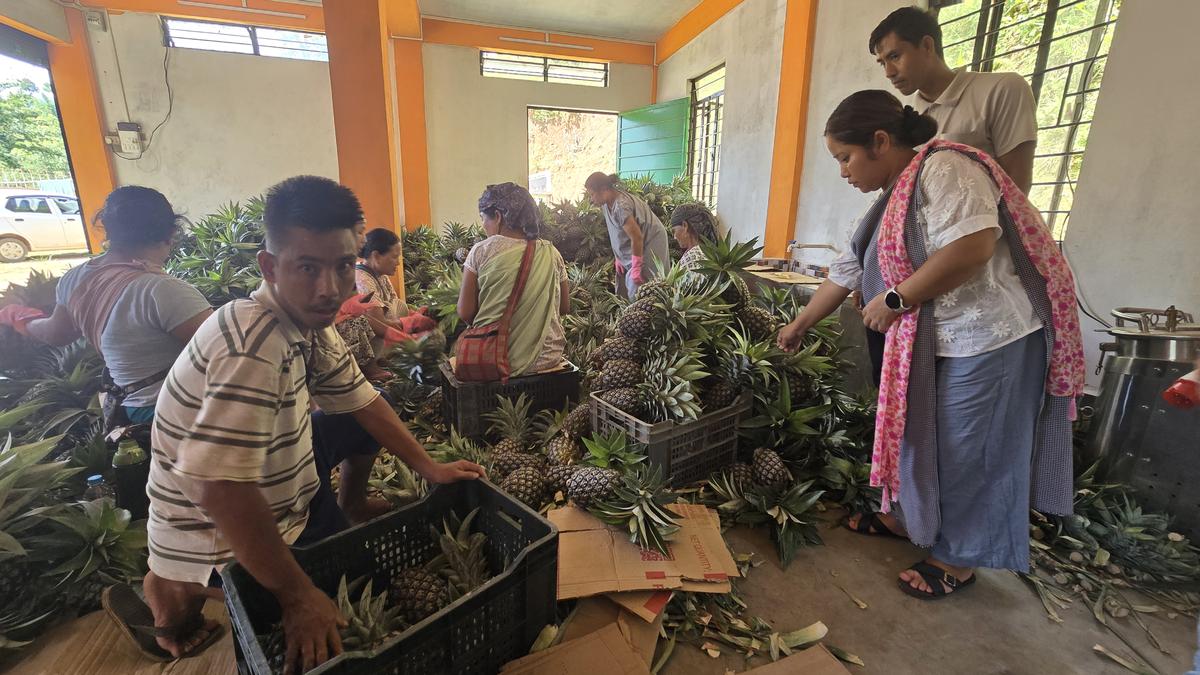
Members and workers of Meghalaya’s Jirang Organic Agro Farmers Producer Company Limited sort pineapples booked by a Delhi-based retail brand.
| Photo Credit:
–
The FPC expanded gradually from New Jirang, the centralised location of its product collection centre, to rope in 433 members across 18 villages—the farthest 25 km away—cultivating approximately 500 acres of land. About 75% of the members are women.
“Our farmers began getting premium prices for their products after the FPC came into existence. A farmer who used to fetch ₹400-500 for 80 pieces of the GI-tagged Khasi Mandarin earned ₹700-800 and even ₹1,000 for the bigger pieces. Similarly, a pineapple that sold for ₹8-10 per piece started fetching ₹20-25,” Ms. Thangkhiew told The Hindu.
“More importantly, post-FPC, farmers were spared the trouble of selling their products at Patharkmah, the sub-divisional headquarters 5 km uphill, or faraway weekly markets. Today, Reliance Retail, Blinkit, Safal-Mother Dairy, and other brands send air-conditioned trucks to buy our products,” she said.
After 2022, when the first consignment of Jirang’s Khasi Mandarin oranges was exported to Dubai, each FPC member has been earning ₹50,000-80,000 annually from fruits alone. Additionally, each grows paddy and vegetables for self-sustenance and sale.
Pulping push
The “big leap” that the farmers had been preparing for came after a ₹2.46-crore aseptic pulp processing unit was set up within the 2.5-acre collection centre, which also houses a cold storage, in September 2025. It was the first fruit pulping unit established under Meghalaya’s innovative Community-Public-Private Partnership model with support from the International Fund for Agricultural Development and the FOCUS (Farmer’s Collectivisation for Upscaling Production and Marketing Systems) programme.
“This unit, with a capacity to process 10 metric tonnes of fresh fruits per day, has drastically reduced wastage. The quality of our products is assured, but our traditionally organic approach cannot make them adhere to a uniform size and shape, which the buyers prefer. The smaller, crooked fruits or those damaged on the surface during transit from the villages to the collection centre are now pulped,” Persevere Ranee, Jirang FPC’s chairman, said.
“The pulped fruits in specialised bags not only have takers at a competitive price; they also have a shelf life of 18 months to help us do business beyond the pineapple and orange seasons,” he said.
The farmer-members are not the only beneficiaries of the FPC, which the Conrad K. Sangma-led Meghalaya government claimed has become a model for successful farm collectivisation. The FPC employs 20 people to load, unload, clean, and pack fruits for ₹350-450 per day depending on the working hours.
According to the State’s Agriculture and Horticulture officials, the Jirang model is inspiring villagers in other parts of the State to go for collectivisation to fetch better prices for their products. The model, Mr. Ranee said, warrants that villagers get to know the basics of market dynamics and train themselves in other aspects of farming, including preparing their own vermicompost.
Matrilineal strength
A factor behind the growth of Jirang FPC is Meghalaya’s community traditions and women-led agriculture. In the State’s matrilineal society, women play a central role in cultivation, post-harvest management, and farmer institutions, making pineapple or orange not merely a crop but an important source of household income and rural empowerment.
To take the women-led enterprise a notch higher, the State government initiated the Meghalaya State Organic Mission in 2024 with an investment of ₹295 crore, aiming to bring 1 lakh hectares under certified organic cultivation by 2028 and benefiting more than 90,000 farmers.
Pineapple, one of the priority crops under the mission, accounts for nearly 25% of the area currently under organic certification, reflecting its importance in Meghalaya’s horticultural economy.
“Scientific interventions have been undertaken to improve planting materials, cultivation practices, and productivity, while demonstration farms and exposure visits have helped farmers adopt modern technologies without compromising traditional and sustainable farming methods,” a government spokesperson said.
Modern processing infrastructure
“The State has invested in modern processing infrastructure and decentralised aggregation systems, ensuring that farmers receive better prices and reduced post-harvest losses,” he added.
Among such units are the MeghFarm Processing Hub and the Tikrikilla PRIME Hub in the West Garo Hills district, offering some 10,000 farmers modern facilities for juice processing, dehydration, blast freezing, and storage.
The government has also been acquainting farmers with the farm festival circuit in Meghalaya and beyond to connect them directly with consumers, retailers, and food businesses. One such event is the Meghalaya Pineapple Festival, which has emerged as a flagship platform to promote the State’s premium pineapples since its launch in 2023.
The 2026 edition of the pineapple festival is scheduled in New Delhi’s Dilli Haat from July 10-12.