Skip to content
  • Facebook
  • X
  • Linkedin
  • WhatsApp
  • YouTube
  • Associate Journalism
  • About Us
  • Privacy Policy
  • 033-46046046
  • editor@artifex.news
Artifex.News

Artifex.News

Stay Connected. Stay Informed.

  • Breaking News
  • World
  • Nation
  • Sports
  • Business
  • Science
  • Entertainment
  • Lifestyle
  • Toggle search form
  • Ukraine claims its drones hit a Russian oil facility, sparking a huge blaze
    Ukraine claims its drones hit a Russian oil facility, sparking a huge blaze World
  • Prashant Veer ‘is a same-to-same replacement for Jadeja’: UPCA official Sajid
    Prashant Veer ‘is a same-to-same replacement for Jadeja’: UPCA official Sajid Sports
  • Tunnel road is a ‘real estate project in disguise’: Citizen groups
    Tunnel road is a ‘real estate project in disguise’: Citizen groups Nation
  • “If India Go Over The Top…”: Australia Legend Ian Chappell’s Sharp Warning To Team India
    “If India Go Over The Top…”: Australia Legend Ian Chappell’s Sharp Warning To Team India Sports
  • Apple abused position in apps market, finds antitrust probe
    Apple abused position in apps market, finds antitrust probe Business
  • Access Denied Business
  • Access Denied
    Access Denied Nation
  • I’m not your traditional spinner, says Smith
    I’m not your traditional spinner, says Smith Sports
Kingmakers: Meet the insects that make India’s famed mangoes

Kingmakers: Meet the insects that make India’s famed mangoes

Posted on June 24, 2026 By admin


More than a thousand varieties of mangoes exist in India, the popular ones being Banganapalli, Dassheri, Alphonso, Badaami, Imaam Pasandh, and Mulgoa. There is even a “Lalbagh” variety in Bengaluru. Many of us associate the fruit with a summer childhood memory, of eating it with our bare hands, the mango juice dripping on our clothes.

More recently, the fruit has become popular on social media platforms, where users explain hundreds of ways to cook and eat it. This year, the fruit’s popularity reached a new height: the red carpet at the Met Gala in New York. Mangoes and Indian summers go hand-in-hand, yet do you know how this fruit comes to be?

In other words, the mango tree gives out flowers… and then what happens?

Making a mango

Between December and March every year, mango trees across the country bloom and issue a sweet yet slightly fermented odour. Look closer at a mango tree in this time and you will find a branch with several bouquets of small, cream-coloured flowers. Each branch, which botanists call a panicle, contains a few hundred to up to 10,000 individual flowers. And a single mango tree can carry up to some 3,000 panicles, depending on its size and branching.

Each one of these flowers is the start of a mango in the making. Some flowers carry only the male parts while others only the female parts, and sometimes there can be flowers with both (which are biologically called hermaphrodites). Regardless, for the mango to form, pollen must travel between these flowers.

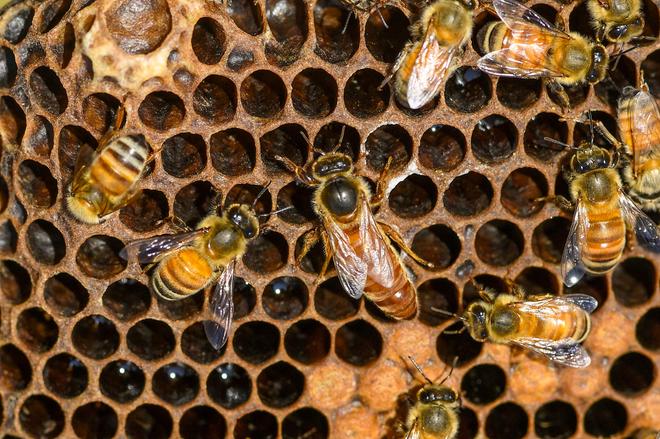
A colony of bees is seen at a hive in the backyard of University of Maryland bee researcher Nathalie Steinhauer, June 21, 2023.

A colony of bees is seen at a hive in the backyard of University of Maryland bee researcher Nathalie Steinhauer, June 21, 2023.
| Photo Credit:
AP

This is where pollinators make their mark. There is a curious history here. Mango cultivars had once insisted that mango flowers are pollinated only by wind. But this theory could not explain why the flowers issued a sweet odour. It had to be to attract insects.

To confirm that insects were indeed pollinators, researchers in Bengaluru teamed up with their peers from Germany to survey several Badami mango farms in the city’s urban and rural areas. Their findings, published in 2023, were striking: when flying insects were excluded from visiting the flowers, the mango yield dropped as much as 350% compared to when flowers were left open to all visitors.

These flying insects were found to include wild bees such as the dwarf honey bee (Apis florea), giant honey bee (Apis dorsata), and stingless bees (Tetragonula sp.). Other important flying visitors included hoverflies, which look like bees (Syrphus sp.), the common house fly (Musca domestica), and the blow fly (Calliphoridae family).

Effective pollination

The researchers also observed that the mango yields dropped when they barred crawling insects, such as ants, from the flowers. Soubadra Devy, a senior researcher at the Ashoka Trust for Research in Ecology and the Environment, Bengaluru, and an author of the study, said ants are “messy pollinators” and that it is essential to investigate them as pollinators of mango in future studies.

Dr. Devy also said she anticipates that the pollinator community is not any different for other Indian mango varieties since the “floral traits, i.e. the flower structure, pollen, and nectar are likely to be very similar”.

A bee is covered with pollen as it approaches a dandelion blossom on a lawn in Klosterneuburg April 29, 2013.

A bee is covered with pollen as it approaches a dandelion blossom on a lawn in Klosterneuburg April 29, 2013.
| Photo Credit:
Reuters

Researchers have conducted similar studies in Mexico, on the ‘Ataulfo’ mango, and in Australia, on the ‘Kensington Pride’ variety — and have revealed similar findings. Both teams also took more steps to determine which insects were the pollinators. They calculated a ‘pollination effectiveness’ metric based on the abundance of pollinators, the number of visits to flowers (with a ‘legitimate’ visits quantified using video cameras on trees), and the number of pollen grains deposited. And both studies showed that wild and native insects were most efficient at pollination, producing a higher yield of fruits.

Non-native bees to Mexico, such as European honey bees (Apis mellifera), were abundant and contributed to 80% of the pollination. Paradoxically, however, that did not result in a higher yield. The reason was that these non-native bees stayed around the same trees or in the same orchard and delivered the wrong pollen, resulting in malformed fruits. On the other hand, the native bees transferred pollen between orchards, giving rise to more full and juicy fruits.

Farmers’ friends

Yet these native bees are under threat from the same insecticides that protect the mango crop from pests. Neonicotinoid insecticides, which are commonly sprayed on mango trees, are neurotoxic and affect cognitive functions in bees, such as navigation, learning, and memory, and eventually their survival. This ripples through the entire colony, as the insecticides travel to the pollen and nectar and are brought back to the hive by bees. 

The Bengaluru-based study observed that fewer bees visited the mango flowers, and the harvested fruits were lighter by almost 30%, resulting in a three-way loss for the farmer: expensive pesticides, loss of pollinators, and a loss in the fruit yield.

Dr. Devy said monoculture farms that prevail in rural areas are more prone to pest attacks, and hence suffer higher pollinator loss as well. However, she also said she sees hope in bee-safe pesticides and in farmers timing their sprays to avoid peak pollinator activity — practices already in use in several western countries.

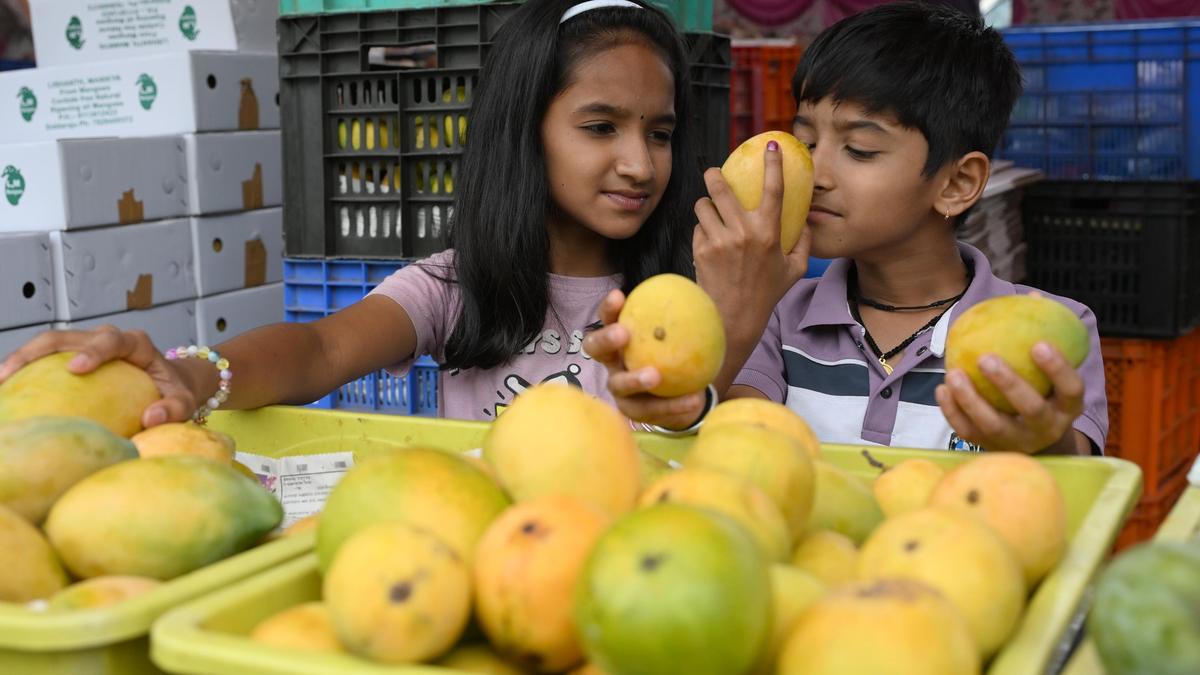
Display of mangoes in Srirangam for the summer season in Tiruchi, Tamil Nadu, on April 29, 2018.

Display of mangoes in Srirangam for the summer season in Tiruchi, Tamil Nadu, on April 29, 2018.
| Photo Credit:
Srinath M./The Hindu

“One recent welcome move”, in her words, was the Indian government recognising pollinators in the country’s new ‘environmental accounting’ framework. This framework recognised that India has more than 800 bee species, plus butterflies, moths, beetles, birds, bats and flies as pollinators and that they are ecologically important for agriculture. The government has also attached a monetary value equivalent to 8-10% of the total crop output value, amounting to ₹2.6 lakh crore in 2021-22, to pollinators.

Rights of pollinators

Attaching a monetary value could nudge policy towards actively protecting  our pollinators, through changes at the farm and landscape levels. These could include, as the Mexico study suggested, increasing the spread of natural and semi-natural areas near orchards, such as native forest patches and wildflower strips, to attract more wild insects.

Dr. Devy also pointed out that in May, stingless bees in Peru had become the first insects to win the legal rights to exist, thrive, and be represented in court. This is significant for the conservation of the species against insecticides, climate change, and competition from non-native insects.

The question then arises: will India accord similar rights to its pollinators, which carry the weight of the country’s agriculture? As you relish this season’s mangoes, it could also be your food for thought.

Kavitha Kannan is a biologist and science writer.


Source link

Science

Post navigation

Previous Post: Need forces DR Congo gold miners to keep working despite Ebola
Next Post: Several trapped after warehouse shed collapses at Taratala in Kolkata

Related Posts

  • Kerala researchers batting for better understanding of the flying mammal
    Kerala researchers batting for better understanding of the flying mammal Science
  • Indian-American scientist hopes to be first woman to make stratospheric jump in 2025
    Indian-American scientist hopes to be first woman to make stratospheric jump in 2025 Science
  • inStem’s fabric offers protection from pesticides
    inStem’s fabric offers protection from pesticides Science
  • Astronomers find the small, hot helium stars they had been looking for
    Astronomers find the small, hot helium stars they had been looking for Science
  • How new DGCA rules put human limits at the centre of air safety
    How new DGCA rules put human limits at the centre of air safety Science
  • Flying by Saturn and Neptune, eight years apart
    Flying by Saturn and Neptune, eight years apart Science

More Related Articles

Rare celestial object sighted over Bengaluru skies Rare celestial object sighted over Bengaluru skies Science
PM congratulates ISRO on successful launch of Aditya-L1 PM congratulates ISRO on successful launch of Aditya-L1 Science
Study offers clues to why COVID-19 vaccine protection wanes quickly Study offers clues to why COVID-19 vaccine protection wanes quickly Science
As in Kerala, local climate processes can worsen climate extremes | Analysis As in Kerala, local climate processes can worsen climate extremes | Analysis Science
Down syndrome, Edwards syndrome found in ancient individuals Down syndrome, Edwards syndrome found in ancient individuals Science
Artificial Intelligence: What water turning to vapour and the way AI learns have in common Artificial Intelligence: What water turning to vapour and the way AI learns have in common Science
SiteLock

Archives

  • September 2026
  • August 2026
  • July 2026
  • June 2026
  • May 2026
  • April 2026
  • March 2026
  • February 2026
  • January 2026
  • December 2025
  • November 2025
  • October 2025
  • September 2025
  • August 2025
  • July 2025
  • June 2025
  • May 2025
  • April 2025
  • March 2025
  • February 2025
  • January 2025
  • December 2024
  • November 2024
  • October 2024
  • September 2024
  • August 2024
  • July 2024
  • June 2024
  • May 2024
  • April 2024
  • March 2024
  • February 2024
  • January 2024
  • December 2023
  • November 2023
  • October 2023
  • September 2023
  • August 2023
  • July 2023
  • June 2023
  • May 2023
  • April 2023
  • March 2023
  • February 2023
  • January 2023
  • December 2022
  • November 2022
  • October 2022
  • September 2022
  • August 2022
  • July 2022
  • June 2022
  • May 2022

Categories

  • Business
  • Nation
  • Science
  • Sports
  • World

Recent Posts

  • Three killed, one critically injured after speeding BMW crashes on Mumbai Coastal Road
  • Battle lines in the boardroom | Tata Sons
  • Donald Trump seeks to bring health-research funding under his control, Politico reports
  • Residents want dislodged railings along tracks on GST Road in East Tambaram fixed and opening on Sudhanandha Bharati Salai closed
  • The Hindu Foundation Day: revisiting the journey

Recent Comments

  1. PhilipLog on UP Teacher Who Asked Students To Slap Muslim Classmate
  2. DennisDum on UP Teacher Who Asked Students To Slap Muslim Classmate
  3. DonaldFrosy on UP Teacher Who Asked Students To Slap Muslim Classmate
  4. DonaldFrosy on UP Teacher Who Asked Students To Slap Muslim Classmate
  5. YWgliuZUXRuWYumGOFzzpY on UP Teacher Who Asked Students To Slap Muslim Classmate
  • “Constant Personal Attacks”: Hardik Pandya Sent ‘Stay Strong’ Message Amid Criticism
    “Constant Personal Attacks”: Hardik Pandya Sent ‘Stay Strong’ Message Amid Criticism Sports
  • Access Denied
    Access Denied Nation
  • Watch: ED raids on Pinarayi: Why the Left alleges a Congress-BJP nexus | Above the Fold | 27.05.2026
    Watch: ED raids on Pinarayi: Why the Left alleges a Congress-BJP nexus | Above the Fold | 27.05.2026 World
  • U.S. House advances Russia sanctions Bill that seeks 100% tariffs on India, others; set for final vote
    U.S. House advances Russia sanctions Bill that seeks 100% tariffs on India, others; set for final vote World
  • Health Ministry Allows Use Of “Leftover” Organs, Blood, Hair For Research
    Health Ministry Allows Use Of “Leftover” Organs, Blood, Hair For Research Nation
  • What About Women Wrestlers? Asks Trinamool On PM’s Sandeshkhali Remark
    What About Women Wrestlers? Asks Trinamool On PM’s Sandeshkhali Remark Nation
  • Hong Kong Lesbian Couple Win Court Victory In IVF Case
    Hong Kong Lesbian Couple Win Court Victory In IVF Case World
  • Telescope Captures “City-Killer” Asteroid, NASA Tracking Potential Threat
    Telescope Captures “City-Killer” Asteroid, NASA Tracking Potential Threat World

Editor-in-Chief:
Mohammad Ariff,
MSW, MAJMC, BSW, DTL, CTS, CNM, CCR, CAL, RSL, ASOC.
editor@artifex.news

Associate Editors:
1. Zenellis R. Tuba,
zenelis@artifex.news
2. Haris Daniyel
daniyel@artifex.news

Photograher:
Rohan Das
rohan@artifex.news

Artifex.News offers Online Paid Internships to college students from India and Abroad. Interns will get a PRESS CARD and other online offers.
Send your CV (Subjectline: Paid Internship) to internship@artifex.news

Links:
Associate Journalism
About Us
Privacy Policy

News Links:
Breaking News
World
Nation
Sports
Business
Entertainment
Lifestyle

Registered Office:
72/A, Elliot Road, Kolkata - 700016
Tel: 033-22277777, 033-22172217
Email: office@artifex.news

Editorial Office / News Desk:
No. 13, Mezzanine Floor, Esplanade Metro Rail Station,
12 J. L. Nehru Road, Kolkata - 700069.
(Entry from Gate No. 5)
Tel: 033-46011099, 033-46046046
Email: editor@artifex.news

Copyright © 2023 Artifex.News Newsportal designed by Artifex Infotech.