Skip to content
  • Facebook
  • X
  • Linkedin
  • WhatsApp
  • YouTube
  • Associate Journalism
  • About Us
  • Privacy Policy
  • 033-46046046
  • editor@artifex.news
Artifex.News

Artifex.News

Stay Connected. Stay Informed.

  • Breaking News
  • World
  • Nation
  • Sports
  • Business
  • Science
  • Entertainment
  • Lifestyle
  • Toggle search form
  • Saransh, Kartikeya help Central bundle out South for 149
    Saransh, Kartikeya help Central bundle out South for 149 Sports
  • DMK faces a challenge as allies set to join TVK government
    DMK faces a challenge as allies set to join TVK government Nation
  • Donald Trump Pleads Not Guilty In Georgia Election Fraud Case
    Donald Trump Pleads Not Guilty In Georgia Election Fraud Case World
  • Vice President Jagdeep Dhankhar Dig At Opposition
    Vice President Jagdeep Dhankhar Dig At Opposition Nation
  • Samit Dravid in India U19 squad to face Australia in multi-format series
    Samit Dravid in India U19 squad to face Australia in multi-format series Sports
  • IT Minister Ashwini Vaishnaw presents first ‘Made in India’ chip to PM Modi at Semicon 2025
    IT Minister Ashwini Vaishnaw presents first ‘Made in India’ chip to PM Modi at Semicon 2025 Business
  • What Caused The Storm That Brought Dubai To A Standstill?
    What Caused The Storm That Brought Dubai To A Standstill? World
  • Access Denied
    Access Denied Nation
Group of Seven | A platform for the globalised elite

Group of Seven | A platform for the globalised elite

Posted on June 20, 2026 By admin


The 1960s were a period of restlessness. The anti-Vietnam war protests and civil rights agitation made the Lyndon Johnson administration uneasy. It was in this backdrop that Johnson came to Michigan on May 22, 1964 to deliver his ‘Great Society’ speech.

Johnson quoted Greek philosopher Aristotle to talk about how to create prosperity. “The Great Society” he said, “rests on abundance and liberty for all. It demands an end to poverty and racial injustice, to which we are totally committed in our time. But that is just the beginning.”

The previous decade had seen the arrival of the Non-Aligned Movement (NAM) that mobilised the decolonised societies. With the upswing in domestic disturbances in the U.S. it was obvious that the U.S. that had provided loans and economic assistance after the Second World War would no longer be able to provide leadership to the global north on its own and that it would require support from the partner countries in the West. As the decolonisation gathered speed, there was a greater need for the Global North to team up. Thus was born the idea of reviving the Global Economic Governance in favour of the industrialised economies out of which would emerge the Group of Seven (G7) in the following decade.

The Global Economic Governance (GEG) had been fashionable since the beginning of the Bretton Woods system but after nearly a decade of unrest in western societies, a definite push came in 1973 when the Yom Kippur war and hostilities between the Arabs and Israel triggered the first oil shock. The oil shock highlighted that the emerging order would challenge the domination of the western world.

In this backdrop, the first World Economic Summit was organised by French President Giscard d’Estaing and West Germany’s Chancellor Helmut Schmidt in 1975 who invited the leaders of the U.K., Italy, Japan and the U.S. for a meeting at the Chateau de Rambouillet in France. It began as the Group of Six and in 1976, Canada joined the grouping, making it the G7. The economic and financial crises of that time provided the G7 the agenda for the foreseeable future as it came to be known as a platform of industrialised countries for dealing with financial challenges.

Beyond economy

The 1970s were the decade of the New International Economic Order (NIEO) under which the Global south under the leadership of the Group of 77 and NAM demanded the establishment of a new economic order. Under this system, developing nations pushed for a transformation of global financial institutions such as the World Bank and the International Monetary Fund to deal with the requirements of the newly decolonised economies of Asia, Africa and Latin America. These demands, however, had to be adjusted against the overall power dynamics between the two superpowers, the U.S. and the Soviet Union.

The G7 started playing a bigger role beyond pure economic issues during the 1980s when it provided a platform to industrialised countries to coordinate response to major conflicts that threatened to interrupt global supply chains. First was the Soviet invasion of Afghanistan, which was followed almost simultaneously by the hostilities between the U.K. and Argentina over the Falkland islands and the Iran-Iraq war. It also played an active role in dealing with various sides for the Lebanese civil war. In 1982 when Israel invaded Lebanon, the G7 expressed shock on Israel’s actions. On the Falklands dispute, however, it supported the U.K. and warned about controlling the conflicts in the West Asian region as they could spill into larger disruption of energy and navigation.

Through coordination among the major economies, G7 for the first time in 1990 showed that it had acquired the ability to put economic pressure to a country that refused to abide by the norms of the international order. As Saddam Hussein prepared to invade Kuwait in August 1990, the G7 convened a meeting in Houston and ensured that Hussein would not profit from forcibly acquiring the energy wealth of Kuwait. By handling a range of conflicts in the 1980s, G7 evolved from the strictly an economic platform to a strategic international mechanism that could play a greater role in maintaining the status quo and avoid shocks and disruptions to the system.

The end of the Cold War provided the G7 with the major opportunity to reinvent itself and this it did by opening its doors to Russia. Already during the Iraqi crisis of 1990-91, G7 had succeeded in getting the USSR on board. The new equation with the USSR was made evident with the arrival of Mikhail Gorbachev to the G7 London summit on July 14-16, 1991.

Following the dissolution of the USSR, the G7 invited Russian President Boris Yeltsin on multiple occasions, indicating a deeper integration of post-Soviet Russia into the international financial architecture. During this period, the G7 also helped Russia deal with the demands for transition by supporting it with an economic package. In 1998, Russia formally joined the grouping, transforming it into G8.

France summit

The G7’s most visible role in recent years has been in opposing Russia’s military campaign in Ukraine. Following Russia’s annexation of Crimea in 2014, G8 expelled Russia reverting the grouping to its earlier avatar of G7. That apart, the grouping has emerged as a forum for important discussions in dealing with issues that are global in nature and require a collective action.

Among the issues that the G7 has prioritised are climate change, pandemic preparedness, energy security, critical minerals and preservation of supply chains. In order to address these vital issues, the G7 has welcomed participation by other important countries such as India, Egypt, South Africa, Brazil, South Korea, Ukraine and the UAE to its summit meetings and consultations.

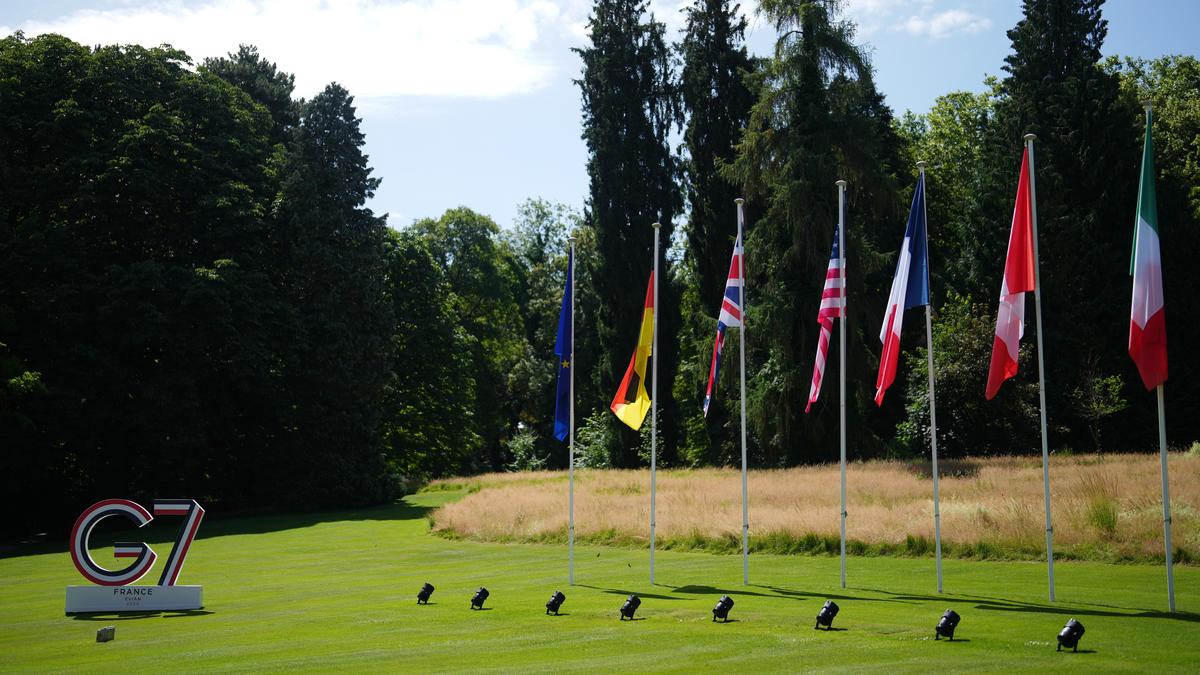
In 52nd G7 summit, held in France on June 15-17, Prime Minister Narendra Modi had participated. Among the topics discussed at the summit were the Ukraine war, the U.S.-Iran deal, global economic imbalances, Artificial Intelligence and debt burdens in the developing countries.

As the world deals with major supply chain disruptions and uncertainties following the eruption of the U.S.-Israel war against Iran and the closure of the Strait of Hormuz, the G7, with its permanent guest European Union, has provided an additional mechanism to discuss difficult issues, often providing its high power table to dissect policies that are relevant to the world order.

This informal meeting allows the global leaders a much required interaction that is not possible within the confines of the UN. While the world has gone through the Cold War and post-Cold War phases, the G7 remains a continuity as it maintains the globalised economic structure without allowing cracks to spread.

Published – June 21, 2026 01:26 am IST


Source link

World Tags:G7 Summit, G7 Summit explained, G7 world leaders meeting, Group of Seven, What is G7 Summit

Post navigation

Previous Post: India thrash Chile 6-0 to enter Women’s Nations Cup final
Next Post: Gender agenda teaching consent – The Hindu

Related Posts

  • Access Denied World
  • ‘Military ventures bring long-term decline’: How Beijing views the Iran crisis
    ‘Military ventures bring long-term decline’: How Beijing views the Iran crisis World
  • Access Denied World
  • Macron aims to thwart French far right in election runoff
    Macron aims to thwart French far right in election runoff World
  • EU and Israel in war of words as ties nosedive ahead of Spain, Ireland recognising Palestinian state
    EU and Israel in war of words as ties nosedive ahead of Spain, Ireland recognising Palestinian state World
  • Spanish PM’s wife must stand trial on corruption charges, judge rules
    Spanish PM’s wife must stand trial on corruption charges, judge rules World

More Related Articles

BBC “Urgently Looking” Into Issues Raised By Charges Against Russell Brand BBC “Urgently Looking” Into Issues Raised By Charges Against Russell Brand World
President Trump threatens 200% tariffs on French wines to get Emmanuel Macron to join Board of Peace President Trump threatens 200% tariffs on French wines to get Emmanuel Macron to join Board of Peace World
Kamala Harris Launches  Million Ad Blitz In US Presidential Race Kamala Harris Launches $50 Million Ad Blitz In US Presidential Race World
Indian probe team in Pannun assassination plot to travel to Washington on Oct 15: U.S. Indian probe team in Pannun assassination plot to travel to Washington on Oct 15: U.S. World
Turkiye arrests 99 suspected Islamic State members Turkiye arrests 99 suspected Islamic State members World
Hundreds Of Bodies Of Hamas Victims Still In Containers, Yet To be Identified Hundreds Of Bodies Of Hamas Victims Still In Containers, Yet To be Identified World
SiteLock

Archives

  • June 2026
  • May 2026
  • April 2026
  • March 2026
  • February 2026
  • January 2026
  • December 2025
  • November 2025
  • October 2025
  • September 2025
  • August 2025
  • July 2025
  • June 2025
  • May 2025
  • April 2025
  • March 2025
  • February 2025
  • January 2025
  • December 2024
  • November 2024
  • October 2024
  • September 2024
  • August 2024
  • July 2024
  • June 2024
  • May 2024
  • April 2024
  • March 2024
  • February 2024
  • January 2024
  • December 2023
  • November 2023
  • October 2023
  • September 2023
  • August 2023
  • July 2023
  • June 2023
  • May 2023
  • April 2023
  • March 2023
  • February 2023
  • January 2023
  • December 2022
  • November 2022
  • October 2022
  • September 2022
  • August 2022
  • July 2022
  • June 2022
  • May 2022

Categories

  • Business
  • Nation
  • Science
  • Sports
  • World

Recent Posts

  • International Yoga Day 2026: PM Modi to lead nation from Kolkata
  • Indian man jailed for over 5 years in U.K.-France people smuggling case
  • At least 12 shot after SUV pulls up and opens fire on a crowd, Chicago police say
  • Number of patients in Bhiwandi food poisoning rises to 122
  • Trump tries to blame Reflecting Pool woes on vandalism, without offering substantiation

Recent Comments

  1. Davidtox on UP Teacher Who Asked Students To Slap Muslim Classmate
  2. ThomasSap on UP Teacher Who Asked Students To Slap Muslim Classmate
  3. Donaldacalf on UP Teacher Who Asked Students To Slap Muslim Classmate
  4. Albertstymn on UP Teacher Who Asked Students To Slap Muslim Classmate
  5. Melvinbew on UP Teacher Who Asked Students To Slap Muslim Classmate
  • India On Surveillance Of Officials In Canada
    India On Surveillance Of Officials In Canada World
  • Human Sacrifice Suspected As Man Kills Grandmother, Then Attempts Suicide
    Human Sacrifice Suspected As Man Kills Grandmother, Then Attempts Suicide Nation
  • Access Denied World
  • Biden Watching Situation In Bangladesh Very Closely: White House
    Biden Watching Situation In Bangladesh Very Closely: White House World
  • Xi calls for immediate end to all hostilities in West Asia
    Xi calls for immediate end to all hostilities in West Asia World
  • Access Denied Sports
  • Access Denied
    Access Denied Nation
  • Arvind Kejriwal, Atishi On 4th AAP List For Delhi Polls
    Arvind Kejriwal, Atishi On 4th AAP List For Delhi Polls Nation

Editor-in-Chief:
Mohammad Ariff,
MSW, MAJMC, BSW, DTL, CTS, CNM, CCR, CAL, RSL, ASOC.
editor@artifex.news

Associate Editors:
1. Zenellis R. Tuba,
zenelis@artifex.news
2. Haris Daniyel
daniyel@artifex.news

Photograher:
Rohan Das
rohan@artifex.news

Artifex.News offers Online Paid Internships to college students from India and Abroad. Interns will get a PRESS CARD and other online offers.
Send your CV (Subjectline: Paid Internship) to internship@artifex.news

Links:
Associate Journalism
About Us
Privacy Policy

News Links:
Breaking News
World
Nation
Sports
Business
Entertainment
Lifestyle

Registered Office:
72/A, Elliot Road, Kolkata - 700016
Tel: 033-22277777, 033-22172217
Email: office@artifex.news

Editorial Office / News Desk:
No. 13, Mezzanine Floor, Esplanade Metro Rail Station,
12 J. L. Nehru Road, Kolkata - 700069.
(Entry from Gate No. 5)
Tel: 033-46011099, 033-46046046
Email: editor@artifex.news

Copyright © 2023 Artifex.News Newsportal designed by Artifex Infotech.