

Skip to content
  • Facebook
  • X
  • Linkedin
  • WhatsApp
  • YouTube
  • Associate Journalism
  • About Us
  • Privacy Policy
  • 033-46046046
  • editor@artifex.news
Artifex.News

Artifex.News

Stay Connected. Stay Informed.

  • Breaking News
  • World
  • Nation
  • Sports
  • Business
  • Science
  • Entertainment
  • Lifestyle
  • Toggle search form
  • US Clings To “Wrong Perception”, Yet To Fulfil Promises: China Minister
    US Clings To “Wrong Perception”, Yet To Fulfil Promises: China Minister World
  • Access Denied
    Access Denied Nation
  • Plight of betel leaf farmers miserable as gale storms hit fields, expect new government to give relief swiftly
    Plight of betel leaf farmers miserable as gale storms hit fields, expect new government to give relief swiftly Nation
  • Access Denied World
  • Access Denied
    Access Denied Nation
  • Trump, Putin, Netanyahu, other global leaders greet PM Modi on his 75th birthday
    Trump, Putin, Netanyahu, other global leaders greet PM Modi on his 75th birthday World
  • Access Denied World
  • “Working Together As Iron Fist To Eliminate Hamas”: Israel PM Benjamin Netanyahu
    “Working Together As Iron Fist To Eliminate Hamas”: Israel PM Benjamin Netanyahu World
How small can a liquid be?

How small can a liquid be?

Posted on June 1, 2026 By admin


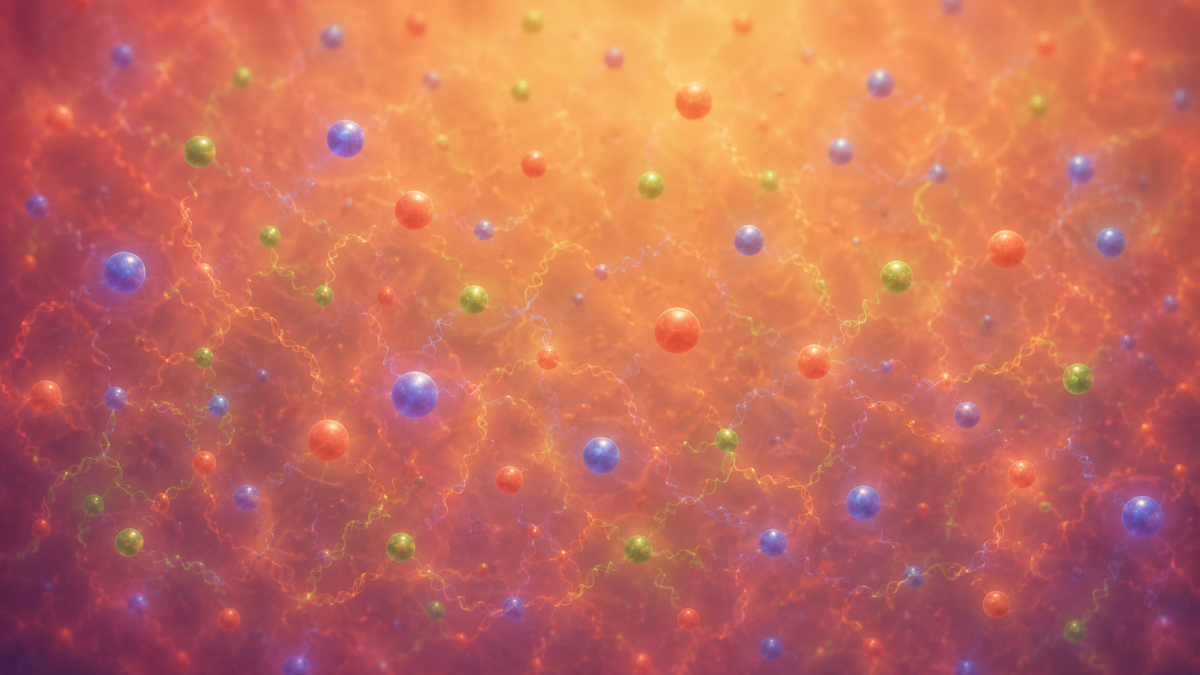
Quark-gluon plasma are extraordinarily hot, reaching trillions of degrees centigrade. Representative image.
| Photo Credit: Image created by AI

Physicists have spent more than two decades studying one of the strangest forms of matter ever created in a laboratory: the quark-gluon plasma (QGP).

Quarks and gluons are the smallest pieces of matter. A QGP existed in the first few millionths of a second after the Big Bang, before the quarks bound together to form the first protons and neutrons.

Researchers routinely create small droplets of QGP by colliding heavy atomic nuclei at extremely high energies. These droplets are extraordinarily hot, reaching trillions of degrees centigrade. Their behaviour, however, has been more surprising: instead of acting like a gas, the QGP behaves like a fluid.

A new study in Physical Review Letters has now reported a new ‘boundary’ in this field. By smashing together oxygen nuclei at the Large Hadron Collider (LHC), researchers have found the smallest dollop of QGP — so far — that still behaves like a fluid.

Physicists have known for decades now that energising and colliding lead nuclei, which are much heavier than oxygen nuclei, produces QGP. The new study addresses a different question: how small can a droplet of matter be and still have fluid-like behaviour?

The LHC usually smashes together protons. The researchers picked oxygen ions because they occupy a middle ground between the tiny clumps of energy and matter created by smushed protons and the massive ones formed by lead ions. A middle ground that could reveal the tipping point where subatomic matter starts to resemble a fluid.

The research team analysed collisions between oxygen nuclei at the LHC, looking for fast-moving particles that emerged from the collision, and compared their numbers with what would be expected if no dense medium had formed.

If no dense medium forms, physicists can predict how many such particles should appear. But if a medium is present, some of the energetic quarks and gluons should lose energy before they escape, reducing the number of energetic particles eventually reaching the detector.

The researchers have reported signs of such a suppression. It was less pronounced in collisions involving the oxygen ions, but it was noticeable.

The finding suggests that oxygen-oxygen collisions can create a medium large enough to affect the motion of energetic quarks and gluons. The data “are also in better agreement with theoretical models that include quark–gluon energy loss than they are with models that omit it,” Physical Review Letters associate editor Nikhil Karthik wrote in Physics.

Properties like viscosity and flow are associated with fluids, and these fluids usually have an enormous number of particles. A droplet of water sliding down a wall has quadrillions of water molecules. A glob of honey big enough to show how slowly it slides has roughly a quintillion sugar molecules. Yet the QGP is much, much smaller — it has maybe thousands of quarks and gluons — but it is still a fluid.

According to the new finding, a strongly interacting medium can emerge even in collisions involving relatively light nuclei. At the same time, it makes the mystery of where exactly the transition between a fluid-like medium and a gas of largely independent particles emerges more intriguing.

mukunth.v@thehindu.co.in

Published – June 04, 2026 07:45 am IST


Source link

Science

Post navigation

Previous Post: Cuddalore government school toppers now get to learn scuba diving
Next Post: IPL 2026 | From desperation to title triumphs: how Andy Flower redefined Royal Challengers’ legacy

Related Posts

  • Boeing can recover from its Starliner troubles, but it can’t afford any other misfires
    Boeing can recover from its Starliner troubles, but it can’t afford any other misfires Science
  • J. Craig Venter, who won the race to sequence the human genome, dies at 79
    J. Craig Venter, who won the race to sequence the human genome, dies at 79 Science
  • Why does an elevator need three electrical phases to operate?
    Why does an elevator need three electrical phases to operate? Science
  • Drug regulator warns about Meropenem, Disodium
    Drug regulator warns about Meropenem, Disodium Science
  • Major cause of inflammatory bowel disease discovered
    Major cause of inflammatory bowel disease discovered Science
  • Kalpakkam fast breeder reactor attains criticality
    Kalpakkam fast breeder reactor attains criticality Science

More Related Articles

Scientists trigger ‘controlled’ earthquakes under Swiss Alps Scientists trigger ‘controlled’ earthquakes under Swiss Alps Science
Trump administration fires entire National Science Board Trump administration fires entire National Science Board Science
Scientists surprised by source of largest quake detected on Mars Scientists surprised by source of largest quake detected on Mars Science
Science News: With lunar missions looming, scientists grow chickpeas in ‘moon dirt’ Science News: With lunar missions looming, scientists grow chickpeas in ‘moon dirt’ Science
Drought, degrading land take centrestage at UN talks in Riyadh Drought, degrading land take centrestage at UN talks in Riyadh Science
Daily quiz: in honour of the world’s first artificial nuclear reactor, on its birth anniversary Daily quiz: in honour of the world’s first artificial nuclear reactor, on its birth anniversary Science
SiteLock

Archives

  • June 2026
  • May 2026
  • April 2026
  • March 2026
  • February 2026
  • January 2026
  • December 2025
  • November 2025
  • October 2025
  • September 2025
  • August 2025
  • July 2025
  • June 2025
  • May 2025
  • April 2025
  • March 2025
  • February 2025
  • January 2025
  • December 2024
  • November 2024
  • October 2024
  • September 2024
  • August 2024
  • July 2024
  • June 2024
  • May 2024
  • April 2024
  • March 2024
  • February 2024
  • January 2024
  • December 2023
  • November 2023
  • October 2023
  • September 2023
  • August 2023
  • July 2023
  • June 2023
  • May 2023
  • April 2023
  • March 2023
  • February 2023
  • January 2023
  • December 2022
  • November 2022
  • October 2022
  • September 2022
  • August 2022
  • July 2022
  • June 2022
  • May 2022

Categories

  • Business
  • Nation
  • Science
  • Sports
  • World

Recent Posts

  • There is no DMK-led Secular Progressive Alliance in Tamil Nadu now: P. Shanmugam
  • Tilak emerges costliest buy at inaugural TG20 auction
  • DNA test planned to verify woman’s claim to child
  • Malayalam actor Salim Kumar cremated with State honours
  • Saleem’s consistency was superb: Pybus

Recent Comments

  1. Jamesben on UP Teacher Who Asked Students To Slap Muslim Classmate
  2. Keithjep on UP Teacher Who Asked Students To Slap Muslim Classmate
  3. Waynefoogs on UP Teacher Who Asked Students To Slap Muslim Classmate
  4. RobertCargy on UP Teacher Who Asked Students To Slap Muslim Classmate
  5. JosephJoype on UP Teacher Who Asked Students To Slap Muslim Classmate
  • Cyclone Dana To Make Landfall Soon, Bengal And Odisha On Alert: 10 Points
    Cyclone Dana To Make Landfall Soon, Bengal And Odisha On Alert: 10 Points Nation
  • Access Denied
    Access Denied Nation
  • Access Denied Sports
  • Two arrested for assault on BMTC conductor and driver in Bengaluru
    Two arrested for assault on BMTC conductor and driver in Bengaluru Nation
  • BCCI set to bar state units from directly partnering with foreign boards
    BCCI set to bar state units from directly partnering with foreign boards Sports
  • Police make arrests at UCLA in tense clashes with Israel-Hamas war protesters
    Police make arrests at UCLA in tense clashes with Israel-Hamas war protesters World
  • Access Denied
    Access Denied Nation
  • Access Denied Sports

Editor-in-Chief:
Mohammad Ariff,
MSW, MAJMC, BSW, DTL, CTS, CNM, CCR, CAL, RSL, ASOC.
editor@artifex.news

Associate Editors:
1. Zenellis R. Tuba,
zenelis@artifex.news
2. Haris Daniyel
daniyel@artifex.news

Photograher:
Rohan Das
rohan@artifex.news

Artifex.News offers Online Paid Internships to college students from India and Abroad. Interns will get a PRESS CARD and other online offers.
Send your CV (Subjectline: Paid Internship) to internship@artifex.news

Links:
Associate Journalism
About Us
Privacy Policy

News Links:
Breaking News
World
Nation
Sports
Business
Entertainment
Lifestyle

Registered Office:
72/A, Elliot Road, Kolkata - 700016
Tel: 033-22277777, 033-22172217
Email: office@artifex.news

Editorial Office / News Desk:
No. 13, Mezzanine Floor, Esplanade Metro Rail Station,
12 J. L. Nehru Road, Kolkata - 700069.
(Entry from Gate No. 5)
Tel: 033-46011099, 033-46046046
Email: editor@artifex.news

Copyright © 2023 Artifex.News Newsportal designed by Artifex Infotech.