



The National Human Rights Commission of India has asked the Union government to “review” laws to “ensure gender inclusivity”, including the most recent amendments to the Transgender Persons (Protection of Rights) Act. The NHRC noted that the amendments removing transgender people’s right to a “self-perceived gender identity” had caused concern among community members, adding, “It may be appropriate for the authorities to consider revisiting these concerns.”
It has also recommended that the population enumeration phase of the ongoing Census 2027 exercise should include distinct categories for “intersex”, “transmen”, and “transwomen”, so that accurate disaggregated data can be gathered and maintained.
EXPLAINED | What are the changes being proposed to Transgender Persons (Protection of Rights) Act, 2019
Self-identification focus
In a detailed advisory issued on Monday, the NHRC said that transgender and gender-diverse students should be admitted to educational institutions based on self-identified gender, and recommended that elderly transgender persons be enrolled for identity certificates based on self-identification.
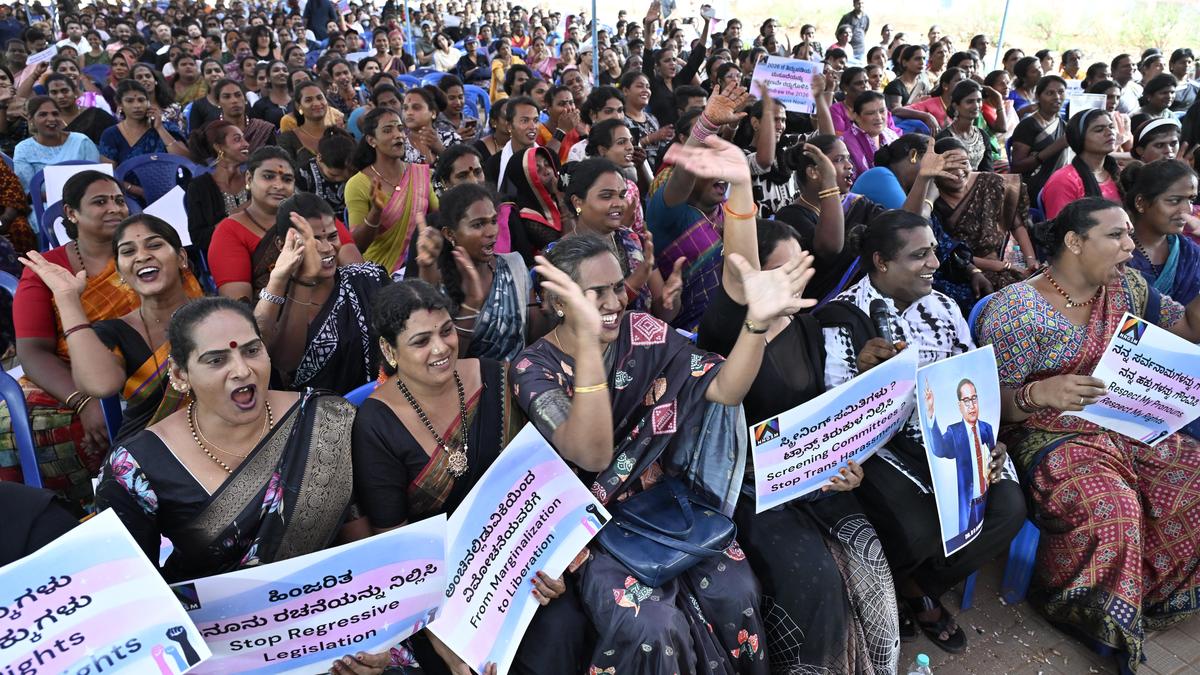
This emphasis on self-identification appears to contradict the most recent changes to the trans rights law, brought in by the Union Social Justice Ministry to widespread protests and resignations from the government’s own National Council for Transgender Persons.
The new amendments, passed by Parliament in March, specifically removed a clause that codified transgender people’s right to a “self-perceived gender identity”, and provided for a medical process through which gender certificates are to be issued. The Social Justice Ministry has justified the change, claiming that “self-identification” was creating hurdles in identifying the “real beneficiaries”.
The NHRC’s advisory, issued to 11 Union Ministries and all State and UT governments for “ensuring the welfare of transgender persons”, is an update to its 2023 advisory on the same subject. It has directed governments to submit action taken reports on its latest advisory within two months.
Also Read | SC flags ‘risk’ of misuse in transgender self-identification debate
‘Ensure inclusive framework’
Referring to the 2026 amendments to the trans rights law, the NHRC said, “This development has led to concerns among certain sections of the community, particularly regarding its implications for recognition and rights. In this context, it may be appropriate for the authorities to consider revisiting these concerns with a view to ensuring that the framework remains inclusive, rights-affirming, and sensitive to diverse lived experiences.”
In addition, the NHRC has recommended that schools and educational institutions provide for gender-neutral restrooms, hostels, and uniforms, and also said that institutions “may admit transgender and gender-diverse students based on self-identified gender, without requiring medical or legal proof”.
The rights body said that the gender certification process for elderly transgender people should be done on the “basis of self-identification, without subjecting applicants to intrusive or medically invasive verification processes”. The NHRC placed similar emphasis on self-identification and gender-neutral spaces in processes involving prison inmates and correctional institutes as well.
Also Read | Transgender communities across India demand withdrawal of Bill to redefine trans people
Other laws to be reviewed
The NHRC called for a review of other laws like the Registration of Births and Deaths Act, which it said should be amended to “incorporate gender-inclusive procedures and recognition of self-identified gender”. In suggested wordings for birth certificates, the NHRC recommended that the forms include options for “male”, “female”, “intersex”, “indeterminate/not specified at birth”, and “prefer not to state at birth (to be updated later)” under the category of “sex”.
It also called for reviewing the Juvenile Justice (Care and Protection of Children) Act to “explicitly include gender non-conforming children”, and provide for “gender-affirming placements”. The rights body also called for reviewing personal and secular laws like the Hindu Succession Act to “explicitly include transgender and intersex persons within the definitions of ‘son,’ ‘daughter,’ ‘heir,’ and ‘family, ensuring equal rights to inheritance and succession”.
The NHRC also recommended that States and UTs set up dedicated childcare institutions for children with diverse sex characteristics and gender identities, “with at least one pilot home in each State and Union Territory”.
Also Read | The Transgender Persons Amendment Bill and the question of identity: Who gets to define a trans life?
Gender-affirming healthcare
It asked for specific guidelines, rules, and SOPs to be established for gender-affirming healthcare, adding that medical institutions should not be performing “irreversible” gender-affirming procedures on an intersex child until they are legally capable of consenting to it.
The advisory covered the necessary review of laws, building an inclusive legal framework, ensuring trans people’s right to education, right to healthcare, right to property, making workplaces inclusive, strengthening shelter homes for trans people, and safeguarding the rights of children with diverse sex characteristics and gender identities/expressions.
Published – May 19, 2026 10:17 pm IST