




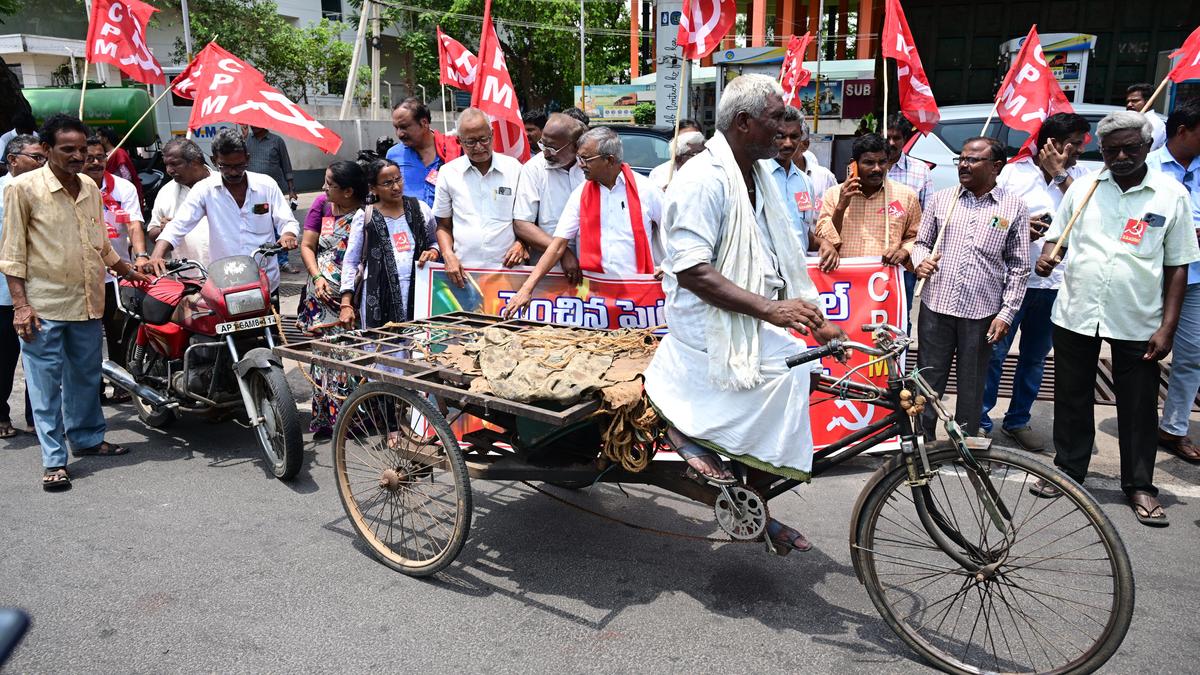
The increase in petrol and diesel prices drew flak from people across the State as they wished that the West Asia war would not impact them in any way, but it eventually did in no small measure.
In a conversation with The Hindu, Nadendla Manohar, Minister for Civil Supplies and Consumer Affairs, called the ₹3-a-litre hike a compulsion for the Oil Marketing Companies (OMCs), and pointed out that they had been bearing the brunt of the war effect on the crude oil prices, which shot off to over $100 per barrel, and therefore they had no other option except to increase the prices (to make good some of the losses).
Mr. Manohar said, “To meet the crisis, the Andhra Pradesh government is taking steps to increase ethanol blending and encouraging measures like car pooling to cut down the fuel consumption to some extent.”
Mr. Manohar said he was constantly reviewing the situation while insisting that there was no shortage of the fuels. “A detailed planning is going on at the national level. We have a meeting with the Secretary of the Ministry of Petroleum & Natural Gas in New Delhi on May 18. The entire gamut of issues will be discussed,” he added.
But, the commoner is extremely unhappy with the decision to increase the prices as it entails a huge burden on them. Especially, the middle classes and daily-wage workers are fuming that the hike will have a cascading effect on their household expenses.
“Every month fuel prices go up, but our salaries remain the same. I travel from Mangalagiri to Vijayawada daily for work on my motorcycle. In addition to the spurt in fuel prices, the rising prices of vegetables, groceries and transport are worrisome. For middle class employees like me, it becomes very difficult to save anything,” said Anil Sharma, a private employee.
Expressing similar concern, U. Saraswathi, a government school teacher who travels from Guntur to a village school every day, said the burden was unbearable.
“I travel a long distance daily to my school. With diesel and petrol prices increasing frequently, transportation costs are shooting up. Teachers working in villages have no option but to travel long distances. Government should think about employees and common people before increasing fuel prices,” she said.
The hike is affecting the petrol pump operators too. The price hike catapulted petrol and diesel rates higher across the tri-State junction of Chittoor district, with petrol now hovering around ₹113 per litre and diesel ₹100 per litre in most towns, highway outlets, and border-facing pumps.
In many places of the erstwhile Chittoor district, from Kuppam to Satyavedu, fuel stations report that even before Friday’s hike, customers were filling up locally, but only out of necessity.
In border towns such as Nagari, Kuppam, V. Kota, Palamaner, and Madanapalle, petrol bunks were seeing a different pattern emerge.
“We have to plan ahead and cross into Tamil Nadu or Karnataka, where fuel is still cheaper by several rupees per litre,” said Karthik Vinayagam, a lorry driver, working for a transport company in Trichy, shuttling between Theni and Bhubaneshwar.
“Earlier, we used to have a steady flow throughout the day. Now, after every price hike, we see fewer vehicles, and the drivers prefer two or three liters, hoping to cross into Tamil Nadu. It’s a vital decision for public and also for transporters because savings are lifeline,” he said.
Farmers say the hike would put additional burden on them. “Already, farmers are facing problems with hike in labour charges and investment cost. Now, the increase in fuel prices will cause the losses to mount,” a paddy farmer P. Mallikharjuna Rao said.
Aqua farmer C. Mohan Rao of Nagayalanka village in Krishna district said the hike would have an effect on aquaculture in the State. “Aqua farmers need diesel for running aerators regularly to maintain oxygen levels in shrimp and fish tanks. The hike in fuel prices is a cause for concern,” he added.
The mechanised fishing industry is also facing a severe crisis. Vasupalli Janakiram, national president of the East Coast Mechanised Fishing Boat Owners’ Association in Visakhapatnam, said a single boat required 10,000 litres of diesel monthly. The increase would translate to a staggering additional burden of 30,000 per month per vessel. For many operators, this overhead exceeded the value of their catch, he observed.
Autorickshaw and cab drivers say the increase placed an additional burden on their already paltry earnings. R. Venku Naidu, an autorickshaw driver in Visakhapatnam, said he spent nearly ₹2,000 on petrol every day and the latest hike would directly affect his daily income.
Published – May 15, 2026 08:24 pm IST