

Skip to content
  • Facebook
  • X
  • Linkedin
  • WhatsApp
  • YouTube
  • Associate Journalism
  • About Us
  • Privacy Policy
  • 033-46046046
  • editor@artifex.news
Artifex.News

Artifex.News

Stay Connected. Stay Informed.

  • Breaking News
  • World
  • Nation
  • Sports
  • Business
  • Science
  • Entertainment
  • Lifestyle
  • Toggle search form
  • Netanyahu’s Speech Interrupted By Protesters
    Netanyahu’s Speech Interrupted By Protesters World
  • US Shoots Down 15 Drones Fired By Houthi Rebels In Red Sea
    US Shoots Down 15 Drones Fired By Houthi Rebels In Red Sea World
  • Access Denied World
  • Revolutionising home-food preservation, one jar at a time
    Revolutionising home-food preservation, one jar at a time Science
  • US Alleges Google Got Rich Because People Stick With Default Search Engines
    US Alleges Google Got Rich Because People Stick With Default Search Engines World
  • Priyanka Gandhi Declares Assets Worth Rs 12 Crore In Wayanad Nomination Papers
    Priyanka Gandhi Declares Assets Worth Rs 12 Crore In Wayanad Nomination Papers Nation
  • Access Denied Sports
  • Israeli strikes kill 20 Palestinians in Gaza, some in attacks on tents, say medics
    Israeli strikes kill 20 Palestinians in Gaza, some in attacks on tents, say medics World
Secretive jungle cats need habitats outside protected areas: study

Secretive jungle cats need habitats outside protected areas: study

Posted on March 29, 2026 By admin


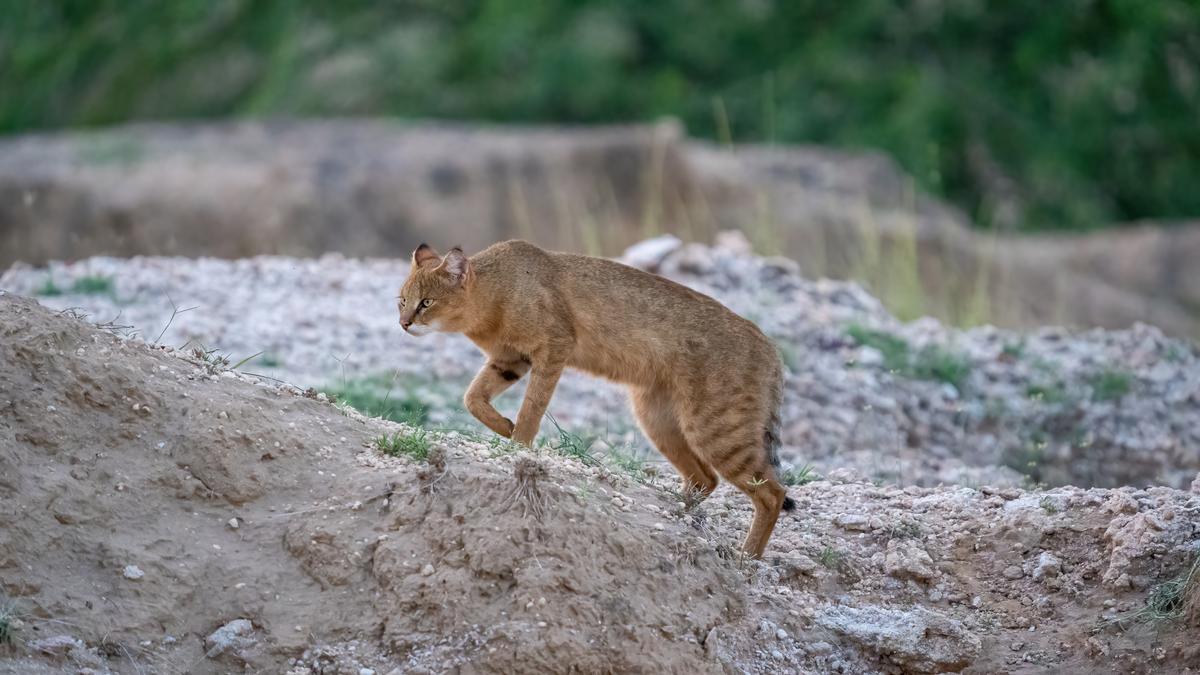
Jungle cats (Felis chaus) are found across diverse habitats, from grasslands and wetlands to deserts. They’re present across Asia, with large populations in India and Nepal, among others. The IUCN Red List lists the species as being of ‘least concern’.

This has led to a “misconception that they are doing fine”, Kathan Bandyopadhyay, a postdoctoral research associate at the University of Illinois Urbana-Champaign, said.

Jungle cats’ populations are in fact considered to be shrinking. In India, they are protected under Schedule II of the Indian Wildlife (Protection) Act 1972, which means hunting or trading them is illegal.

Despite being the most widespread of India’s small cats, jungle cats are understudied and have received little conservation attention relative to larger carnivores such as tigers and leopards.

Conservation baseline

This animal — with a white muzzle, yellow irises, large ears ending in black tufts, and the sometimes faint striping on its long legs — avoids dense forests and heavily-modified landscapes, preferring agro-pastoral and open habitats, according to a new study based on the largest dataset on the species in India.

The study was published in Scientific Reports, and provides a baseline for future conservation planning.

“Until now, we didn’t know about their population status or how they are responding to several habitat and climatic covariates,” Dr. Bandyopadhyay, who undertook this research as a PhD student at the University of Wyoming, said.

The team found human pressure to be the foremost factor influencing where jungle cats live and that while they can tolerate moderate levels of human disturbance, they avoid densely populated areas.

“Our results highlight the importance of agro-pastoral landscapes in conserving wildlife beyond protected areas, especially as urbanisation continues to expand,” Dr. Bandyopadhyay said.

‘An important analysis’

To estimate how many jungle cats were in India and where, the team compiled camera-trap records from more than 26,000 locations across India. These records were a ‘bycatch’ of tiger surveys and were supplemented with data from previous studies, radio-collared individuals, and the authors’ personal observations.

The researchers then included one camera-trap record every 25 sq. km, one radio-collar data point from every 5 sq. km, plus all secondary data (from outside protected areas). Then they used machine-learning to model suitable habitats using the final dataset of over 6,000 records.

The team combined these results with sex-specific home range data to estimate a countrywide population of over 3 lakh jungle cats, with at least 1.57 lakh and at most 4.59 lakh individuals.

“It’s an estimate. It gives you a limit within which the cat is likely to be,” Yadvendradev Jhala, senior scientist at the National Centre for Biological Sciences and the study’s co-author and co-supervisor, said.

Across 21 States with suitable habitats, Madhya Pradesh, Rajasthan, and Odisha were estimated to support the largest populations.

The study is an “important analysis” and has “strengthened the observation that the jungle cat is tightly associated with open natural ecosystems, currently under enormous threat of conversion to other forms of land use, such as built-up areas and large-scale linear infrastructure like highways,” Shomita Mukherjee, senior principal scientist at the Salim Ali Centre for Ornithology and Natural History, Coimbatore, and a member of the IUCN/SSC Cat Specialists Group, said. Dr. Mukherjee was not a part of the study. 

Ideal landscapes

Per the study,jungle cats prefer warm, semi-arid regions that are seasonally dry, with moderate rainfall and canopy cover. Their predicted hotspots lie in India’s east rather than in the drier west.

India needs land policies that recognise the ecological value of open ecosystems, Dr. Mukherjee added.

According to her, the finding that jungle cats use agricultural landscapes aligns with previous knowledge of the species. In and around farms, these cats keep rodent populations in check, thus ‘protecting’ crops.

However, these landscapes lie outside protected areas and harbour several threats, including fragmented habitats, speeding vehicles on roads, and poaching, according to the study.

It also pointed to a potential threat from hybridisation with domestic cats, which could compromise their genetic lineage, although Dr. Bandyopadhyay and Dr. Mukherjee cautioned that this idea doesn’t have enough evidence.

Another key threat is the stray dog population, which “acts as a source of wildlife diseases and kleptoparasitism — that means snatching kills from jungle cats and other carnivores,” Dr. Bandyopadhyay said.

Per the study, stray dogs could share foraging spaces with other livestock, so where there is livestock, there could be the risk of these canines as well.

A policy for small cats

According to Dr. Mukherjee, the study’s strengths lie in its large spatial coverage and sample size, although she added that jungle cats from Sikkim had been left out and that the population figures were based on a “meagre dataset of a few radio-collared individuals in just a couple of locations”.

“Yet this should not be seen as a limitation but an effort to get the best out of data currently available,” she added.

Dr. Bandyopadhyay said the records from Sikkim were sporadic and insufficiently viable for the models.

Scientists still have a great number of unknowns, including jungle cats’ denning sites, litter sizes, ranging patterns, densities, and diets.

Small cats are generally hard to study because they are nocturnal and secretive. Public awareness is also low, and few organisations have been willing to fund more study.

Going forward, Dr. Jhala said, there is a need to plan wildlife passageways alongside infrastructure development in agro-pastoral and open habitats.

“When roads pass through a tiger or elephant corridor, there is a policy to try and mitigate those. But when they pass through agro-pastoral landscapes, we don’t plan for it even though these areas support rich biodiversity,” he said.

Ananya Singh is an independent journalist. 


Source link

Science

Post navigation

Previous Post: Access Denied
Next Post: Access Denied

Related Posts

  • Iceland hit by ‘seismic swarm‘ of small earthquakes in volcano warning
    Iceland hit by ‘seismic swarm‘ of small earthquakes in volcano warning Science
  • ‘Online education is one of the biggest finds of the last decade’
    ‘Online education is one of the biggest finds of the last decade’ Science
  • Major cause of inflammatory bowel disease discovered
    Major cause of inflammatory bowel disease discovered Science
  • Kerala scientist bags Marie Skłodowska-Curie Postdoctoral Fellowship
    Kerala scientist bags Marie Skłodowska-Curie Postdoctoral Fellowship Science
  • Climate change intensified rain that caused Wayanad landslides: study
    Climate change intensified rain that caused Wayanad landslides: study Science
  • Asian cities are growing upwards more than outwards, satellite data show
    Asian cities are growing upwards more than outwards, satellite data show Science

More Related Articles

Why Greenland? Remote but resource-rich island occupies a key position in a warming world Why Greenland? Remote but resource-rich island occupies a key position in a warming world Science
Why do flags flutter in the wind? Why do flags flutter in the wind? Science
Kenyan farmers use bees, sesame to keep marauding elephants away Kenyan farmers use bees, sesame to keep marauding elephants away Science
Four astronomy facilities announced in Union Budget to cost ₹3,500 crore, to be completed over a period of three to 13 years Four astronomy facilities announced in Union Budget to cost ₹3,500 crore, to be completed over a period of three to 13 years Science
GSLV mission planned in January would be 100th launch from Sriharikota: ISRO chief GSLV mission planned in January would be 100th launch from Sriharikota: ISRO chief Science
Trump pulls U.S. out of key climate treaty, science body: White House Trump pulls U.S. out of key climate treaty, science body: White House Science
SiteLock

Archives

  • May 2026
  • April 2026
  • March 2026
  • February 2026
  • January 2026
  • December 2025
  • November 2025
  • October 2025
  • September 2025
  • August 2025
  • July 2025
  • June 2025
  • May 2025
  • April 2025
  • March 2025
  • February 2025
  • January 2025
  • December 2024
  • November 2024
  • October 2024
  • September 2024
  • August 2024
  • July 2024
  • June 2024
  • May 2024
  • April 2024
  • March 2024
  • February 2024
  • January 2024
  • December 2023
  • November 2023
  • October 2023
  • September 2023
  • August 2023
  • July 2023
  • June 2023
  • May 2023
  • April 2023
  • March 2023
  • February 2023
  • January 2023
  • December 2022
  • November 2022
  • October 2022
  • September 2022
  • August 2022
  • July 2022
  • June 2022
  • May 2022

Categories

  • Business
  • Nation
  • Science
  • Sports
  • World

Recent Posts

  • Sinner reaches Italian Open semis, breaks Masters 1000 winning streak record
  • Trading in organs illegally in Kerala, with forged documents
  • IPL 2026 | Raghuvanshi — repaying the faith shown by Knight Riders
  • Three-day Mohiniyattam masterclass at Fort Kochi
  • Sri Lanka’s Fisheries Minister urges CM Vijay to ban bottom trawling

Recent Comments

  1. Davidexomi on UP Teacher Who Asked Students To Slap Muslim Classmate
  2. AllanSwexy on UP Teacher Who Asked Students To Slap Muslim Classmate
  3. Davidcag on UP Teacher Who Asked Students To Slap Muslim Classmate
  4. CordellVoice on UP Teacher Who Asked Students To Slap Muslim Classmate
  5. Wesleyunfix on UP Teacher Who Asked Students To Slap Muslim Classmate
  • Israel army says established ‘Yellow Line’ in Lebanon
    Israel army says established ‘Yellow Line’ in Lebanon World
  • Access Denied
    Access Denied Nation
  • Big Butterfly Month | A month for the winged ones
    Big Butterfly Month | A month for the winged ones Science
  • Could Israel’s SC ruling ending draft exemptions for ultra-Orthodox Israelis topple Netanyahu’s government?
    Could Israel’s SC ruling ending draft exemptions for ultra-Orthodox Israelis topple Netanyahu’s government? World
  • Zelenskyy tells European leaders and Trump that Putin ‘is bluffing’
    Zelenskyy tells European leaders and Trump that Putin ‘is bluffing’ World
  • Access Denied
    Access Denied Nation
  • Over 100 Monkeys Die After Inhaling Pesticide In UP, Buried Secretly: Cops
    Over 100 Monkeys Die After Inhaling Pesticide In UP, Buried Secretly: Cops Nation
  • Max Verstappen Wins US Grand Prix Sprint Race
    Max Verstappen Wins US Grand Prix Sprint Race Sports

Editor-in-Chief:
Mohammad Ariff,
MSW, MAJMC, BSW, DTL, CTS, CNM, CCR, CAL, RSL, ASOC.
editor@artifex.news

Associate Editors:
1. Zenellis R. Tuba,
zenelis@artifex.news
2. Haris Daniyel
daniyel@artifex.news

Photograher:
Rohan Das
rohan@artifex.news

Artifex.News offers Online Paid Internships to college students from India and Abroad. Interns will get a PRESS CARD and other online offers.
Send your CV (Subjectline: Paid Internship) to internship@artifex.news

Links:
Associate Journalism
About Us
Privacy Policy

News Links:
Breaking News
World
Nation
Sports
Business
Entertainment
Lifestyle

Registered Office:
72/A, Elliot Road, Kolkata - 700016
Tel: 033-22277777, 033-22172217
Email: office@artifex.news

Editorial Office / News Desk:
No. 13, Mezzanine Floor, Esplanade Metro Rail Station,
12 J. L. Nehru Road, Kolkata - 700069.
(Entry from Gate No. 5)
Tel: 033-46011099, 033-46046046
Email: editor@artifex.news

Copyright © 2023 Artifex.News Newsportal designed by Artifex Infotech.