


On 19th August 2011, a former General and Myanmar President Thein Sein’s decision to invite recently released Aung San Suu Kyi at his residence for dinner marked a quiet but consequential turning point in Myanmar’s political trajectory. The meeting, understated in form yet profound in implication, was widely interpreted as the first genuine signal from the military-backed establishment that it was willing to engage with democratic forces after decades of isolation and repression.
For a country long defined by rigid authoritarianism, this moment suggested the possibility of a negotiated transition, an opening that raised cautious optimism both within Myanmar and among international stakeholders eager to see the country step back into the global fold. Following this meeting, world leaders including U.S. President Barrack Obama visited Myanmar though the country was more or less controlled by the military establishment.
The recent Myanmar general elections, conducted in three phases between December 2025 and January 2026, reflect the long political journey of a country that in the last decade stood as an oasis of hope and democratic optimism, but now risks being seen as a lost cause.
The military coup of February 1, 2021, marked a rupture in Myanmar’s fragile democratic transition, abruptly ending a decade-long experiment with quasi-civilian rule. In the early hours of the morning, the armed forces detained State Counsellor Aung San Suu Kyi, President Win Myint, and other senior leaders of the National League for Democracy (NLD), alleging electoral irregularities in the 2020 polls with the claims widely dismissed by international observers. Power was swiftly consolidated under Senior General Min Aung Hlaing, who declared a state of emergency and transferred authority to the military command.
What followed was not merely a political reset but a nationwide upheaval: mass protests, a brutal crackdown, and the gradual descent into a protracted civil conflict that continues to define Myanmar’s political and humanitarian landscape.
At a time when the international community’s attention remains riveted on West Asia, largely due to its far-reaching global economic implications, comparatively little notice has been taken of recent developments in Myanmar, a country of nearly 55 million people. For those in Asia, particularly, Myanmar continues to hold strategic importance for a variety of reasons. As a member of ASEAN, its internal stability carries broader implications for regional cohesion and humanitarian considerations. Over the years, prominent figures and stakeholders across Asia have invested considerable political capital in supporting Myanmar’s fragile democratic transition. At the global level, the country also commands attention as a critical arena in the evolving balance of power, particularly in how it manages its complex and often delicate ties with China.
Democracy on a leash
Official figures released by the military authorities suggest an overall voter turnout of roughly 54–55%, with phase-wise participation at around 52% in the first phase, 55% in the second, and over 56% in the final round. These numbers mark a significant drop from the approximately 70% turnout recorded in the 2015 and 2020 elections, which were held under relatively more open political conditions. However, even the reported figures have been contested, with many arguing that when large swathes of conflict-affected regions and disenfranchised populations are accounted for, the effective participation rate may be considerably lower.
While the turnout percentages have been used by the military to project a veneer of electoral legitimacy, they simultaneously underscore the shrinking democratic space in a country still gripped by civil conflict and political repression.

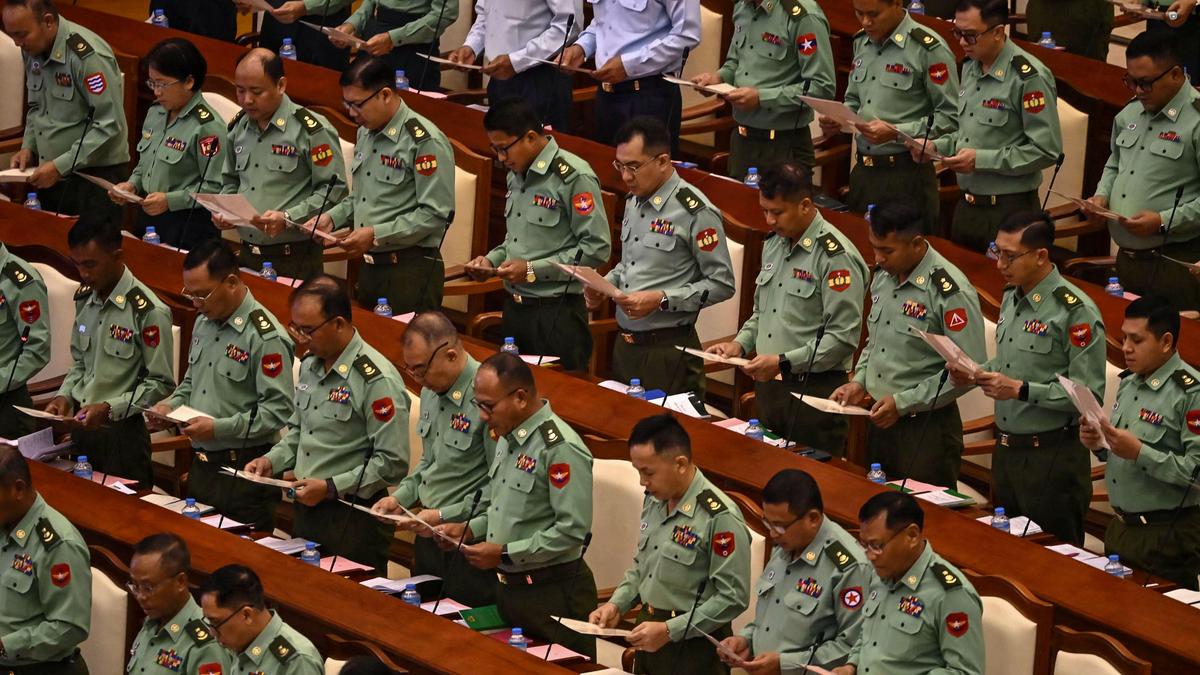
Myanmar’s new Parliament started its session in March 2026 after a gap of more than five years. The Lower House (Pyithu Hluttaw) convened on March 16. The Upper House (Amyotha Hluttaw) followed on March 18 whereas regional and State Assemblies met on March 20.
The Parliament is now expected to move toward electing a President and forming a new government structure in the weeks that follow. With the elections conducted by the military, it is important to understand how the current developments can shape the future.
Ever since 2010, I have been directly and indirectly engaged with developments in Myanmar. My interest in the country is both personal and professional. Myanmar offers a compelling case study of how internal diversity shapes political trajectories. Much like my native region of Jammu and Kashmir, this diversity is ethnic, linguistic, and religious, providing fertile ground for rich, multidisciplinary inquiry. Yet, as in J&K, such diversity also gives rise to competing political aspirations and contested visions of identity.
While no two situations are identical, the comparison offers a useful lens to understand how human interactions evolve in the debates around federalism. Myanmar has struggled to reconcile two competing imperatives: the centralising instincts of the military, and the federal aspirations of its diverse ethnic landscape. In this context, the leadership of the Bamar ethnic majority has vocally championed democratic rights and political consolidation, but has only gradually come to recognise the importance of federalism in the hope of keeping the country united and harmonious one day.

To understand the 2026 election, one must understand the logic that drives it. Myanmar’s military does not view elections in the same way that democratic systems do. Elections are not primarily about democracy; they are about instruments through which the military has sought to manage, and, where necessary, contain or even eliminate political forces. With the advantage of hindsight this was evident even during the period of quasi-civilian rule from 2010 to 2021.
The 2008-Constitution ensured that the military retained decisive power through its guaranteed parliamentary seats, control over key Ministries, and its ability to intervene at will constitutionally.
The 2025–26 election extends this logic into a far more oppressive environment. Major Opposition forces have been excluded. Large parts of the country, where the military’s authority is contested or absent, did not meaningfully participate. The military-aligned Union Solidarity and Development Party (USDP) emerged as the principal winner, reportedly securing over 231 of the 330 contested seats in the Lower House (Pyithu Hluttaw) and 108 seats in Upper House(Amyotha Hluttaw), thereby consolidating the State Administration Council’s grip on political institutions. The result is a system in which elections simply endorse a predetermined outcome.
There are bigger losses after the 2021-coup.
For decades, ethnic armed organisations have operated along the country’s peripheries, fighting civil wars with the central authority and asserting varying degrees of autonomy. The political opening of the 2010s created an opportunity, however imperfect, to bring these groups into a broader national framework. That opportunity has now been lost. The post-coup conflict has transformed Myanmar’s political geography. Ethnic armed groups have expanded their control. The consequence is a country that is no longer governed through a single chain of authority. It is governed through a patchwork of arrangements. In this context, the election is detached from reality.
Patchy governance
In areas affected by conflict, basic functions of governance have either broken down. Local administrations aligned with resistance groups have taken on governance roles. Actually, this was true even before the coup as many of the areas had always remained outside the ambit of Myanmar’s central authority.
In other areas, governance has given way to survival. Healthcare systems and education has been disrupted on a scale that will have long-term consequences. Economic activity has progressively shifted into informal channels and these are structural changes.

In my earlier work on Myanmar, I have argued that the country’s stability depended not just on political reform at the Centre, but on the devolution of powers by factoring in its diversity. In this respect, The new Parliament does not represent the full spectrum of political forces, does not exercise independent authority, and operates within a constrained political space. It cannot perform the role it is meant to. Over the past two decades, the military has sought to derive legitimacy from procedure — through elections, the functioning of institutions, and the invocation of carefully crafted constitutional frameworks that have failed to reconcile the country’s wide-ranging diversity.
With varying degrees other stakeholders have a role to play in creating the present. The National League for Democracy (NLD), despite its global reputation as a pro-democracy force, faced sustained criticism for its stance on the Rohingya crisis. During its time in power after the 2015 and 2020 electoral victories, the party, led by Aung San Suu Kyi, largely defended the actions of the military against allegations of ethnic cleansing in Rakhine State. Rather than challenging the dominant nationalist narrative, the NLD leadership often echoed or remained silent on anti-Rohingya sentiment, contributing to an environment of xenophobia and Islamophobia. Its refusal to use the term “Rohingya,” preference for state-sanctioned terminology, and its legal defence of Myanmar at the International Court of Justice during the genocide case further eroded its moral standing among human rights advocates. This record complicates the Opposition’s claim to ethical legitimacy, even as it continues to resist military rule. At the same time, in its current phase in Opposition, elements within the NLD and allied pro-democracy forces have shown greater willingness to re-engage with the Rohingya issue. This was done through more inclusive rhetoric, outreach to Rohingya representatives, and an emerging acknowledgment that any future democratic settlement must address questions of citizenship, rights and dignity of the community.
Myanmar’s crisis has also exposed the limits of external engagement. In the last five-years, international responses have ranged from sanctions by the west to diplomatic initiatives in Asia, but their impact has been constrained. The military has demonstrated a capacity to absorb pressure, drawing on both internal resources and external support with their outreach to Russia apart from cementing its ties with China.
Read: Four years on, Myanmar and its continuing nightmare
With this background, Myanmar’s immediate future is likely to be shaped by the multiple ongoing conflicts that will persist. Resistance groups will continue to operate, adapting to evolving conditions. Ethnic armed organisations will maintain their positions, negotiating their own arrangements within the broader conflict. The humanitarian situation will remain severe, with long-term implications for the country’s social and economic fabric. This suggests a prolonged period of instability. In this context, the significance of Myanmar’s recent election lies not in what it has achieved, but in what it reveals. It reveals a country that remains, fundamentally, unresolved.
From the mist-laden hills that fold into India and China, to the wide Irrawaddy plains that have long sustained its civilisations, and the riverine arteries that bind distant communities into a shared, if fragile, whole, Myanmar’s geography is not merely a backdrop but a quiet argument for pluralism. Any durable political settlement must therefore echo this natural diversity, layered, negotiated, and inclusive, much like the terrain itself, where unity has never meant uniformity, and where the promise of coexistence rests on a genuinely pluralistic idea of citizenship. In that sense, Myanmar is not only a test for itself but a mirror for Asia, where many countries are grappling with their own majoritarian and nativist impulses; the lesson it offers is stark yet enduring. The stability lies not in enforced sameness, but in the patient accommodation of difference and an inclusive idea of citizenship.
(The author was a member of UN Secretary-General’s Good offices on Myanmar)