



Skip to content
  • Facebook
  • X
  • Linkedin
  • WhatsApp
  • YouTube
  • Associate Journalism
  • About Us
  • Privacy Policy
  • 033-46046046
  • editor@artifex.news
Artifex.News

Artifex.News

Stay Connected. Stay Informed.

  • Breaking News
  • World
  • Nation
  • Sports
  • Business
  • Science
  • Entertainment
  • Lifestyle
  • Toggle search form
  • Centre Acts Against 2 Kolkata Senior Cops For Tarnishing Governor’s Office
    Centre Acts Against 2 Kolkata Senior Cops For Tarnishing Governor’s Office Nation
  • Man Kills Wife, Keeps Body For 4 Days, Then Asks Neighbours To Call Cops
    Man Kills Wife, Keeps Body For 4 Days, Then Asks Neighbours To Call Cops Nation
  • North Korea plans to launch satellite rocket by June 4: Japan Coast Guard
    North Korea plans to launch satellite rocket by June 4: Japan Coast Guard World
  • Sebi cautions investors against fraudulent trading platforms offering stock market access via FPI route
    Sebi cautions investors against fraudulent trading platforms offering stock market access via FPI route Business
  • IT stocks fall for 2nd day; Hexaware Tech drops 5%
    IT stocks fall for 2nd day; Hexaware Tech drops 5% Business
  • US long-range B-2 stealth bombers target underground bunkers of Yemen’s Houthi rebels
    US long-range B-2 stealth bombers target underground bunkers of Yemen’s Houthi rebels World
  • Access Denied World
  • Access Denied
    Access Denied Nation
How agriPV can turn India’s farms into dual-purpose powerhouses

How agriPV can turn India’s farms into dual-purpose powerhouses

Posted on March 22, 2026 By admin


In the 2026-27 budget, the outlay for the PM-KUSUM scheme nearly doubled to Rs 5,000 crore, signalling the government’s renewed emphasis on increasing solar power production centred on India’s farmers. Specifically, the scheme aims to provide energy and water security to farmers, enhance incomes, and decarbonise the farm sector through decentralised solar pumps and power plants.

But as the scheme evolves, India also faces a question: how can solar be expanded on agricultural land without compromising food security?

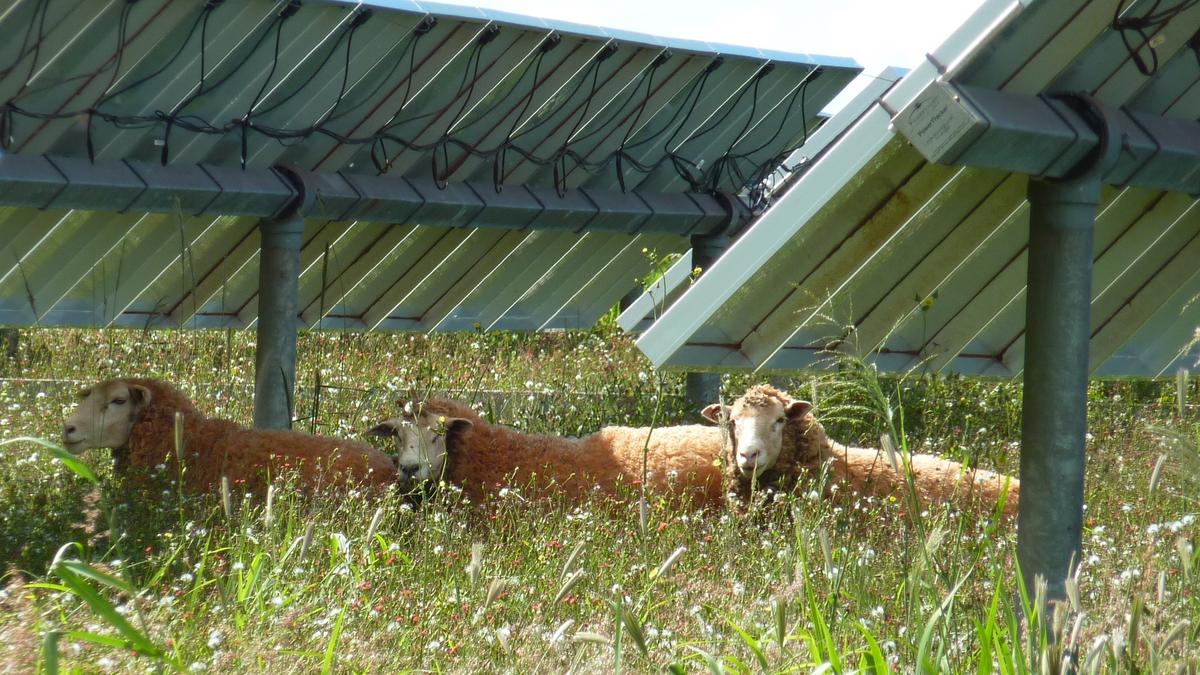
Agri-photovoltaics (agriPV) is emerging as a promising answer to this question. AgriPV integrates solar systems with farming, allowing farmers to generate electricity and cultivate crops on the same parcel of land. The panels are mounted at a suitable height to allow farm operations below, and are spaced between crop rows or integrated into greenhouses to minimise conflict between agricultural production and energy generation.

Selecting right crops

The designs vary by crop and region. Elevated systems have panels mounted a few metres above ground to allow crops to grow below. Row-based systems have panels positioned between crop rows to minimise shading. Vertical systems use upright panels that can capture sunlight from both sides. Greenhouse-integrated systems feature solar panels on roofs or walls to maintain a controlled growing environment. The suitability of a design also depends on the local climate, irrigation practices, and the crop. So systematic and region-specific planning is essential to optimise both agricultural and energy yields.

Careful crop selection is also key to the success of agriPV systems because the amount of sunlight available changes based on how solar panels are placed. Shade-tolerant crops generally perform well in partially shaded areas under solar panels while crops that need more sunlight grow better in the spaces between rows of panels.

Crop selection also varies across India’s diverse agro-climatic regions. For instance, suitable crop options include tomato, onion, garlic, turmeric, ginger, leafy vegetables, and tulsi in Madhya Pradesh, and ragi, jowar, grapes, tomato, potato, chillies, banana, and brinjal in Karnataka and Maharashtra — all of which can perform well in agriPV systems. 

Beyond technical considerations such as crop selection, the scalability of agriPV hinges on developing viable business models. Farmers can own and operate agriPV systems, use a portion of the electricity generated, and sell the surplus. With the help of Farmer Producer Organisations or cooperatives, multiple farmers can also aggregate land and collectively develop projects, enhancing their bargaining power and access to finance.

Private developers could also lease farmland and share revenues or pay fixed rents to farmers. Alternatively, State governments or public agencies could develop agriPV systems to support local energy needs.

Why agriPV matters for India

India’s ambitious energy transition goals — to have 300 GW of installed solar capacity by 2030 and achieve net-zero emissions by 2070 — put land at a premium. Utility-scale solar projects require large tracts of land while agriculture is already under pressure from competing land uses.

AgriPV can ameliorate this conflict. With more than half of India’s land under agriculture, dual-use deployment is valuable. And in an economy that depends heavily on agriculture, the technology’s appeal lies in both farmers diversifying their incomes and producing clean energy. Farmers can earn from selling electricity, leasing land or sharing revenues while continuing to cultivate.

AgriPV also delivers environmental co-benefits. In certain agro-climatic conditions, partial shading can reduce evapotranspiration — the combined loss of water to the atmosphere through evaporation and plant transpiration — and soils retain more moisture, thus enhancing the overall water-use efficiency. Solar panels can also protect crops against extreme heat, rainfall, and hail. By lowering the farm’s need for diesel, such systems can also support rural entrepreneurship and local economic growth.

AgriPV can power ancillary services as well, including cold storage, food processing units, and chaff cutters, strengthening rural value chains. However, this requires clear governance frameworks, tariffs, and accessible finance.

Status in India

There are around 50 pilot agriPV installations nationwide, with various panel-crop combinations and economic feasibility under evaluation. Recent policy discussions have also increasingly referenced agriPV but large-scale replication has yet to commence. Both policymakers and experts need more empirical evidence across agro-climatic zones to say which configurations, crop matrices, and financial frameworks are most suitable.

The technology’s large-scale adoption in India does face economic, regulatory, and institutional barriers. Elevated structures and specialised mounting systems significantly increase capital costs, well above those of conventional solar systems. A crop’s responses to shading can vary and poorly designed systems may even reduce agricultural yields.

System ownership between farmers and developers could also raise doubts, particularly if long-term land rights and revenue-sharing arrangements are not fully clear. Land classification, grid connectivity, and tariffs hinge on regulatory clarity and the lack of design benchmarks adds to investor uncertainty.

Policy pathways

With the right policy support, agriPV has the potential to scale beyond pilot projects. Recent consultations on PM-KUSUM 2.0 have indicated that the government may include agriPV in a proposed ‘National Agri-photovoltaics Mission’ as a dedicated 10-GW component, with viability gap funding to offset the capital costs. Such measures could remarkably improve the bankability of agriPV projects and reduce the financial risk.

Clearly recognising dual-use configurations within PM-KUSUM 2.0 could help align agriPV with farmer-centric solarisation. States can reinforce this by identifying suitable clusters, streamlining approvals, and integrating agriPV into farmer training and advisory programmes.

As India rapidly advances in its energy transition, agriPV offers a pathway for renewable energy to complement agricultural productivity. Its inclusion under PM-KUSUM 2.0 could move it from scattered pilots to a more structured, scalable model, strengthening farmer incomes and easing land pressures.

Shantanu Roy is the Sector Coordinator of the Renewables and Energy Conservation sector at the Center for Study of Science, Technology and Policy (CSTEP), a research-based think tank.

Published – March 23, 2026 07:15 am IST


Source link

Science

Post navigation

Previous Post: Access Denied
Next Post: Access Denied

Related Posts

  • Digital tools are changing how we remember and forget information
    Digital tools are changing how we remember and forget information Science
  • Deep-learning helps classification of tumours during surgery
    Deep-learning helps classification of tumours during surgery Science
  • New NOvA data deepens mystery of subatomic particle’s mass
    New NOvA data deepens mystery of subatomic particle’s mass Science
  • Genome study reveals prehistoric Ethiopian origins of coffee
    Genome study reveals prehistoric Ethiopian origins of coffee Science
  • The Science Quiz | The Skylab ‘incident’
    The Science Quiz | The Skylab ‘incident’ Science
  • SpaceX agrees to take Italian experiments to Mars
    SpaceX agrees to take Italian experiments to Mars Science

More Related Articles

Nine solitary bee species discovered in Kerala for the first time Nine solitary bee species discovered in Kerala for the first time Science
When Manmohan Singh gave a leg-up for SHAR’s initial space missions When Manmohan Singh gave a leg-up for SHAR’s initial space missions Science
How is global warming affecting sea breeze? How is global warming affecting sea breeze? Science
ISRO will take all precautions before manned Gaganyaan mission: Somanath ISRO will take all precautions before manned Gaganyaan mission: Somanath Science
Indian astro community’s vision for solar physics, space weather Indian astro community’s vision for solar physics, space weather Science
What is the Extremely Large Telescope? What is the Extremely Large Telescope? Science
SiteLock

Archives

  • May 2026
  • April 2026
  • March 2026
  • February 2026
  • January 2026
  • December 2025
  • November 2025
  • October 2025
  • September 2025
  • August 2025
  • July 2025
  • June 2025
  • May 2025
  • April 2025
  • March 2025
  • February 2025
  • January 2025
  • December 2024
  • November 2024
  • October 2024
  • September 2024
  • August 2024
  • July 2024
  • June 2024
  • May 2024
  • April 2024
  • March 2024
  • February 2024
  • January 2024
  • December 2023
  • November 2023
  • October 2023
  • September 2023
  • August 2023
  • July 2023
  • June 2023
  • May 2023
  • April 2023
  • March 2023
  • February 2023
  • January 2023
  • December 2022
  • November 2022
  • October 2022
  • September 2022
  • August 2022
  • July 2022
  • June 2022
  • May 2022

Categories

  • Business
  • Nation
  • Science
  • Sports
  • World

Recent Posts

  • With encroachments gone, civic body takes up restoration of Rockfort Teppakulam
  • Sooryavanshi named in India A squad for Sri Lanka tri-series, Tilak to lead side
  • Gold rises ₹650 to ₹1.66 lakh/10g in Delhi
  • France allows asymptomatic passengers off new cruise ship struck by stomach bug outbreak
  • Sensex jumps nearly 790 points on buying in telecom, banking shares

Recent Comments

  1. JasonDag on UP Teacher Who Asked Students To Slap Muslim Classmate
  2. JamesHeR on UP Teacher Who Asked Students To Slap Muslim Classmate
  3. RafaelNar on UP Teacher Who Asked Students To Slap Muslim Classmate
  4. CarlosExorb on UP Teacher Who Asked Students To Slap Muslim Classmate
  5. Robertfloup on UP Teacher Who Asked Students To Slap Muslim Classmate
  • Handwriting on new Epstein note matches one found after his death, say experts
    Handwriting on new Epstein note matches one found after his death, say experts World
  • Rodrygo Keeps Real Madrid Clear Of Barcelona, Girona Boost European Dream
    Rodrygo Keeps Real Madrid Clear Of Barcelona, Girona Boost European Dream Sports
  • Russia sends submarine to escort tanker the U.S. tried to seize off Venezuela: reports
    Russia sends submarine to escort tanker the U.S. tried to seize off Venezuela: reports World
  • What Is Hybrid Pitch? The Innovation That Is All Set To Make Its IPL Debut
    What Is Hybrid Pitch? The Innovation That Is All Set To Make Its IPL Debut Sports
  • Another Accused In Haryana INLD Leader’s Murder Arrested: Cops
    Another Accused In Haryana INLD Leader’s Murder Arrested: Cops Nation
  • National Science Day 2024: Why sustainable funding matters for India’s ‘science power’ ambition | Explained
    National Science Day 2024: Why sustainable funding matters for India’s ‘science power’ ambition | Explained Science
  • Ajit Pawar Diagnosed With Dengue, Advised Rest
    Ajit Pawar Diagnosed With Dengue, Advised Rest Nation
  • Access Denied Business

Editor-in-Chief:
Mohammad Ariff,
MSW, MAJMC, BSW, DTL, CTS, CNM, CCR, CAL, RSL, ASOC.
editor@artifex.news

Associate Editors:
1. Zenellis R. Tuba,
zenelis@artifex.news
2. Haris Daniyel
daniyel@artifex.news

Photograher:
Rohan Das
rohan@artifex.news

Artifex.News offers Online Paid Internships to college students from India and Abroad. Interns will get a PRESS CARD and other online offers.
Send your CV (Subjectline: Paid Internship) to internship@artifex.news

Links:
Associate Journalism
About Us
Privacy Policy

News Links:
Breaking News
World
Nation
Sports
Business
Entertainment
Lifestyle

Registered Office:
72/A, Elliot Road, Kolkata - 700016
Tel: 033-22277777, 033-22172217
Email: office@artifex.news

Editorial Office / News Desk:
No. 13, Mezzanine Floor, Esplanade Metro Rail Station,
12 J. L. Nehru Road, Kolkata - 700069.
(Entry from Gate No. 5)
Tel: 033-46011099, 033-46046046
Email: editor@artifex.news

Copyright © 2023 Artifex.News Newsportal designed by Artifex Infotech.