
Skip to content
  • Facebook
  • X
  • Linkedin
  • WhatsApp
  • YouTube
  • Associate Journalism
  • About Us
  • Privacy Policy
  • 033-46046046
  • editor@artifex.news
Artifex.News

Artifex.News

Stay Connected. Stay Informed.

  • Breaking News
  • World
  • Nation
  • Sports
  • Business
  • Science
  • Entertainment
  • Lifestyle
  • Toggle search form
  • Access Denied
    Access Denied Nation
  • Access Denied
    Access Denied Nation
  • Belligerent and uncomplicated — pocket-dynamite Kishan is here to stay
    Belligerent and uncomplicated — pocket-dynamite Kishan is here to stay Sports
  • How scientists are exploring what extraterrestrial life could look like
    How scientists are exploring what extraterrestrial life could look like Science
  • Access Denied Sports
  • Indigenous clocks delay ISRO’s plans to replace defunct Navic satellites
    Indigenous clocks delay ISRO’s plans to replace defunct Navic satellites Science
  • Antony Blinken Talks Gaza Ceasefire With Saudi Foreign Minister On Mideast Tour
    Antony Blinken Talks Gaza Ceasefire With Saudi Foreign Minister On Mideast Tour World
  • Access Denied
    Access Denied Nation
Education: Why India needs to radically think its doctoral education programmes

Education: Why India needs to radically think its doctoral education programmes

Posted on March 4, 2026 By admin


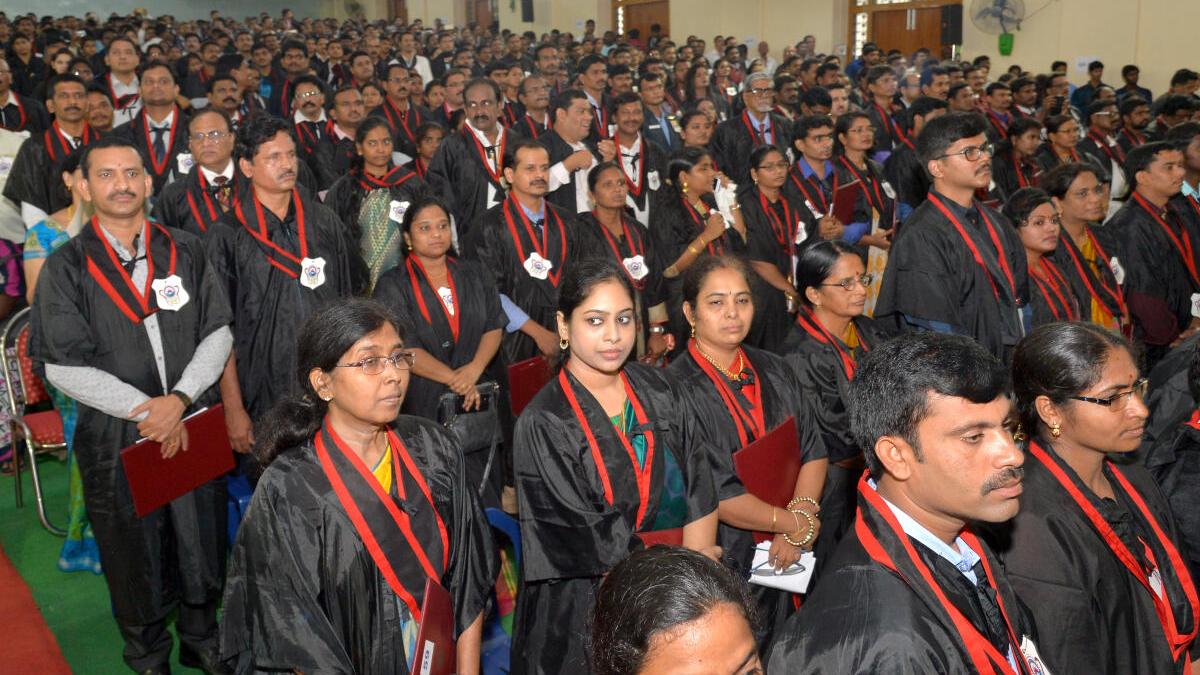
The recent announcement that China awarded its first “practical PhDs”, doctoral degrees conferred for tangible products rather than traditional research papers, is a timely catalyst for a long-overdue conversation on the relevance, design, and culture of PhD education in India.  In China’s new model, doctoral candidates are evaluated on working prototypes and real-world applications instead of lengthy theses and publication counts.

Also Read | Second-generation reforms required in higher education to make India a developed nation

This shift recognises applied innovation on par with scholarly writing and challenges the deeply rooted academic paradigm in which a PhD is almost synonymous with a long thesis and a suite of published papers. Our universities should ask themselves whether we need to evaluate a thesis based on the number of papers a scholar has produced or if we need to focus on the societal relevance of the work.

Academic malaise

One major difficulty students interested in research in India face is the prolongation of the PhD. In many universities, there are students who have spent more than three years; in some cases, students spend eight. Even though there are many issues with delays in PhD work, most instances are due to delays in publishing. In several departments, progress is judged less by the depth of original insight and more by the number of papers indexed in certain databases and the reputational clout of journals in which they appear. This culture undervalues the quality and relevance of research.

While publication is undeniably a pillar of academic excellence, the current fixation on having multiple indexed papers for a degree to be considered completed can encourage superficial research that may not push disciplinary boundaries or address pressing real-world problems.

It also intensifies the pressure on students to chase journals — any journals — that will accept their work, inadvertently fuelling unethical practices like engaging with predatory journals.

Scholars’ plight

In most labs, PhD scholars are treated as labour that supervisors can take for granted. Supervisors exploit the scholars in the name of publication, by prolonging their stay in the lab, so that supervisors don’t lose a good student trained in the domain. To maintain their labs, many supervisors also exploit their scholars by offering them the dream of publishing well, which, in reality, is mainly needed for the supervisors’ appraisals.

This culture is further aggravated by paid publications and dubious journals that promise quick indexing and impact metrics for a fee. Such outlets capitalise on the intense pressure on students to publish, thus creating a shortcut that erodes academic integrity. Though many Indian institutions now require papers to be published in indexed journals, the quality and relevance of these outlets vary widely, and the indexing status itself is frequently commodified by publishers. Ultimately, most doctoral research focuses solely on the university’s administrative needs, lacking scientific rigour or societal significance.

Hurdles with theses

In many universities, PhD theses are measured by the number of pages, often running beyond 200. There is a misconception that the quality of work is directly proportional to this number. History shows that even Nobel Prize-winning can span only a few pages. When one can concisely explain their research work, expanding it to occupy many pages just because that’s the norm is absurd.

The compulsion to write lengthy theses has led scholars to waste time and energy on introductions and inflated literature reviews. Many leading universities across the globe are moving towards compact dissertations that prioritise contributions over volume.

A major structural impediment in India’s PhD environment is the conventional thesis-defence model and long-lasting bureaucratic procedures. When they complete their studies, students have to deal with extended timelines to submit their theses, have them evaluated, and finally complete their oral defence. Administrative delays can further extend the final phases of a PhD by months, and in rare instances, even years, irrespective of the candidate’s productivity or the study’s significance.

For exceptional researchers who have produced significant ideas, potentially creating technologies or therapies with societal relevance, being constrained by prolonged review cycles diminishes the fundamental objective of doctoral studies.

Relevance of doctoral work

An important criticism of India’s existing PhD system is that a lot of doctoral research isn’t very useful to society. Many theses are still preserved in academic archives and don’t often help with public policy, new ideas in business or the health of communities. In many universities, copies of PhD theses are just dumped in a room or a backyard.

A PhD shouldn’t be a solitary intellectual pursuit but rather a conduit between profound investigation and significant influence. China’s practical PhD model seeks to bridge this gap by matching doctoral outputs with real-world applications and industrial scalability, including welding technology for firefighting systems, and is assessed by panels comprising both academics and industry professionals.

India faces many real-world problems that could benefit from high-quality PhD research. These issues span public health, agriculture, sustainability, digital inclusion, and education. The question is whether our current systems support and encourage studies grounded in what the people need.

Indian universities should brainstorm ways to reform the structure of PhD education to better suit the current world. The age-old practice of spending long years for a PhD doesn’t hold any merit in a digital world. Similarly, the structure and evaluation of the thesis should focus on the innovation it describes and its relevance rather than on the number of papers it produced. Just a mushrooming number of PhD holders does no good for the nation; India also needs good quality work that can support nation-building and humankind.

Biju Dharmapalan is  the dean, Academic Affairs, at Garden City University, Bengaluru,  and an adjunct faculty member at the National Institute of Advanced Studies, Bengaluru.

Published – March 04, 2026 07:30 am IST


Source link

Science Tags:education news, education updates, india doctoral programmes, India news, india PhD programmes

Post navigation

Previous Post: Access Denied
Next Post: Access Denied

Related Posts

  • Communication a vital skill in today’s era of AI: Vishwanathan Anand
    Communication a vital skill in today’s era of AI: Vishwanathan Anand Science
  • Malaysia imposes anti-dumping duties on plastic imports from China, Indonesia 
    Malaysia imposes anti-dumping duties on plastic imports from China, Indonesia  Science
  • Aditya-L1 mission to mark 25th flight of PSLV-XL variant
    Aditya-L1 mission to mark 25th flight of PSLV-XL variant Science
  • Why science and scientists must learn to celebrate their failures
    Why science and scientists must learn to celebrate their failures Science
  • After Chandrayaan success, Midhani is ready for ISRO’s Gaganyaan
    After Chandrayaan success, Midhani is ready for ISRO’s Gaganyaan Science
  • Why precision medicine in India can’t advance without biobank laws | Analysis
    Why precision medicine in India can’t advance without biobank laws | Analysis Science

More Related Articles

ISRO to sign off 2024 with space docking experiment mission on December 30 ISRO to sign off 2024 with space docking experiment mission on December 30 Science
What causes the seas to foam? What causes the seas to foam? Science
Four professors from YVU feature in world’s top 2% scientists list Four professors from YVU feature in world’s top 2% scientists list Science
Need to tell AI-made deepfakes from real pics? Call astronomers Need to tell AI-made deepfakes from real pics? Call astronomers Science
China to double size of space station, touts alternative to NASA-led ISS China to double size of space station, touts alternative to NASA-led ISS Science
Conservation in the Global South erases human rights, researchers say Conservation in the Global South erases human rights, researchers say Science
SiteLock

Archives

  • May 2026
  • April 2026
  • March 2026
  • February 2026
  • January 2026
  • December 2025
  • November 2025
  • October 2025
  • September 2025
  • August 2025
  • July 2025
  • June 2025
  • May 2025
  • April 2025
  • March 2025
  • February 2025
  • January 2025
  • December 2024
  • November 2024
  • October 2024
  • September 2024
  • August 2024
  • July 2024
  • June 2024
  • May 2024
  • April 2024
  • March 2024
  • February 2024
  • January 2024
  • December 2023
  • November 2023
  • October 2023
  • September 2023
  • August 2023
  • July 2023
  • June 2023
  • May 2023
  • April 2023
  • March 2023
  • February 2023
  • January 2023
  • December 2022
  • November 2022
  • October 2022
  • September 2022
  • August 2022
  • July 2022
  • June 2022
  • May 2022

Categories

  • Business
  • Nation
  • Science
  • Sports
  • World

Recent Posts

  • Five convicted in connection with Matthew Perry’s death
  • Hotel staff assaulted, case registered
  • IPL 2026 | RCB opts to field in rain-delayed clash against KKR
  • Africa must drop ‘victim mentality’: mogul Tony Elumelu
  • Suspended SI held for sexually assaulting woman on pretext of marriage

Recent Comments

  1. StanleyPeapy on UP Teacher Who Asked Students To Slap Muslim Classmate
  2. Bryandut on UP Teacher Who Asked Students To Slap Muslim Classmate
  3. NathanJobre on UP Teacher Who Asked Students To Slap Muslim Classmate
  4. DavidNup on UP Teacher Who Asked Students To Slap Muslim Classmate
  5. JeffryFok on UP Teacher Who Asked Students To Slap Muslim Classmate
  • Access Denied Business
  • Access Denied Sports
  • Access Denied World
  • Thane Man Arrested For Repeatedly Raping Woman, Forcing Her To Abort Pregnancy
    Thane Man Arrested For Repeatedly Raping Woman, Forcing Her To Abort Pregnancy Nation
  • E.U. chief says Trump’s threats challenge Europe’s security and prosperity, ahead of emergency summit
    E.U. chief says Trump’s threats challenge Europe’s security and prosperity, ahead of emergency summit World
  • RBI’s MPC keeps policy rate unchanged; real GDP growth for FY24 projected at 6.5%
    RBI’s MPC keeps policy rate unchanged; real GDP growth for FY24 projected at 6.5% Business
  • Access Denied World
  • India vs Bangladesh: Langurs Hired As ‘Security’ During Kanpur Test To Prevent Monkey Menace
    India vs Bangladesh: Langurs Hired As ‘Security’ During Kanpur Test To Prevent Monkey Menace Sports

Editor-in-Chief:
Mohammad Ariff,
MSW, MAJMC, BSW, DTL, CTS, CNM, CCR, CAL, RSL, ASOC.
editor@artifex.news

Associate Editors:
1. Zenellis R. Tuba,
zenelis@artifex.news
2. Haris Daniyel
daniyel@artifex.news

Photograher:
Rohan Das
rohan@artifex.news

Artifex.News offers Online Paid Internships to college students from India and Abroad. Interns will get a PRESS CARD and other online offers.
Send your CV (Subjectline: Paid Internship) to internship@artifex.news

Links:
Associate Journalism
About Us
Privacy Policy

News Links:
Breaking News
World
Nation
Sports
Business
Entertainment
Lifestyle

Registered Office:
72/A, Elliot Road, Kolkata - 700016
Tel: 033-22277777, 033-22172217
Email: office@artifex.news

Editorial Office / News Desk:
No. 13, Mezzanine Floor, Esplanade Metro Rail Station,
12 J. L. Nehru Road, Kolkata - 700069.
(Entry from Gate No. 5)
Tel: 033-46011099, 033-46046046
Email: editor@artifex.news

Copyright © 2023 Artifex.News Newsportal designed by Artifex Infotech.