
Skip to content
  • Facebook
  • X
  • Linkedin
  • WhatsApp
  • YouTube
  • Associate Journalism
  • About Us
  • Privacy Policy
  • 033-46046046
  • editor@artifex.news
Artifex.News

Artifex.News

Stay Connected. Stay Informed.

  • Breaking News
  • World
  • Nation
  • Sports
  • Business
  • Science
  • Entertainment
  • Lifestyle
  • Toggle search form
  • Iran’s President-elect Pezeshkian to be sworn in next month
    Iran’s President-elect Pezeshkian to be sworn in next month World
  • U.K., France, Canada and others condemn Israel’s demolition of U.N. site in Jerusalem
    U.K., France, Canada and others condemn Israel’s demolition of U.N. site in Jerusalem World
  • Early voting begins in New York mayoral race dominated by Trump foe
    Early voting begins in New York mayoral race dominated by Trump foe World
  • France bans planned gathering of Muslims in Paris area, citing security risk
    France bans planned gathering of Muslims in Paris area, citing security risk World
  • Martin Guptill Laments New Zealand Retirement, Says “Decisions Have Been Made…”
    Martin Guptill Laments New Zealand Retirement, Says “Decisions Have Been Made…” Sports
  • Despite zoonotic diseases threat, Keralam’s proposed veterinary public health wing yet to take shape
    Despite zoonotic diseases threat, Keralam’s proposed veterinary public health wing yet to take shape Nation
  • Australia vs India live score over Super Eight – Match 11 T20 16 20 updates
    Australia vs India live score over Super Eight – Match 11 T20 16 20 updates Sports
  • On Terror And Elections In J&K, Poll Panel Chief’s ‘Chicken And Egg’ Analogy
    On Terror And Elections In J&K, Poll Panel Chief’s ‘Chicken And Egg’ Analogy Nation
Could the near-extinct Asiatic cheetah rewild Saudi Arabia?

Could the near-extinct Asiatic cheetah rewild Saudi Arabia?

Posted on February 4, 2026 By admin


The cheetah is a spotted beast that can burn through savannas like a bolt of lightning to hunt prey vastly bigger than itself. This big cat is the world’s fastest terrestrial mammal, which purrs more than it growls and has been historically tamed and trained by people to hunt game.

Cheetahs once roamed most of Africa and western and southern Asia, from the Arabian Peninsula to India. Today, it has vanished from 91% of its historical global range. In India, it was declared extinct in 1952 from hunting and habitat loss, and over a century ago, it vanished from Saudi Arabia.

Asiatic cheetahs (Acinonyx jubatus venaticus), unlike those in Africa, which that tenuously hold on, are the most critically endangered: just around 50 individual Asiatic cheetahs remain in the wild, a small population in Iran.

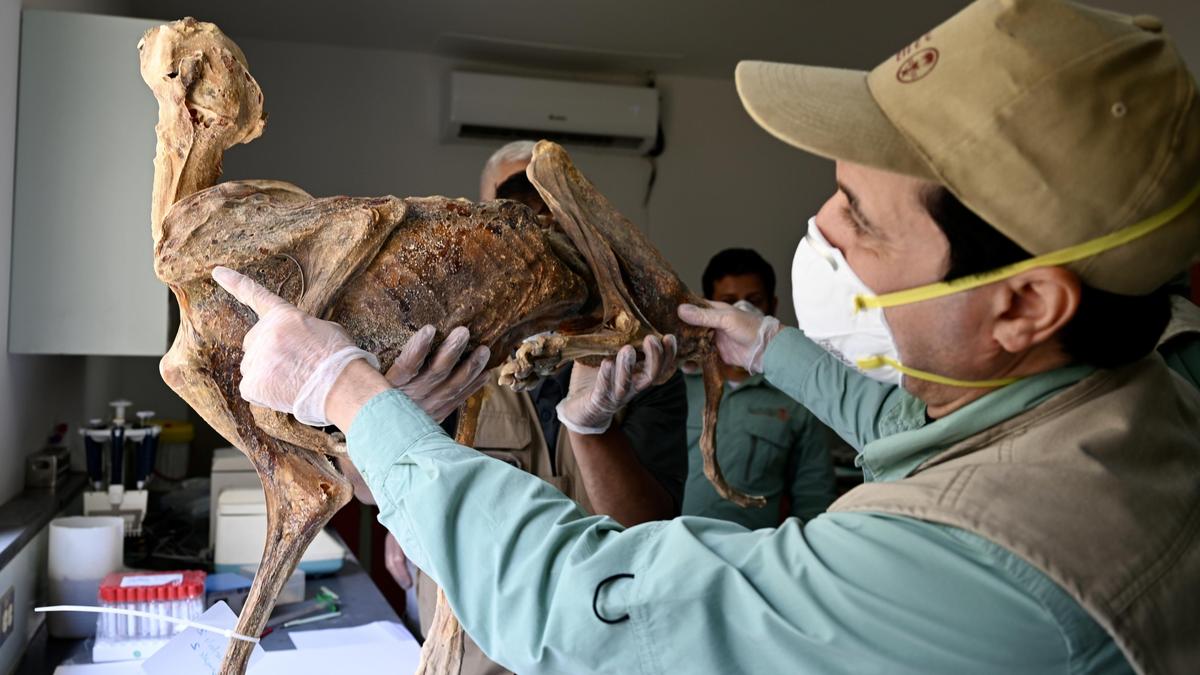
Amidst this dire scenario came a “serendipitous discovery” recently in the caves of Saudi Arabia of the “long-term presence” of cheetahs. Scientists discovered seven naturally mummified animals and skeletal remains of 54, reported in the latest edition of Nature Communications Earth and Environment.

The remains, unearthed from the Lauga cave network in the Arar area of northern Saudi Arabia, dated back to 4,223 years ago and some to just over a century ago, giving scientists a valuable opportunity to understand the evolutionary history of cheetahs in their former range. They concluded that “rewilding” of cheetahs in Saudi Arabia can be sourced from the closest subspecies of the discovered cheetahs”, potentially paving the way for their ‘return’.

Treasures from caves

Genomic data of these specimens showed the presence of two subspecies, the Asiatic cheetah (A. j. venaticus) and the north-western African cheetah (A. j. hecki), neither of which occur in the Arabian Peninsula any more. The many caves in the region could have been used as denning sites for the creatures. The study used palaeo-chronological dating to establish the time period, genomic sequencing to identify subspecies, and radiographic analysis to determine age.

Although records indisputably suggest the historical presence of the species in the areas designated Saudi Arabia, Oman, Yemen, Kuwait, Iraq, Jordan, and Palestine today, some point to the scarcity of evidence to adequately represent the true historical distribution of the cheetah. While the primary reasons for the Arabian Peninsula’s vanishing cheetah are poorly documented, they are thought to be habitat loss and fragmentation, prey depletion, human-wildlife conflict, unregulated hunting, and trade in cheetah as pets or game hunting, said the research paper.

Over the past 50 years, Saudi Arabia has significantly changed wildlife management policy and one of its biodiversity goals includes the re-establishment of animals to their former biogeographic ranges.

The kingdom has already successfully restored ungulates to landscapes where they had disappeared or dwindled, e.g. Arabian oryx, Arabian gazelles, and the Nubian ibex. As ungulate populations recover here, “it is timely for the reestablishment of extirpated apex carnivores — among them cheetah,” said the paper. DNA studies showed that the prehistoric Saudi Arabia cheetahs are genomically closest to the west African subspecies A. j. hecki.

The results also highlight the important role that caves play “as repositories of ancient biodiversity informing.” Natural mummies can remain well preserved for thousands of years, especially in arid soil caves where desiccation was made possible by dry microclimates where bacterial action is diminished.

Africa’s cheetahs are in peril too: 90% of the animals live outside protected areas and on private farmlands, and conflict with people is not infrequent: the cats prey on livestock quite visibly during the day, and farmers, to save their animals, often trap or shoot cheetahs, per the paper. Larger carnivores such as lions, leopards, and hyena also kill cheetahs when competing for prey or territory. As a result, in Saharan Africa, the spotted cats are as few as 0.0002/km.

An adequate habitat?

Ravi Chellam, wildlife biologist and CEO, Metastring Foundation, Bengaluru, has been tracking Project Cheetah in India, as part of which several African cheetahs have been introduced to Madhya Pradesh. The Hindu asked him about the prudence of reintroducing cheetahs to Saudi Arabia: “This is a sovereign decision for each country to take. Having said that, from an ecological perspective it is important to ensure that adequate good quality habitats are available before sourcing the cheetahs for the reintroduction effort,” he said.

Based on the evidence, at least 1 lakh sq. km. of habitat is required to establish a viable and self-sustaining population of cheetahs in the semi-desert and desert landscapes of Saudi Arabia. The chosen habitats should support a reasonable density and diversity of prey species and be relatively free of human activities especially road traffic, he added.

As for whether Asian cheetahs should have been introduced to India, Dr. Chellam said that with the highly endangered status of Asiatic cheetahs in Iran, “it is not advisable to remove any cheetahs from this very small population.”

For the same reason, cheetahs reintroduced to Saudi Arabia would have to be the northwest African sub-species, A. j. hecki. But even this subspecies is endangered in the wild in western and northern Africa. So “the only realistic options are to source the required cheetahs from either A. j. raineyi (east Africa) or A. j. jubatus (southern Africa),” Dr. Chellam said.

There is little clarity about the funding for India’s Project Cheetah but, he added, “it will be one of the most expensive projects” in India’s conservation history.

Liz Kierepka, a molecular ecologist who wasn’t involved in the Saudi Arabia study, told ScienceNews that the discovery is “quite the rarity,” outside of permafrost areas where several natural mummies of megafauna from the Ice Age exist. She also said relocating cheetahs from already tiny populations has the potential to cause “new problems for the donor pools.”.

It requires more data, but Dr. Kierepka said she is curious what shows up in genetic analyses to help select donor cheetahs: “If they really want to pursue rewilding,” she said, that could make reintroduction more likely to succeed.

divya.gandhi@thehindu.co.in

Published – February 05, 2026 05:30 am IST


Source link

Science

Post navigation

Previous Post: Access Denied
Next Post: Access Denied

Related Posts

  • The Science Quiz: The science hidden in proverbs and idioms
    The Science Quiz: The science hidden in proverbs and idioms Science
  • Does the Sun rotate?
    Does the Sun rotate? Science
  • Tech developed by Indian talent abroad being bought back by domestic industry from foreign markets, says Pradhan
    Tech developed by Indian talent abroad being bought back by domestic industry from foreign markets, says Pradhan Science
  • SpaceX loses spacecraft after catching rocket booster at launch pad in latest Starship test
    SpaceX loses spacecraft after catching rocket booster at launch pad in latest Starship test Science
  • 2,000 volunteers join a painstaking effort to restore massive skeleton of prehistoric predator
    2,000 volunteers join a painstaking effort to restore massive skeleton of prehistoric predator Science
  • How jumping genes and RNA bridges promise to shake up biomedicine
    How jumping genes and RNA bridges promise to shake up biomedicine Science

More Related Articles

Researchers build synthetic materials that ‘learn’ to change shape Researchers build synthetic materials that ‘learn’ to change shape Science
Study by Indian researchers finds that body’s immune cells ‘betray’ it to help breast cancer spread Study by Indian researchers finds that body’s immune cells ‘betray’ it to help breast cancer spread Science
How district cooling can ease India’s climate and urban planning troubles How district cooling can ease India’s climate and urban planning troubles Science
Bumrah’s ball to Rizwan shows energy conservation law in action Bumrah’s ball to Rizwan shows energy conservation law in action Science
The Science Quiz | The psychology of colours The Science Quiz | The psychology of colours Science
IIT-Delhi researchers achieve secure quantum communication for 380 km in standard telecom fiber IIT-Delhi researchers achieve secure quantum communication for 380 km in standard telecom fiber Science
SiteLock

Archives

  • October 2026
  • September 2026
  • August 2026
  • July 2026
  • June 2026
  • May 2026
  • April 2026
  • March 2026
  • February 2026
  • January 2026
  • December 2025
  • November 2025
  • October 2025
  • September 2025
  • August 2025
  • July 2025
  • June 2025
  • May 2025
  • April 2025
  • March 2025
  • February 2025
  • January 2025
  • December 2024
  • November 2024
  • October 2024
  • September 2024
  • August 2024
  • July 2024
  • June 2024
  • May 2024
  • April 2024
  • March 2024
  • February 2024
  • January 2024
  • December 2023
  • November 2023
  • October 2023
  • September 2023
  • August 2023
  • July 2023
  • June 2023
  • May 2023
  • April 2023
  • March 2023
  • February 2023
  • January 2023
  • December 2022
  • November 2022
  • October 2022
  • September 2022
  • August 2022
  • July 2022
  • June 2022
  • May 2022

Categories

  • Business
  • Nation
  • Science
  • Sports
  • World

Recent Posts

  • Saudi Supreme Court sets aside Sri Lankan migrant worker’s death penalty
  • Nedumbassery accident: CPI(M) stages protest march to police station over ‘indifference’ in handling of case
  • Why CJI Surya Kant said ‘no’ to Rahul Gandhi’s request to meet | Explained
  • September WPI Inflation rises to 11.39% as food, fuel and manufactured goods prices increase
  • Frankfurt-Delhi Air India flight diverted to Jaipur following bomb threat

Recent Comments

  1. RobertTes on UP Teacher Who Asked Students To Slap Muslim Classmate
  2. Manuelret on UP Teacher Who Asked Students To Slap Muslim Classmate
  3. RobertTes on UP Teacher Who Asked Students To Slap Muslim Classmate
  4. RobertTes on UP Teacher Who Asked Students To Slap Muslim Classmate
  5. BrentWes on UP Teacher Who Asked Students To Slap Muslim Classmate
  • In message to India, Jamaat chief says election will show ‘red card’ to forces of ‘hegemony’
    In message to India, Jamaat chief says election will show ‘red card’ to forces of ‘hegemony’ World
  • Starbucks’ New CEO To Supercommute 1,600 Km To Work On Corporate Jet
    Starbucks’ New CEO To Supercommute 1,600 Km To Work On Corporate Jet World
  • Venezuela opposition seeks army backing, leader to meet Biden
    Venezuela opposition seeks army backing, leader to meet Biden World
  • Access Denied World
  • 8 Soldiers Killed In Colombia Military Helicopter Crash
    8 Soldiers Killed In Colombia Military Helicopter Crash World
  • Access Denied
    Access Denied Nation
  • Access Denied Sports
  • Congress raises fiscal federalism, inequality concerns ahead of Budget
    Congress raises fiscal federalism, inequality concerns ahead of Budget Business

Editor-in-Chief:
Mohammad Ariff,
MSW, MAJMC, BSW, DTL, CTS, CNM, CCR, CAL, RSL, ASOC.
editor@artifex.news

Associate Editors:
1. Zenellis R. Tuba,
zenelis@artifex.news
2. Haris Daniyel
daniyel@artifex.news

Photograher:
Rohan Das
rohan@artifex.news

Associate Journalists
1. Subrata Paul - AN/2020/01
2. Quamruz Zaman - AN/2021/22
3. Ahmed Sha - AN/2021/035
4. Ajay Kumar Shaw - AN/2021/39
5. Tahqiqul Hoda - AN/2021/21

Artifex.News offers Online Paid Internships to college students from India and Abroad. Interns will get a PRESS CARD and other online offers.
Send your CV (Subjectline: Paid Internship) to internship@artifex.news

Links:
Associate Journalism
About Us
Privacy Policy

News Links:
Breaking News
World
Nation
Sports
Business
Entertainment
Lifestyle

Registered Office:
72/A, Elliot Road, Kolkata - 700016
Tel: 033-22277777, 033-22172217
Email: office@artifex.news

Editorial Office / News Desk:
No. 13, Mezzanine Floor, Esplanade Metro Rail Station,
12 J. L. Nehru Road, Kolkata - 700069.
(Entry from Gate No. 5)
Tel: 033-46011099, 033-46046046
Email: editor@artifex.news

Copyright © 2023 Artifex.News Newsportal designed by Artifex Infotech.