






Skip to content
  • Facebook
  • X
  • Linkedin
  • WhatsApp
  • Associate Journalism
  • About Us
  • Privacy Policy
  • 033-46046046
  • editor@artifex.news
Artifex.News

Artifex.News

Stay Connected. Stay Informed.

  • Breaking News
  • World
  • Nation
  • Sports
  • Business
  • Science
  • Entertainment
  • Lifestyle
  • Toggle search form
  • Science quiz: The discovery of Epimetheus
    Science quiz: The discovery of Epimetheus Science
  • Access Denied
    Access Denied Sports
  • Carlos Alcaraz, Daniil Medvedev Ease Into US Open Second Round
    Carlos Alcaraz, Daniil Medvedev Ease Into US Open Second Round Sports
  • Key Doctors’ Body Says Strike Over Kolkata Rape To Continue
    Key Doctors’ Body Says Strike Over Kolkata Rape To Continue Nation
  • Kamala Harris’ Donald Trump Warning As She Accepts Presidential Nomination
    Kamala Harris’ Donald Trump Warning As She Accepts Presidential Nomination World
  • ‘Nuke India’ found scribbled on Minneapolis school shooter’s gun
    ‘Nuke India’ found scribbled on Minneapolis school shooter’s gun World
  • “I Fell…”: Bangladesh Super Fan Changes Tune Amid Assault Row During Kanpur Test
    “I Fell…”: Bangladesh Super Fan Changes Tune Amid Assault Row During Kanpur Test Sports
  • Emperor Penguin That Swam From Antarctica To Australia Released Back Into Ocean
    Emperor Penguin That Swam From Antarctica To Australia Released Back Into Ocean World
Researchers use sound waves to detect elusive helium gas leaks

Researchers use sound waves to detect elusive helium gas leaks

Posted on January 28, 2026 By admin


A simple Kagome lattice. The name comes from the Japanese for “basket” and “eye”, referring to the pattern when woven with bamboo leaves.
| Photo Credit: N. Mori

Helium is famous for making balloons float, voices squeak, and as a critical resource for MRI machines and aerospace engineering. Helium is expensive and scarce, finding leaks quickly is essential, but that’s easier said than done because helium is also chemically inert and sensors, which usually rely on chemical reactors, have a tough time detecting it.

In a new study, researchers from Nanjing University in China have reported a sensor that uses sound waves instead of chemistry to ‘hear’ helium leaks. The study paper was published in the December 2025 issue of Applied Physics Letters.

Most gas sensors work like a sponge that reacts when it touches a particular liquid. They work by absorbing gas or using chemical reactions to change an electrical signal. Since helium is chemically stable, it doesn’t react with these sensitive coatings. And while existing methods like mass spectrometry can detect helium, they’re often bulky and expensive.

In the new study, the researchers took a different approach. They designed a sensor based on acoustic topological materials. These are structures that can trap sound using a particular geometric pattern called a Kagome lattice.

The Kagome lattice is made of interlaced triangles and hexagons. In their specific design, the researchers used rigid cylinders connected by small tubes, creating an effect called topological corner states. Essentially, sound waves introduced into the structure get trapped at the three corners of the triangle and are unable to escape into the middle or from the sides.
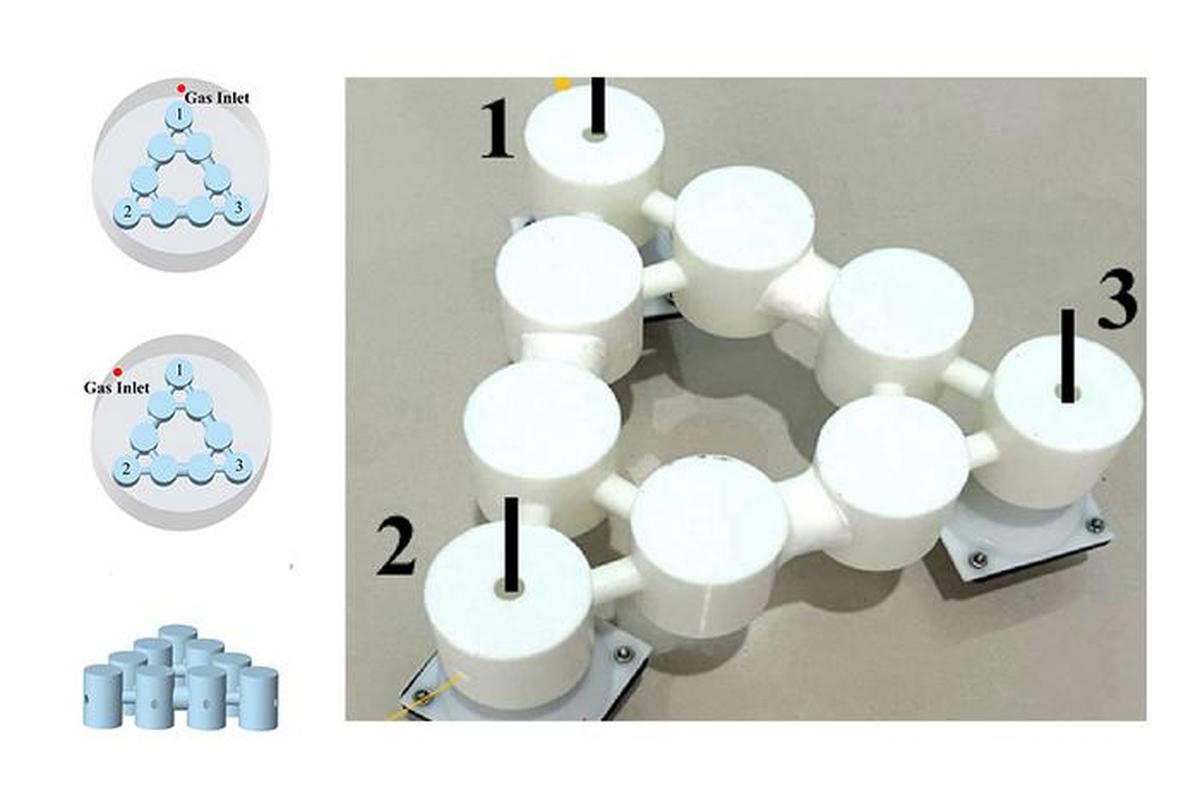
Helium detection device inspired by Kagome. Left: The device’s triangular structure helps determine the location of helium leaks in a 2D space.

Helium detection device inspired by Kagome. Left: The device’s triangular structure helps determine the location of helium leaks in a 2D space.
| Photo Credit:
Wang et al.

Sound travels at different speeds through different gases. When helium leaks into the sensor and mixes with the air inside, it changes the speed at which sound waves travel through the tubes. This change in speed changes the frequency (or pitch) of the trapped sound at the corners. So by measuring this shift in frequency, the sensor can instantly calculate the concentration of helium present.

The acoustic approach offers several advantages over traditional chemical sensors. Because it doesn’t rely on delicate chemical coatings, the sensor is incredibly tough. It works well in temperatures ranging from a comfortable 26º C to a freezing –34º C. It also ignores changes in humidity and thus doesn’t need to be constantly recalibrated like other sensors.

The topological nature of the sensor means its ability to trap sound is very stable. The researchers found that they could drill large holes in the sides of the cylinders to let gas in faster and the sound trap still worked well. This means the sensor can detect leaks rapidly as the gas doesn’t have to seep in slowly.

And because the sensor is a triangle with three distinct corners, it can do more than just say whether helium is present in the air. By comparing the timing of the signals at each of the three corners, the sensor can triangulate the direction the gas is coming from. If the frequency shifts at corner 1 before corner 3, for instance, it would mean the leak is closer to corner 1.

According to the research, this device could make it much easier and cheaper to protect valuable helium supplies in industries ranging from medicine to space exploration.

Published – January 28, 2026 12:40 pm IST


Source link

Science

Post navigation

Previous Post: Vishal Mega Mart Shares May Rally 40% Says ICICI Securities After Q3 Results — Check Target Price
Next Post: Brazil declares acai a national fruit to ward off ‘biopiracy’

Related Posts

  •  Future Skills at Monash College and Microsoft partner to transform tech education with AI
     Future Skills at Monash College and Microsoft partner to transform tech education with AI Science
  • Why does bread become stale even if it doesn’t go mouldy?
    Why does bread become stale even if it doesn’t go mouldy? Science
  • AI comes to the rescue of elephants
    AI comes to the rescue of elephants Science
  • SpaceX’s Falcon-9 deploys India’s GSAT-N2 satellite into orbit
    SpaceX’s Falcon-9 deploys India’s GSAT-N2 satellite into orbit Science
  • China launches lunar probe mission to collect samples for first time from far side of moon
    China launches lunar probe mission to collect samples for first time from far side of moon Science
  • Who are the winners of the 2025 Nobel Prize in Physiology or Medicine?
    Who are the winners of the 2025 Nobel Prize in Physiology or Medicine? Science

More Related Articles

Can resveratrol-copper be used to prevent metastasis without trials? Can resveratrol-copper be used to prevent metastasis without trials? Science
Somatic genetic variants: A genomic revolution hiding inside our cells Somatic genetic variants: A genomic revolution hiding inside our cells Science
Sun’s magnetic field may form close to the surface: new study Sun’s magnetic field may form close to the surface: new study Science
science for all newsletter What are Trojan asteroids? science for all newsletter What are Trojan asteroids? Science
V. Narayanan, who is set to take over as ISRO Chairman, terms his new assignment ‘a great responsibility’ V. Narayanan, who is set to take over as ISRO Chairman, terms his new assignment ‘a great responsibility’ Science
2023 Nobel Prize in Physics: Seeing electrons through brief pulses of light | Explained 2023 Nobel Prize in Physics: Seeing electrons through brief pulses of light | Explained Science
SiteLock

Archives

  • January 2026
  • December 2025
  • November 2025
  • October 2025
  • September 2025
  • August 2025
  • July 2025
  • June 2025
  • May 2025
  • April 2025
  • March 2025
  • February 2025
  • January 2025
  • December 2024
  • November 2024
  • October 2024
  • September 2024
  • August 2024
  • July 2024
  • June 2024
  • May 2024
  • April 2024
  • March 2024
  • February 2024
  • January 2024
  • December 2023
  • November 2023
  • October 2023
  • September 2023
  • August 2023
  • July 2023
  • June 2023
  • May 2023
  • April 2023
  • March 2023
  • February 2023
  • January 2023
  • December 2022
  • November 2022
  • October 2022
  • September 2022
  • August 2022
  • July 2022
  • June 2022
  • May 2022

Categories

  • Business
  • Nation
  • Science
  • Sports
  • World

Recent Posts

  • Access Denied
  • Brazil declares acai a national fruit to ward off ‘biopiracy’
  • Researchers use sound waves to detect elusive helium gas leaks
  • Vishal Mega Mart Shares May Rally 40% Says ICICI Securities After Q3 Results — Check Target Price
  • Access Denied

Recent Comments

  1. Donaldnek on UP Teacher Who Asked Students To Slap Muslim Classmate
  2. KevinUnece on UP Teacher Who Asked Students To Slap Muslim Classmate
  3. Donaldnek on UP Teacher Who Asked Students To Slap Muslim Classmate
  4. Stephenbug on UP Teacher Who Asked Students To Slap Muslim Classmate
  5. Donaldnek on UP Teacher Who Asked Students To Slap Muslim Classmate
  • Access Denied Sports
  • Two Indian tourists sentenced to jail for robbing, assaulting sex workers in Singapore hotels
    Two Indian tourists sentenced to jail for robbing, assaulting sex workers in Singapore hotels World
  • Access Denied
    Access Denied Nation
  • Indian-American Computer Engineer Honoured With Texas’ Highest Academic Award
    Indian-American Computer Engineer Honoured With Texas’ Highest Academic Award World
  • Trump orders firing of all ‘Biden-era’ US attorneys
    Trump orders firing of all ‘Biden-era’ US attorneys World
  • US War On Terror And How It Changed The World
    US War On Terror And How It Changed The World World
  • Railway Employees Union Writes To PM Modi On Pay Revision
    Railway Employees Union Writes To PM Modi On Pay Revision Nation
  • Gujarat Titans Star, Bought For Rs 3.60 Crore, Meets With Accident; Super Bike Damaged
    Gujarat Titans Star, Bought For Rs 3.60 Crore, Meets With Accident; Super Bike Damaged Sports

Editor-in-Chief:
Mohammad Ariff,
MSW, MAJMC, BSW, DTL, CTS, CNM, CCR, CAL, RSL, ASOC.
editor@artifex.news

Associate Editors:
1. Zenellis R. Tuba,
zenelis@artifex.news
2. Haris Daniyel
daniyel@artifex.news

Photograher:
Rohan Das
rohan@artifex.news

Artifex.News offers Online Paid Internships to college students from India and Abroad. Interns will get a PRESS CARD and other online offers.
Send your CV (Subjectline: Paid Internship) to internship@artifex.news

Links:
Associate Journalism
About Us
Privacy Policy

News Links:
Breaking News
World
Nation
Sports
Business
Entertainment
Lifestyle

Registered Office:
72/A, Elliot Road, Kolkata - 700016
Tel: 033-22277777, 033-22172217
Email: office@artifex.news

Editorial Office / News Desk:
No. 13, Mezzanine Floor, Esplanade Metro Rail Station,
12 J. L. Nehru Road, Kolkata - 700069.
(Entry from Gate No. 5)
Tel: 033-46011099, 033-46046046
Email: editor@artifex.news

Copyright © 2023 Artifex.News Newsportal designed by Artifex Infotech.