Skip to content
  • Facebook
  • X
  • Linkedin
  • WhatsApp
  • YouTube
  • Associate Journalism
  • About Us
  • Privacy Policy
  • 033-46046046
  • editor@artifex.news
Artifex.News

Artifex.News

Stay Connected. Stay Informed.

  • Breaking News
  • World
  • Nation
  • Sports
  • Business
  • Science
  • Entertainment
  • Lifestyle
  • Toggle search form
  • Himanta Sarma In Swati Maliwal Assault Case
    Himanta Sarma In Swati Maliwal Assault Case Nation
  • IPL 2026: Axar Patel shifts focus to next season after KKR crushes DC’s playoff hopes
    IPL 2026: Axar Patel shifts focus to next season after KKR crushes DC’s playoff hopes Sports
  • Delhi Court Allows Early Hearing On Bail Petition Of Manish Sisodia
    Delhi Court Allows Early Hearing On Bail Petition Of Manish Sisodia Nation
  • Access Denied
    Access Denied Nation
  • Trump Confirms Military Plan For Mass Deportation Of Undocumented Migrants
    Trump Confirms Military Plan For Mass Deportation Of Undocumented Migrants World
  • When, Where To Watch On TV, Online In India? Business
  • Virat Kohli All Set To Beat Anil Kumble, On Cusp Of Breaking Massive World Cup Record
    Virat Kohli All Set To Beat Anil Kumble, On Cusp Of Breaking Massive World Cup Record Sports
  • PM Modi To Inaugurate 18th Pravasi Bharatiya Divas Today
    PM Modi To Inaugurate 18th Pravasi Bharatiya Divas Today Nation
IIT-Gn team builds precise sieve for industry with molecular ‘donuts’

IIT-Gn team builds precise sieve for industry with molecular ‘donuts’

Posted on February 1, 2026 By admin


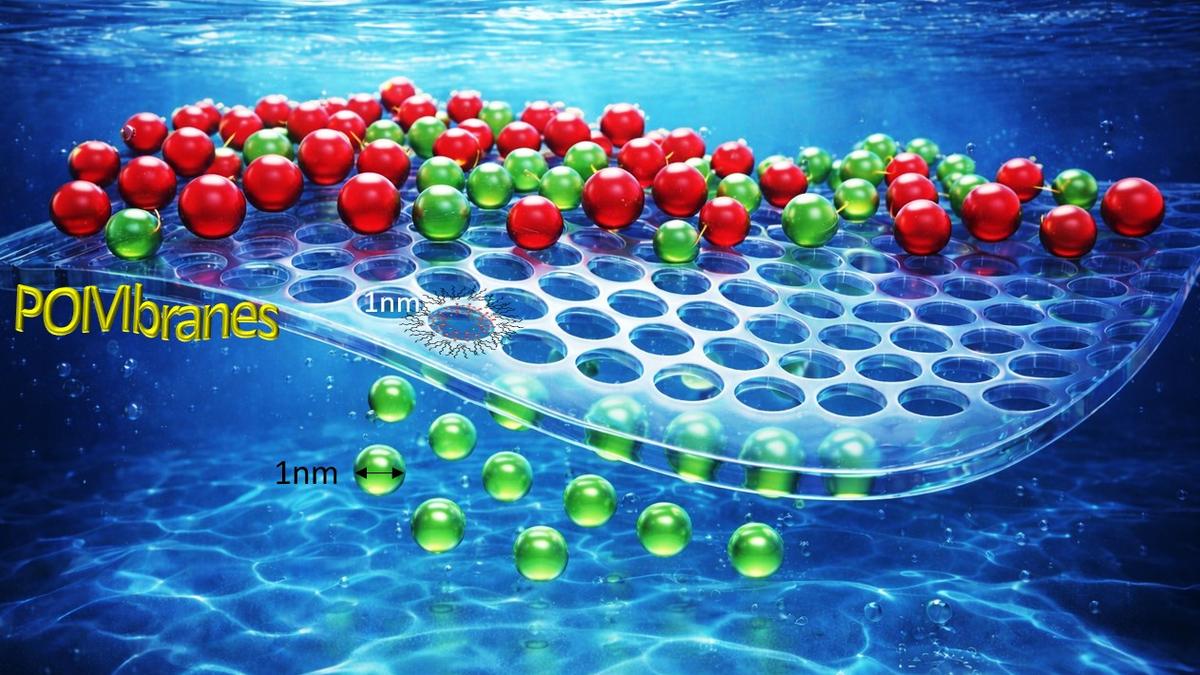
Ultra-precise “POMbranes” sieve out larger molecules (red) and allow only 1-nm species (green) to pass through, enabling sharp molecular sorting.
| Photo Credit: CSIR-Central Salt and Marine Chemical Research Institute, Bhavnagar

Imagine trying to filter sand from pebbles using a fishing net: it won’t work because the holes are too big and uneven. In chemistry, separating molecules that are almost the same size is just as difficult. However, a new study from IIT-Gandhinagar has offered a solution: a synthetic membrane capable of distinguishing between molecules with sub-nanometer precision.

At the heart of the solution is a type of cluster called a polyoxometalate (POM). The researchers focused on a cluster named P8 that has a crown-like structure. Imagine it to be a small, rigid donut. The hole in its middle is exactly 1 nm wide.

The fixed size is perfect for a filter because it never changes, unlike the flexible, uneven holes in standard plastic filters.

The find is significant because accurate separation is essential to purify water, capture carbon, and to manufacture certain medicines.

The study was published in Journal of the American Chemical Society on January 13.

On their own, the POM clusters form brittle crystals that are tough to use as filters. Instead, the researchers attached ‘tails’ made of alkyl chains to them. The tails acted like shock absorbers and glue, allowing the clusters to self-assemble into large and flexible thin films called POMbranes.

When the tails were too short, they couldn’t fill all the space between the donut clusters, leaving gaps between the donuts. Longer tails on the other hand packed tightly together and fully plugged the gaps.

The tail length also determined how the filter worked. In the version with short tails, called Q4, water and molecules could flow through both the donut holes and the gaps between them. This made the filter work faster but less precise. In the versions with long tails, Q7 and Q10, the gaps were blocked, forcing all the liquid to pass through the 1-nm holes in the centre of the P8 clusters. Thus the POMbrane was a very precise sieve.

In tests, Q7 and Q10 blocked molecules larger than 1 nm and let smaller ones through. They could also separate molecules that differed in weight by just 100-200 daltons, about 10x better than current membranes.

“These membranes are flexible, stable across different acidity levels, and can be manufactured in large sheets,” CSIR-Central Salt and Marine Chemical Research Institute principal scientist and study co-author Ketan Patel said in a release. “This combination is essential if the membranes are to be adopted widely in industry.”

Published – February 02, 2026 09:00 am IST


Source link

Science

Post navigation

Previous Post: Access Denied
Next Post: Bourses Feel STT Hike Effect On Markets To Subside; NSE Says No Impact On IPO

Related Posts

  • How the deadliest virus in human history paved the way for new cures
    How the deadliest virus in human history paved the way for new cures Science
  • Budget 2025: FM opens up Nuclear power sector to private players and incentivises distribution reforms
    Budget 2025: FM opens up Nuclear power sector to private players and incentivises distribution reforms Science
  • IIT-M, IISc team makes carbon-free version of the ferrocene sandwich
    IIT-M, IISc team makes carbon-free version of the ferrocene sandwich Science
  • What is perpetual motion? – The Hindu
    What is perpetual motion? – The Hindu Science
  • Sea otters get more prey and reduce tooth damage using tools
    Sea otters get more prey and reduce tooth damage using tools Science
  • Chandrayaan-3 | With moon now in India’s orbit, focus shifts to Pragyan rover
    Chandrayaan-3 | With moon now in India’s orbit, focus shifts to Pragyan rover Science

More Related Articles

International Asteroid Day: Asteroids fly-by Earth in serendipitous celebration International Asteroid Day: Asteroids fly-by Earth in serendipitous celebration Science
National Mathematics Day and the double life of Jantar Mantar National Mathematics Day and the double life of Jantar Mantar Science
India’s space startup calls off maiden rocket launch for a fourth time India’s space startup calls off maiden rocket launch for a fourth time Science
Reproduce or it didn’t happen: why replicable science is better science Reproduce or it didn’t happen: why replicable science is better science Science
What makes the NASA-ISRO NISAR satellite so special? | Explained What makes the NASA-ISRO NISAR satellite so special? | Explained Science
U.S.-Russian space crew lands safely in Kazakhstan after an 8-month stint on the ISS U.S.-Russian space crew lands safely in Kazakhstan after an 8-month stint on the ISS Science
SiteLock

Archives

  • September 2026
  • August 2026
  • July 2026
  • June 2026
  • May 2026
  • April 2026
  • March 2026
  • February 2026
  • January 2026
  • December 2025
  • November 2025
  • October 2025
  • September 2025
  • August 2025
  • July 2025
  • June 2025
  • May 2025
  • April 2025
  • March 2025
  • February 2025
  • January 2025
  • December 2024
  • November 2024
  • October 2024
  • September 2024
  • August 2024
  • July 2024
  • June 2024
  • May 2024
  • April 2024
  • March 2024
  • February 2024
  • January 2024
  • December 2023
  • November 2023
  • October 2023
  • September 2023
  • August 2023
  • July 2023
  • June 2023
  • May 2023
  • April 2023
  • March 2023
  • February 2023
  • January 2023
  • December 2022
  • November 2022
  • October 2022
  • September 2022
  • August 2022
  • July 2022
  • June 2022
  • May 2022

Categories

  • Business
  • Nation
  • Science
  • Sports
  • World

Recent Posts

  • U.S. State Department clears $2.7 billion Ukraine defence package
  • Operation Toofan to trace drug money through UPI, crypto wallets
  • Houthis say Saudi Arabia launched 26 strikes in Yemen over 24 hours
  • Odisha government plans 870-Acre Silicon Valley hub in Cuttack’s Naraj for semiconductor, IT projects
  • Bihar announces OTS scheme for brick kilns, waives ₹90 crore interest on outstanding dues

Recent Comments

  1. AlvinNet on UP Teacher Who Asked Students To Slap Muslim Classmate
  2. AlvinNet on UP Teacher Who Asked Students To Slap Muslim Classmate
  3. Jamesslits on UP Teacher Who Asked Students To Slap Muslim Classmate
  4. MichaelClear on UP Teacher Who Asked Students To Slap Muslim Classmate
  5. Jamesslits on UP Teacher Who Asked Students To Slap Muslim Classmate
  • China’s role in the international order
    China’s role in the international order World
  • Access Denied Sports
  • Access Denied
    Access Denied Nation
  • Ethics Committee To Hear BJP MP Nishikant Dubey’s Complaint Against Mahua Moitra On Oct 26
    Ethics Committee To Hear BJP MP Nishikant Dubey’s Complaint Against Mahua Moitra On Oct 26 Nation
  • Australian journalist says she was detained for 3 years in China for breaking an embargo
    Australian journalist says she was detained for 3 years in China for breaking an embargo World
  • Why are earthquakes frequent in Afghanistan? | Explained
    Why are earthquakes frequent in Afghanistan? | Explained Science
  • Groom, 26, Collapses On Horse, Dies During Wedding Procession In Madhya Pradesh
    Groom, 26, Collapses On Horse, Dies During Wedding Procession In Madhya Pradesh Nation
  • Barn swallows in Manipur may have shed migratory trait
    Barn swallows in Manipur may have shed migratory trait Science

Editor-in-Chief:
Mohammad Ariff,
MSW, MAJMC, BSW, DTL, CTS, CNM, CCR, CAL, RSL, ASOC.
editor@artifex.news

Associate Editors:
1. Zenellis R. Tuba,
zenelis@artifex.news
2. Haris Daniyel
daniyel@artifex.news

Photograher:
Rohan Das
rohan@artifex.news

Artifex.News offers Online Paid Internships to college students from India and Abroad. Interns will get a PRESS CARD and other online offers.
Send your CV (Subjectline: Paid Internship) to internship@artifex.news

Links:
Associate Journalism
About Us
Privacy Policy

News Links:
Breaking News
World
Nation
Sports
Business
Entertainment
Lifestyle

Registered Office:
72/A, Elliot Road, Kolkata - 700016
Tel: 033-22277777, 033-22172217
Email: office@artifex.news

Editorial Office / News Desk:
No. 13, Mezzanine Floor, Esplanade Metro Rail Station,
12 J. L. Nehru Road, Kolkata - 700069.
(Entry from Gate No. 5)
Tel: 033-46011099, 033-46046046
Email: editor@artifex.news

Copyright © 2023 Artifex.News Newsportal designed by Artifex Infotech.